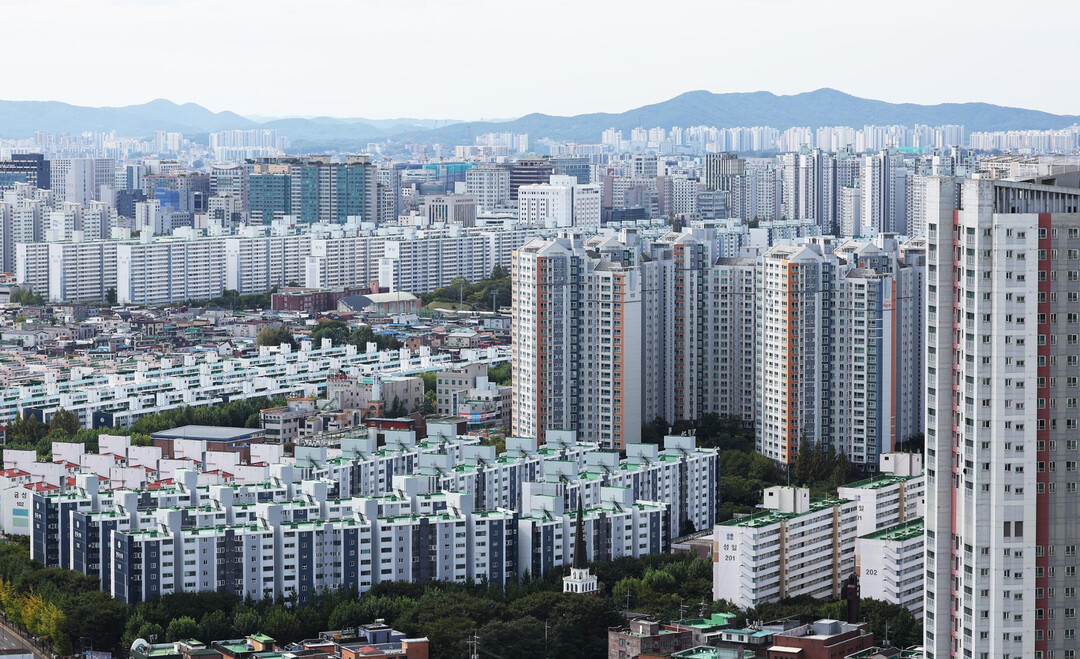
SEOUL — The financial barrier to upgrading from a compact apartment to a standard family-sized home in South Korea's capital has lowered significantly. Recent market data shows that the price gap between Seoul's 59㎡ (small) and 84㎡ (mid-sized) apartments has contracted to roughly 170 million won ($120,000+), primarily driven by aggressive government lending restrictions.
Real estate research provider Real Today revealed on Monday that actual transaction records from September show an average price of 1.301 billion won for 84㎡ apartments and 1.132 billion won for 59㎡ units across Seoul. The resulting price variance of 168.94 million won marks a dramatic compression compared to previous periods.
The trend reflects a sharp, continuous downward trajectory in price differences. In February of last year, buying a mid-sized home meant paying over 417 million won more than a small unit. By September of that year, the gap had already halved to 240 million won, translating to a staggering 29.7% reduction year-over-year.
Regional Breakdown: Premium and Outlying Areas Alike
This shrinking margin is evident across various administrative districts. In the affluent "Gangnam 3-gu" cluster—comprising Gangnam, Seocho, and Songpa—the price gap fell 30.2% from 424.45 million won last September to 296.36 million won this September.
Meanwhile, in more budget-friendly peripheral districts such as Geumcheon, Gwanak, and Guro (collectively known as Geum-Gwan-Gu), as well as Nowon, Dobong, and Gangbuk (No-Do-Gang), the price differential has plummeted below the 100-million-won threshold in some areas. In Geum-Gwan-Gu, the gap dropped to 95.5 million won, while No-Do-Gang saw a decrease down to approximately 103 million won. Buyers in these regions can now transition from compact to standard layouts with a much lighter financial footprint.
Lending Regulations Altering Consumer Choices
Market analysts point squarely to financial policy changes as the catalyst for this structural shift. In October of last year, authorities rolled out rigorous housing market stabilization packages. Under these rules, while mortgage caps remained at 600 million won for properties valued under 1.5 billion won, limits were sharply reduced for higher-priced tiers—squeezing liquidity for mid-to-high-end properties.
Faced with constrained borrowing limits, prospective homeowners have increasingly gravitated toward smaller floor plans that remain safely within accessible mortgage brackets.
"Although overall home price inflation in Seoul is moderating, tightening financial frameworks make 59㎡ units a pragmatic and realistic alternative for buyers managing tight budgets," noted Koo Ja-min, a researcher at Real Today. Industry watchers expect this consumer preference for smaller, high-efficiency apartment footprints to persist in the near term.
[Copyright (c) Global Economic Times. All Rights Reserved.]