![[등록] 2026-09-01 15:48:31](/support/_updata/banner2/tl181982910_6749.png)


(C) KMJ
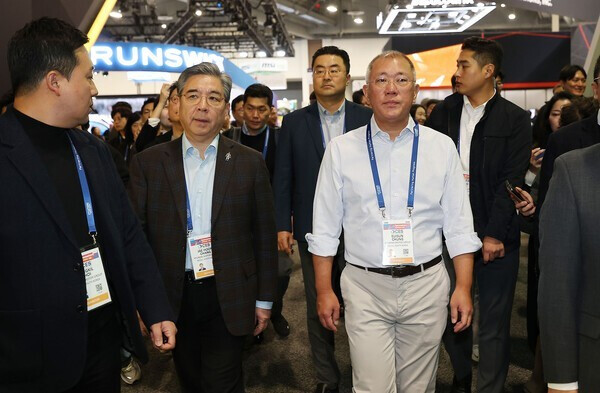
LAS VEGAS — In a move that signals a tectonic shift in its corporate identity, Hyundai Motor Group (HMG) has effectively relocated its global headquarters to Las Vegas for the duration of CES 2026. On January 7, 2026, Executive Chair Chung Euisun convened the Global Leaders Forum (GLF)—the group’s highest-level annual strategic meeting—directly at the CES site. This marks the first time in the group's history that such a critical internal summit has been held at a public exhibition venue.
The message is clear: Hyundai is no longer a traditional automaker. It is pivoting to become a "Physical AI Company."
A Command Center in the Desert: 130 Key Leaders Gather
The scale of the delegation is unprecedented. Approximately 130 top-tier executives, including CEOs of major affiliates, heads of overseas regional divisions, and executive vice presidents, converged to witness the "future of intelligence" firsthand.
According to industry insiders, the decision to hold the GLF in Las Vegas was a direct order from Chair Chung. His rationale is rooted in the belief that for the group to successfully transition into a leader of "Physical AI"—AI that interacts with the real world through robotics, Advanced Air Mobility (AAM), and autonomous systems—its leaders must first undergo a "digital baptism" by experiencing the cutting edge of global innovation.
Defining "Physical AI": From Software to Reality
While generative AI (like LLMs) dominated the previous years, CES 2026 has become the stage for Physical AI. This technology integrates artificial intelligence into tangible machines that move, sense, and perform tasks in the physical realm.
For Hyundai, this transition is personified by Boston Dynamics. During the tour, Chair Chung meticulously inspected the latest demonstrations of the humanoid robot Atlas and the quadruped robot Spot. Crucially, he engaged in deep discussions with Carolina Parada, Senior Director at Google DeepMind, regarding Atlas’s "brain." This synergy—combining Google’s cognitive AI with Hyundai’s mechanical prowess—is the cornerstone of the group’s new vision.
The "Partnership First" Strategy: Navigating the Giant Booths
The core of Chung’s itinerary was a strategic "sweep" of global tech titans. His actions suggest that in the era of Physical AI, self-reliance is a myth; collaboration is the only path to survival.
Qualcomm & The Processing Edge: Chung met with Qualcomm COO Akash Palkhiwala to discuss the "Snapdragon Wing IQ10," a high-performance processor specifically designed for humanoids. He reportedly scrutinized the chip’s computational efficiency and its ability to be integrated into robotic frames.
Samsung & The Cross-Industry Alliance: At Samsung Electronics' private booth, Chung met with President Roh Tae-moon. In a moment of spontaneous collaboration, Chung suggested merging Samsung’s robot vacuum technology with Hyundai’s "MobED" (Mobile Eccentric Droid) platform to improve obstacle navigation and suction efficiency. "Let’s collaborate," Chung proposed, to which Roh responded affirmatively.
LG & The Future Cabin: He also explored LG Electronics’ "Windshield Display" technology, which turns the entire front glass of a vehicle into an AR screen, alongside AI-powered cockpits and facial recognition systems.
The Highlight: A 30-Minute "Kkanbu" Meeting with Jensen Huang
The most significant event occurred at the Fontainebleau Hotel, where Chair Chung held a private 30-minute meeting with NVIDIA CEO Jensen Huang. This follows their high-profile "Kkanbu" (close friend) meeting in Seoul two months prior.
The discussion centered on the implementation of the partnership agreed upon last October, where Hyundai secured 50,000 NVIDIA Blackwell GPUs. However, industry analysts believe this meeting went further. With NVIDIA recently unveiling "Alpha Mayo," its proprietary autonomous driving platform, the two leaders likely discussed integrating NVIDIA’s latest AI architecture into Hyundai’s next-generation Software-Defined Vehicles (SDVs).
Strategic Outlook: Beyond the Steering Wheel
Hyundai’s transformation into a Physical AI company represents a high-stakes gamble on the future of mobility. By integrating GPU-powered intelligence into its vast manufacturing ecosystem, the group aims to lead in three distinct areas:
Robotic Logistics: Utilizing Atlas and Spot for autonomous factory and warehouse management.
Smart Mobility: Transitioning from cars to AAM (UAM/RAM) powered by autonomous AI.
Humanoid Integration: Bringing AI-driven robots into domestic and service environments.
"The era of Physical AI requires a mix of hardware reliability and software intelligence," noted an industry analyst present at CES. "By bringing 130 of his top lieutenants to Las Vegas, Chung Euisun is ensuring that the entire organization's DNA is rewritten simultaneously."
The GLF concluded with a clear directive: To lead the next decade, Hyundai must not only build the world's best machines but also the most sophisticated "digital souls" to inhabit them.
[Copyright (c) Global Economic Times. All Rights Reserved.]