• 2026.06.05 (Fri)
  • All articles
  • LOGIN
  • JOIN
Global Economic Times
fashionrunwayshow2026
  • Synthesis
  • World
  • Business
  • Industry
  • ICT
  • Distribution Economy
  • Well+Being
  • Travel
  • Eco-News
  • Education
  • Korean Wave News
  • Opinion
  • Arts&Culture
  • Sports
  • People & Life
    • International Student Report
    • With Ambassador
  • Column
    • Cho Kijo Column
    • Cherry Garden Story
    • Ko Yong-chul Column
    • Kim Seul-Ong Column
    • Lee Yeon-sil Column
  • Photo News
  • New Book Guide
MENU
 
Home > New Book Guide

Guardians of the Local Narrative: A Tribute to Regional Journalism

Hwang Sujin Reporter / Updated : 2025-11-07 07:40:07
  • -
  • +
  • Print


The gravity of regional disparity is a defining challenge of contemporary society. The phenomenon, often encapsulated by the stark term 'rural extinction' (a concept popularized by figures like former Japanese Minister of Internal Affairs and Communications Hiroya Masuda), describes a reality where human capital and infrastructure overwhelmingly concentrate in metropolitan areas, while non-capital regions experience decline.

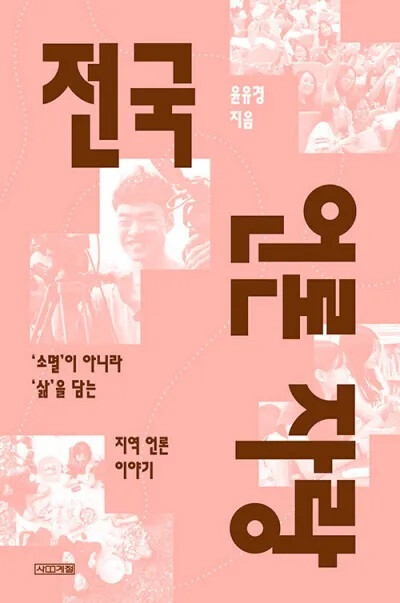
However, journalist Yoon Yu-kyung, having extensively covered local news outlets for the media criticism magazine Media Today, contests this reductionist framing. In her book, "Praise for Local Media Nationwide" (published by S 계절, 352 pages, ₩19,000), she argues that the communities she documented are "living, breathing places where new things happen every day," deeming the description of any area as 'extinct' to be "callous and violent." The book is a culmination of a nearly two-year series, profiling 19 regional news organizations that diligently fulfill the essential role of the press.

Echoes Beyond Seoul-Centrism 

The nation's self-proclaimed 'major media' are predominantly based in Seoul, focusing their coverage on the political and economic power structures centered there. Regional news, unless it involves major accidents or high-profile events, is often relegated to a peripheral status.

The regional news organizations spotlighted in Yoon's work offer a vital counterbalance. They share the stories of local residents and tenaciously investigate the small and large incidents that shape their communities—a critical form of journalism that major outlets, though obligated, frequently overlook.

The book serves as a powerful reminder of perspectives missed when viewing the world through a Seoul-centric lens. It brings to light the struggles of a grandmother in Jinan, Jeollabuk-do, who "couldn't take the bus or visit her family because she couldn't read." It reveals the paradox that rural children, despite the ideal of free outdoor play, increasingly turn to platforms like YouTube due to the scarcity of adequate recreational facilities in low-population areas. Furthermore, the divide exists even within the regions: half of Chungbuk's population is clustered in Cheongju, and residents of Daegu often dismiss smaller cities and counties in Gyeongbuk as 'country villages,' underscoring the severe inter-regional disparities outside the capital.

For media in areas like Incheon and Gyeonggi, which are effectively integrated with Seoul, the challenge is different: gaining resonance with local residents through "our region's story" when their lives are so intertwined with the capital.

Survival Through Local Trust 

For some regional news organizations, a deep engagement with the community is not merely a journalistic ideal but a matter of survival. To hold local institutions accountable through critical reporting, they must secure the essential backing of readers through subscriptions and donations.

The book highlights several models of sustainability:

Dangjin Sidae: Relies on a 6:4 ratio of print advertising to subscription fees and circulation revenue.
Weekly Hamyang: Developed an internship program tied to the popular 'one-month stay' local tourism initiative.
Wonju Today: Achieved the highest paid circulation among regional weekly newspapers nationwide by building local trust through diverse private-sector collaborative public service projects.

These examples offer crucial food for thought, demonstrating that regional media can serve as a bastion that listens to, records, and safeguards the local way of life, challenging the narrative of 'extinction' with tangible evidence of resilience and journalistic commitment.

[Copyright (c) Global Economic Times. All Rights Reserved.]

  • #globaleconomictimes
  • #micorea
  • #mykorea
  • #Lifeplaza
  • #nammidonganews
  • #singaporenewsk
  • #Samsung
  • #Daewoo
  • #Hyosung
  • #A
Hwang Sujin Reporter

Popular articles

  • SK hynix CEO Kwak Noh-jung Meets Bill Gates and Satya Nadella to Solidify AI Memory Alliance

  • Hyundai Mobis Completes Independent EV 'Heart' Lineup: A Major Leap Toward Global Leadership in Power Electric Systems

  • "Singer of Filial Piety" Hyun Sook: "I Visit the Marginalized to Honor My Mother’s Memory"

I like it
Share
  • Facebook
  • X
  • Kakaotalk
  • LINE
  • BAND
  • NAVER
  • https://globaleconomictimes.kr/article/1065566361357118 Copy URL copied.
Comments >

Comments 0

Weekly Hot Issue

  • South Korea Emerges as Global AI Powerhouse, Ranking 3rd in Clarivate’s Inaugural 'AI50' Report
  • Star Historian Choi Tae-sung and 2NE1’s Sandara Park Appointed as Honorary Ambassadors for the Overseas Koreans Agency (OKA)
  • SKT Partners with NVIDIA to Bring Digital Twin Technology to SK Hynix Semiconductor Fabs 
  • South Korea’s Top Five Automakers Suffer Broad May Sales Decline Amid Weakening Domestic Demand and Global Headwinds
  • Chinese Humanoid Robotics Pioneer Unitree Clears Shanghai IPO Hurdle to Raise $580 Million
  • Hyundai Motor Bets on ‘The New Grandeur’ to Jumpstart Sluggish Domestic Sales

Most Viewed

1
From a moment of collective sacrifice to a moment of collective democracy: The Timing of the Election in Ethiopia and Korea
2
U.S. Holds Off on Immediate Comprehensive Semiconductor Tariffs, but Pressure Mounts for Samsung and SK Hynix to Accelerate Domestic Investments
3
[Interview] "Halal is Not a Religious Regulation, but a 'Trust Infrastructure'… Creating a Premium 'K-Halal' Centered on Data and Platforms"
4
‘600 Million Won Bonus’ at Samsung Electronics Triggers Deep Sense of Relative Deprivation Among Korean Workers
5
Musk’s SpaceX Secures Space Hegemony with Flawless Starship V3 Recovery Ahead of Historic IPO
광고문의
임시1
임시3
임시2

Hot Issue

South Korea Emerges as Global AI Powerhouse, Ranking 3rd in Clarivate’s Inaugural 'AI50' Report

Overcoming the Fragility of Robot Firms is Prerequisite to the Flourishing of Physical AI

South Korea’s Top Five Automakers Suffer Broad May Sales Decline Amid Weakening Domestic Demand and Global Headwinds

SKT Partners with NVIDIA to Bring Digital Twin Technology to SK Hynix Semiconductor Fabs 

Fashion Runway Show 2026

Global Economic Times
korocamia@naver.com
CEO : LEE YEON-SIL
Publisher : KO YONG-CHUL
Registration number : Seoul, A55681
Registration Date : 2024-10-24
Youth Protection Manager: KO YONG-CHUL
Singapore Headquarters
5A Woodlands Road #11-34 The Tennery. S'677728
Korean Branch
Phone : +82(0)10 4724 5264
#304, 6 Nonhyeon-ro 111-gil, Gangnam-gu, Seoul
Copyright © Global Economic Times All Rights Reserved
  • 에이펙2025
  • APEC2025가이드북TV
  • 반달곰 프로젝트
Search
Category
  • All articles
  • Synthesis
  • World
  • Business
  • Industry
  • ICT
  • Distribution Economy
  • Well+Being
  • Travel
  • Eco-News
  • Education
  • Korean Wave News
  • Opinion
  • Arts&Culture
  • Sports
  • People & Life 
    • 전체
    • International Student Report
    • With Ambassador
  • Column 
    • 전체
    • Cho Kijo Column
    • Cherry Garden Story
    • Ko Yong-chul Column
    • Kim Seul-Ong Column
    • Lee Yeon-sil Column
  • Photo News
  • New Book Guide
  • Multicultural News
  • Jobs & Workers