![[등록] 2026-09-01 15:48:31](/support/_updata/banner2/tl181982910_6749.png)


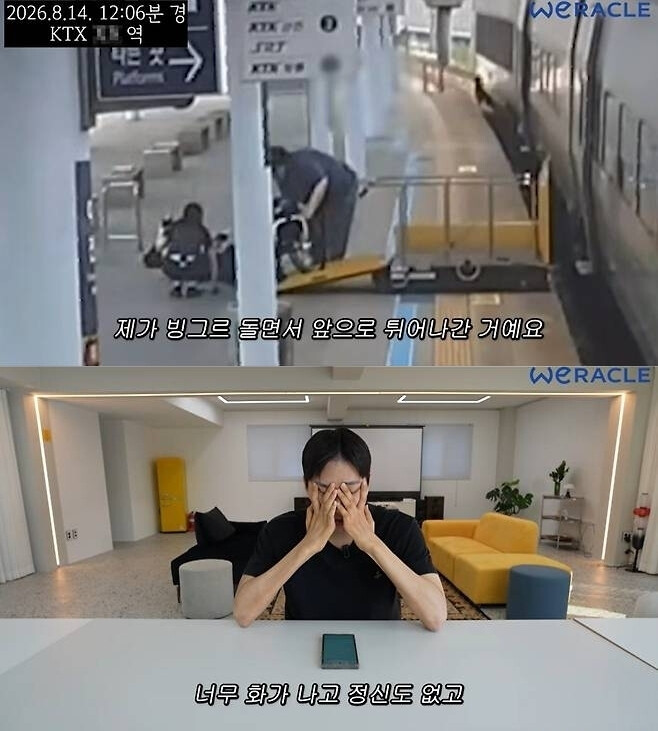
The recent accident involving popular South Korean YouTuber Park Wi—who suffered a fall while disembarking from a KTX train in a wheelchair—has brought structural safety issues regarding public transit accessibility, on-site operational practices, and the responsibilities of public advocacy into sharp focus.
1. Incident Background and Public Backlash
The accident occurred on August 14, 2026, when Park Wi was exiting a KTX train after completing a scheduled lecture. While moving down a temporary portable ramp deployed for wheelchair users, his wheelchair's front wheel caught on the foot of a social service worker assisting at the scene. The impact caused Park to lurch forward and crash onto the station platform floor.
Park later posted a video titled "The Reason for Releasing CCTV Footage" on his YouTube channel, revealing security camera footage of the fall. Having experienced complete lower-body paralysis following an accidental fall in 2014, Park emphasized the severity of the incident, noting that his lack of physical sensation meant he might not immediately recognize if he had sustained a bone fracture or spinal injury. Medical examinations later confirmed no fractures, though he suffered lingering lower back pain.
While Park acknowledged that the worker did not act intentionally and offered an immediate, polite apology, he expressed deep frustration regarding the physical positioning of the worker's foot on the ramp. However, publishing the unedited CCTV footage triggered a strong public backlash. Critics argued that publicly exposing the mistake of a frontline worker who had already apologized was an excessive and counterproductive approach. Facing mounting criticism and a decline in subscriber count, Park removed the video and issued a formal apology, admitting that his delivery method was immature and failed to appreciate the worker's efforts to help.
2. Systemic Debates: Equipment Design Versus Field Reality
The controversy quickly evolved from a personal dispute into a broader debate regarding the design and operational safety of KTX wheelchair boarding equipment.
According to the Korea Railroad Corporation (Korail), the portable ramps used for trains are not engineered to lie completely flat against the platform surface initially. Korail explained that a shock-absorbing mechanism is built into the folding joints to prevent feet from getting caught between the ramp and the platform floor.
However, wheelchair users and railway staff noted a significant gap between official design and field realities. Because the unweighted ramp can leave a slight lip or bump, frontline workers frequently step on the edge of the ramp to stabilize and flatten it—a practice that has evolved into an unwritten field routine. Korail stated that stepping on the ramp is not written into the official user manual, asserting that the weight of an approaching wheelchair naturally secures the ramp to the ground. Furthermore, Korail officials noted that an accident caused by a worker placing a foot on the ramp is the first of its kind recorded by the corporation.
3. Moving Toward Safer Mobility Rights
The incident has underscored the risks associated with manual, temporary ramps and the heavy reliance on individual worker competence. Advocacy groups emphasize that systemic improvements are necessary to protect both passengers with disabilities and frontline service workers.
In response to long-standing complaints regarding height gaps and steep gradients, Korail has developed an advanced, motorized wheelchair lift. The new equipment features automated omnidirectional movement—allowing forward, backward, lateral, and in-place rotational mobility. This upgraded system began a pilot operation at Seoul Station on July 1, 2026. Following a comprehensive evaluation of the pilot phase, Korail plans to expand the deployment of the new safety equipment nationwide starting late next year.
[Copyright (c) Global Economic Times. All Rights Reserved.]