![[등록] 2026-09-01 15:48:31](/support/_updata/banner2/tl181982910_6749.png)


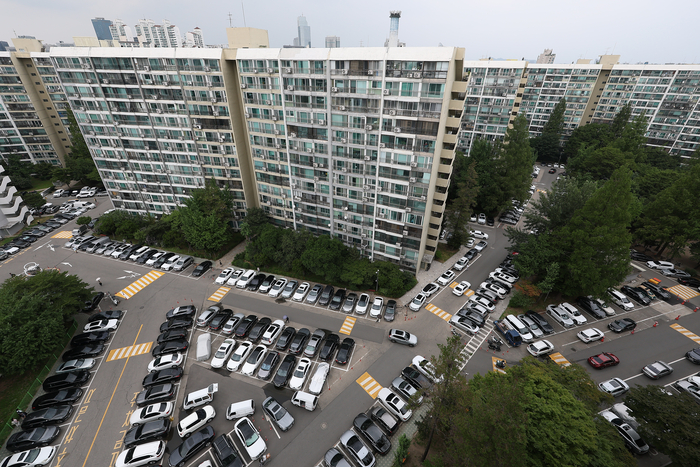
Calls are continuously emerging to introduce so-called "half-price apartments"—known as land-lease housing, where buyers purchase only the building while paying a monthly land lease fee—as an alternative for supplying affordable housing. The reasoning is that because current land prices are heavily inflated, public housing continues to carry expensive pre-sale prices.
However, critics point out that this may not be a realistic alternative because residents lack land shares to use as collateral, making it difficult to secure loans for initial move-in costs, and demands for land privatization could increase years down the line.
On the 29th, the Citizens' Coalition for Economic Justice (CCEJ) announced the results of an analysis of public housing pre-sale prices in Namyangju Wangsuk, a 3rd-generation new town. They claimed, "While the Korea Land and Housing Corporation (LH) sold a 25-pyeong apartment for 460 million won, the estimated cost was 340 million won. Under the land-lease method, it can be supplied at half the price—230 million won—along with a monthly land lease fee of around 60,000 won."
They argued that under a land-lease system, buyers would not need to pay the 220 million won land development cost set by LH and could purchase the property solely for the 230 million won construction cost estimated by CCEJ.
Democratic Party lawmaker Jeon Hyun-heui also proposed a bill on the 21st to expand land-lease housing through support from the Housing and Urban Fund. Lawmaker Jeon stated, "We can sufficiently supply 'quarter-price apartments'—30-pyeong apartments in Gangnam, Seoul—for in the 300 million won range."
The government's establishment of principles last year through the September 7 Measures, such as "prohibiting the sale of public land and executing housing projects directly through LH," serves as another basis for arguments to expand land-lease housing. Originally, the structure relied on "cross-subsidization," where LH developed land, sold it to the private sector, and used the funds to supply public rental housing. However, with the halt on land sales, an alternative became necessary. Proponents argue that land-lease housing can recover the full construction cost through building sales, while also recovering part of the land cost month by month via land lease fees.
The CCEJ argued, "Land-lease housing reduces the financial burden compared to public rental housing, allowing for the supply of more public housing."
There are actual precedents where 760 units were supplied in Gangnam and Seocho-gu, Seoul, between 2011 and 2012. At that time, the pre-sale price for an 84㎡ exclusive area was around 200 million won, with a monthly land lease fee of around 500,000 won. During the pre-reservations for the Magok district in Gangseo-gu in 2023, the pre-sale price for a 59㎡ unit was estimated at the 300 million-won range, with a monthly land lease fee of 700,000 won.
However, critics point out that while it is theoretically sound, there are many hurdles to overcome. Concerns have also been raised that land ownership disputes will eventually erupt between the public sector and residents.
This was previously brought up during a real estate grand debate on July 23. At the time, in response to a proposal by Cho Jung-heun, chairman of the CCEJ Land and Housing Committee, urging the supply of land-lease housing, President Lee Jae-myung remarked, "It sounds very plausible in theory. But I couldn't help thinking whether it would actually work out ideally. If land-lease housing expands to hundreds of thousands of units, it will have a fatal impact on elections. Can we really withstand [the pressure to privatize and sell the land as well]?"
In fact, Gangnam-gu land-lease apartments have surged from 200 million won at the time of pre-sale to 1.3 billion won today. Though cheaper than surrounding market prices, prices have risen due to expectations of future land privatization. Observers note that a situation similar to what happened during the June local elections—where local politicians responded positively when some residents of long-term jeonse housing in Gangdong-gu, Seoul, demanded continued residency even after the expiration of their 20-year terms—could also occur with land-lease housing.
Furthermore, practical issues are raised: while the lack of land shares may lower pre-sale prices for ordinary citizens, it can simultaneously make it difficult to secure bank loans.
Choi Kyung-ho, director of the Housing Neutrality Research Institute, pointed out, "Banks are reluctant to lend to residents who do not hold land shares, making it a pie in the sky for those without assets. Because building value depreciates over time, it is difficult to guarantee residents' rights during future reconstruction." He added that consumer financing and long-term maintenance and redevelopment plans must be considered together.
[Copyright (c) Global Economic Times. All Rights Reserved.]