![[등록] 2026-09-01 15:48:31](/support/_updata/banner2/tl181982910_6749.png)


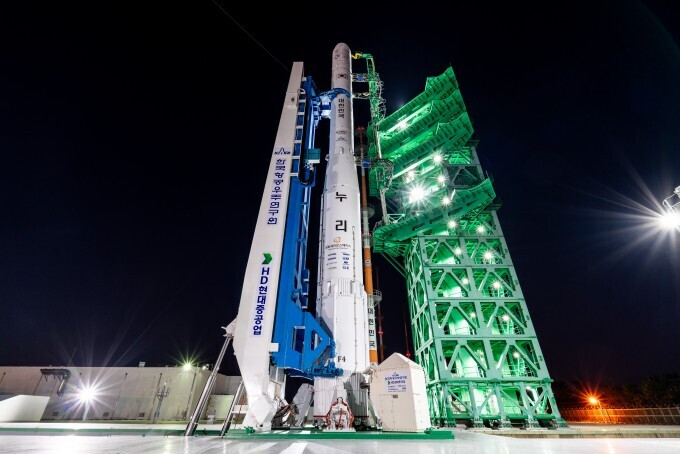
With the 5th launch of South Korea’s space launch vehicle, Nuri, just a week away, it has been revealed that "wind speed" is the key factor that will determine the success of the launch. If strong winds exceeding an average of 15 meters per second blow on the day of the launch, Nuri’s journey to space will be postponed. Solar flare explosions, which can affect the communication equipment of satellites and the launch vehicle, are also a major variable. The Korea Aerospace Research Institute (KARI) held a briefing session for the press and the Korea Science Journalists Association on the 28th to reveal the preparation status for Nuri’s 5th launch.
KARI plans to assemble the 1st through 3rd stages of Nuri in a line inside the assembly building at the Naro Space Center in Goheung, Jeollanam-do, by the 30th. This is the process of creating the 47-meter-long "complete body" of Nuri. Han Young-min, head of the KARI Space Launch Vehicle Research Institute, who attended the briefing, stated, "We plan to check if there are any electrical problems in Nuri moving forward." If there are no issues, Nuri is scheduled to be transported to the launch pad on the 6th of next month and soar toward space between 12:23 PM and 1:23 PM on the 7th, a day later.
KARI pointed to wind speed as the critical factor for Nuri's successful launch. Director Han stated, "If the average wind speed is 15 meters per second or higher, we must postpone the launch." When winds of this strength blow, a gale advisory is issued. This is a force that can flip umbrellas inside out, tear down poorly attached signs, and rip banners. It can shake Nuri’s body as it takes off and ruin its flight attitude.
However, forecasts suggest that the possibility of Nuri’s 5th launch being blocked by such strong winds is statistically low. According to weather data measured around the Naro Space Center in early and mid-October from 2016 to 2025, the maximum average wind speed is 3 to 5 meters per second. This is a level where flags flutter lightly or dust on the ground blows slightly.
The variable that could overturn these favorable wind conditions is typhoons. Over the past 5 years, no typhoons affected the Korean Peninsula in early and mid-October, but if the observation period is expanded to the past 10 years, the situation is different. Three typhoons arrived during that time.
Another problem that could halt Nuri’s launch lies in space. This is when solar flares erupt violently and a "danger" grade is issued. Among the solar flare explosion intensities divided into a total of 5 stages (R1 to R5), this corresponds to the highest categories, R4 and R5. It can cause functional abnormalities in the communication equipment of satellites and Nuri.
This Nuri launch will carry 15 satellites, the most in any launch to date. These include 5 "NEONSAT" micro-cluster satellites for observation of the Korean Peninsula and 10 cube satellites manufactured by domestic universities and companies. This 5th launch marks the starting point for Nuri to emerge as a "mass satellite transportation vehicle."
Director Han added, "We will also check whether there is a possibility of collision with manned spacecraft or unmanned space objects during the launch of Nuri."
[Copyright (c) Global Economic Times. All Rights Reserved.]