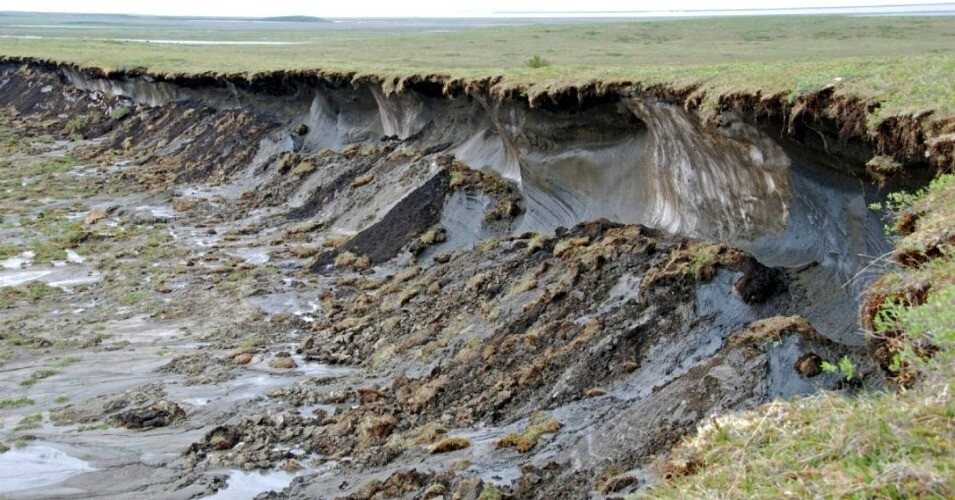
Rapidly warming temperatures across the Arctic are destabilizing vast stretches of frozen earth, prompting scientists to warn of massive carbon releases while innovators test unconventional, nature-based shields to halt the erosion.
New satellite analysis reveals that the frequency of abrupt permafrost collapses in sections of Western Siberia has surged 23-fold over the past six decades. Alongside the threat of escalating greenhouse gas emissions and reawakening ancient microbes, researchers in Canada are piloting an organic "insulating blanket" made of wood chips to stabilize vulnerable terrain.
A 23-Fold Surge and a Looming Carbon Feedback Loop
Permafrost—ground that stays continuously frozen at or below 0°C for at least two years—acts as a massive freezer across high-latitude regions like Alaska, Canada, and Siberia, locking away millennia of organic matter.
However, rising winter temperatures are destabilizing this frozen foundation. In a June study published in Scientific Reports, researchers compared 1960s aerial imagery with modern satellite data across roughly 6,100 square kilometers of Siberia’s Yamal and Gydan peninsulas, documenting the 23-fold spike in thaw slumps.
As this organic matter thaws and decomposes, it vents carbon dioxide and methane into the atmosphere, creating a self-reinforcing warming loop. Research in Communications Earth & Environment projects that when abrupt ground collapses and wildfires are factored in, thawing permafrost could release between 7 billion and 15 billion metric tons of carbon dioxide equivalent annually by 2100. At the upper end, those emissions would more than double the total annual output of the United States.
Biological Hazards Beneath the Ice
Beyond climate metrics, thawing soil poses biological risks. Scientists previously revived a 48,500-year-old virus from Siberian permafrost in a laboratory setting; while that specific pathogen only targets amoebas, researchers remain cautious about dormant microbes capable of affecting wildlife or humans. In 2016, an unusually severe Siberian heatwave was linked to an anthrax outbreak on the Yamal Peninsula that killed over 2,300 reindeer and hospitalized dozens of people, likely triggered by thawing soil exposing old bacterial spores.
Can 'Wood Blankets' Protect Vulnerable Slopes?
To mitigate the damage on-site, Canadian startup PermaC is testing a biodegradable barrier designed to insulate exposed permafrost edges. Crafted from wood chips, soil, coconut fibers, and native seeds, the mat shields the frozen ground from ambient heat. As the blanket naturally breaks down, the sprouting native plants establish root networks to anchor the soil against further erosion.
During initial summer field trials in northern Canada, untreated permafrost edges eroded by roughly five meters, whereas sections draped with the wood blanket remained intact, according to the company. PermaC estimates that deploying the cover at a single active slump site could prevent around 2,200 metric tons of carbon emissions each year.
While industry observers note the method could eventually help safeguard Arctic roads and railways built atop unstable ground, experts caution that the technology is still in its infancy. Because the findings stem from a single-season trial and have yet to undergo peer review, broader testing will be required to verify its long-term viability.
[Copyright (c) Global Economic Times. All Rights Reserved.]