![[등록] 2026-09-01 15:48:31](/support/_updata/banner2/tl181982910_6749.png)


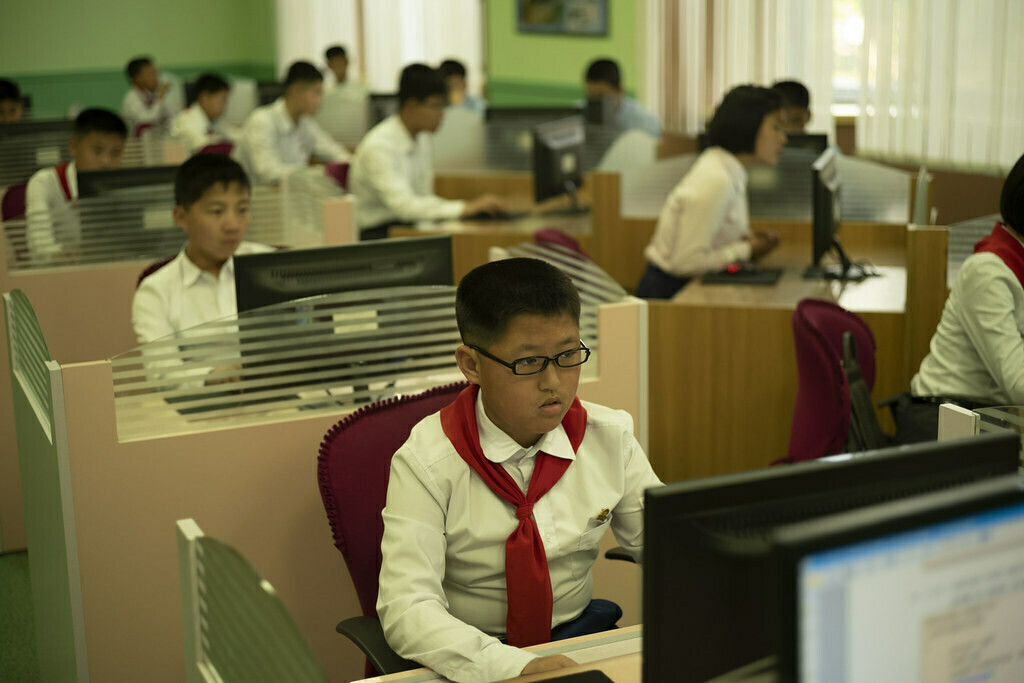
(C) NKNews
SEOUL, South Korea - A recent international conference in Seoul highlighted the rapidly evolving media and mobile landscape in North Korea, revealing a growing adoption of smart devices and even the limited, state-controlled use of sophisticated technologies like generative Artificial Intelligence (AI), exemplified by tools similar to ChatGPT.
The "2025 Inter-Korean Broadcasting and Telecommunications International Conference," held at Hanyang University and co-hosted by the Korea Communications Commission (KCC), the Korea Information Society Development Institute (KISDI), and Hanyang University’s Unification Education Program, focused on "The Future of Inter-Korean Broadcasting and Telecommunications Cooperation in the Era of Digital Transformation." The event provided an in-depth look at North Korea’s scientific advancements and its citizens’ mobile daily lives.
AI and Mobile Proliferation
Experts at the conference suggested that while North Korea is intensely focused on leveraging science and technology to build an economic powerhouse under Kim Jong Un’s leadership, the use of advanced technologies like generative AI is strictly monitored and highly restricted.
Professor Park Min-joo of the National Institute for Peace Unification and Democratic Education speculated that access to generative AI, such as ChatGPT, is likely limited to a small, elite group of IT personnel—specifically "hackers or top-tier IT warriors"—and is used under close surveillance. Crucially, the motivation for such access is not for personal curiosity but rather for strategic intelligence gathering.
"It's highly probable that personnel involved in training hackers or top-tier IT warriors use it restrictively under surveillance," Professor Park noted. "While they won't use it to satisfy personal curiosity, they will use it to inversely determine what information we [the outside world] are interested in and what information we possess."
This assessment was supported by Professor Kang Chae-yeon, also from the National Institute for Peace Unification and Democratic Education, who added that ChatGPT is known to be utilized for state-level projects.
The conference also detailed the significant proliferation of mobile devices. Professor Park Min-joo analyzed that North Korea has seen approximately 55 models of smartphones released by ten different companies, coexisting with lower-cost feature phones. While newer models like the 'Jindallae 7' incorporate AI features, they also feature increasingly deep surveillance technologies, such as automatic screenshots and file watermarking for path tracking.
Martin Williams, a fellow at the Stimson Center, shared insights into the user base, estimating several years ago that North Korea had about seven million mobile phone users. While recent, accurate estimates are unavailable, he confirmed that mobile phones have become commonplace, especially in Pyongyang, with devices being constantly updated and competition intensifying among models. Williams analyzed that the expansion of smartphones likely coincided with the installation of a 4G network around 2023.
Despite external internet access remaining limited, the content available on these domestic smartphones is surprisingly diverse, including apps for electronic payments, healthcare, e-pharmacies, media, games, foreign language learning, agriculture, and cooking.
Media and Cooperation Challenges
The second session shifted focus to North Korean media and the long-term prospects for inter-Korean broadcasting cooperation.
Jeon Young-sun, a research professor at Konkuk University’s Institute of Humanities for Unification, provided an analysis of North Korean drama, using 'The New Spring in the White Crane Plain' as a case study to describe the characteristics and creative direction of drama under the Kim Jong Un era.
Jeon Sung-ho, Deputy General Manager of MBC's Technology and Information Business Team, addressed the perennial issue of broadcasting exchange. He pointed out that while political circumstances have caused inter-Korean broadcasting exchange to proceed and halt repeatedly, the technical and logistical discussions for cooperation must continue. He offered a broadcast engineer’s perspective on the current state of North Korea’s satellite and terrestrial broadcasting.
In the ensuing panel discussion, chaired by Professor Hong Yong-pyo of Hanyang University, participants explored future policy directions for inter-Korean exchange in the broadcasting and telecommunications sectors.
The KCC confirmed that it plans to continue exploring methods for inter-Korean exchange and cooperation in broadcasting and telecommunications, adapting to the technological changes brought by the digital transformation era based on the insights gathered at the conference. The prevailing theme remains a technological push under state control: rapid modernization for strategic purposes, all while maintaining a tight grip on information access and personal behavior.
[Copyright (c) Global Economic Times. All Rights Reserved.]