![[등록] 2026-09-01 15:48:31](/support/_updata/banner2/tl181982910_6749.png)


- Spring-born kittens begin exploring; car hoods offer a dark, secure hiding spot
- Drivers urged to perform a gentle "Cat Check"
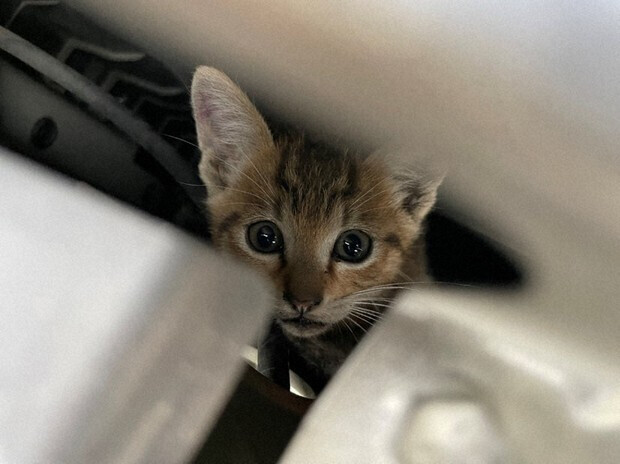
The sight of a stray cat curled up inside a car's engine room is a familiar story during the freezing winter months, as animals look for any remaining engine heat to survive the cold. However, experts are now raising a surprising and urgent warning: drivers may actually encounter significantly more cats inside their vehicles during the early summer than in winter.
According to recent data released by the Japan Automobile Federation (JAF), the organization received 402 distress calls regarding "cats trapped inside vehicles" in June alone. This figure is approximately 4.8 times higher than the 83 cases reported in November of the previous year. Contrary to public perception, the frequency of these incidents spikes drastically as the weather warms up rather than when it drops.
The Rise of Young Kittens and the Appeal of Engine Bays
Animal behaviorists and automotive experts attribute this sharp summer increase to the reproductive cycle and surging activity levels of feral cats. Stray cats predominantly give birth during the spring. By May and June, these spring-born kittens grow large and independent enough to leave their nests and explore their surroundings.
By nature, felines possess an instinctual preference for narrow, dark, and enclosed environments where they feel secure from predators. A vehicle's engine room perfectly fits this description—it acts as an ideal shield against sudden summer rain and heavy winds while remaining completely hidden from human eyes. For highly curious, energetic young kittens, an open undercarriage is not just a sanctuary, but a complex playground.
The real danger arises when a driver starts the ignition without realizing a small animal is resting inside. Once the engine roars to life, the rapid rotation of the cooling fans, drive belts, and various moving mechanical components can cause fatal injuries or instant death to the trapped animal. Furthermore, these incidents frequently lead to severe mechanical failures for the vehicle itself, including snapped belts, severed electrical wiring, and expensive engine damage.
A Common Summer Dilemma in Urban Parking Lots
This phenomenon is not isolated to Japan. Domestic animal welfare organizations in South Korea report a steady stream of identical cases every year. Online communities and social media platforms are consistently flooded with rescue stories, photographs, and videos of tiny kittens pulled from deep inside car engines. These encounters are particularly prevalent in outdoor residential parking lots, ground-level apartment spaces, and open street alleys where stray cat populations live in close proximity to human vehicles.
Fortunately, protecting these fragile animals and safeguarding vehicles requires very little effort from drivers. The Japan Automobile Federation heavily promotes a simple pre-driving routine known as the "Cat Check." Before stepping into the driver's seat, motorists are encouraged to take a brief walk around their vehicle and lightly tap on the hood or side panels with their hands to alert any hidden animals of human presence.
However, experts emphasize that moderation is key. Slamming the hood with excessive force or making violent noises can backfire completely. Startled or terrified kittens are likely to panic and wedge themselves even deeper into the complex structural crevices of the engine block, making extraction far more difficult. The correct approach is to tap gently a few times and wait quietly for a brief moment.
After getting into the car, drivers should also pause for a few seconds before turning the key, listening carefully for any muffled meows, scratching sounds, or unusual movements coming from the dashboard area. If a cat's presence is strongly suspected, the driver should manually open the hood to inspect the bay or contact local emergency services and animal rescue groups for professional assistance.
When people think of seasonal vehicle maintenance in the summer, they typically prioritize checking coolant levels, air conditioning systems, or tire pressure. However, taking a quick moment to look out for a tiny life hiding from the world underneath the hood might just be the most important safety check a driver can perform this season.
[Copyright (c) Global Economic Times. All Rights Reserved.]