![[등록] 2026-09-01 15:48:31](/support/_updata/banner2/tl181982910_6749.png)


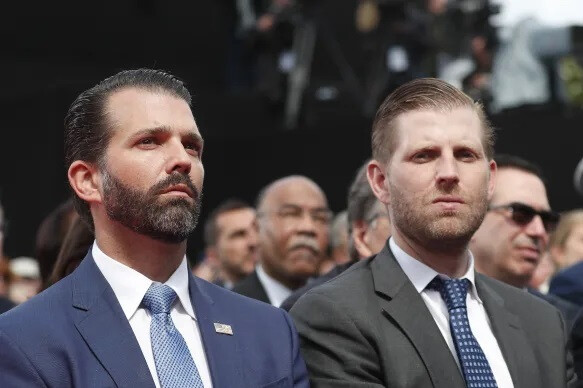
WASHINGTON D.C. — Ethical alarms are ringing across the capital as reports surface that Donald Trump Jr. and Eric Trump, the sons of President Donald Trump, have positioned themselves to profit from a massive mining project in Kazakhstan—one slated to receive billions in U.S. government backing.
According to a report by the Financial Times on May 1, a construction and investment firm backed by the Trump brothers is currently finalizing a merger with a key mineral development company. The target entity holds the rights to one of the world’s largest untapped tungsten deposits.
Tungsten is a "critical mineral" essential for manufacturing high-tech weaponry, aerospace components, and industrial machinery. As the U.S. intensifies its efforts to decouple strategic supply chains from Chinese dominance, the Kazakhstan project has become a cornerstone of American resource security.
The $1.7 Billion Question
The controversy centers on the scale of federal involvement. The Export-Import Bank of the United States (EXIM) and the International Development Finance Corporation (DFC) have previously expressed intent to provide up to $1.7 billion (approx. 2.36 trillion KRW) in financing and guarantees for the development of this specific Kazakh mine.
Critics argue that the timeline of the brothers' investment raises red flags. The Trump sons first invested in the construction firm in August of last year. However, they reportedly funneled additional capital into the venture shortly after high-level bilateral discussions between the U.S. and Kazakhstan regarding strategic resource cooperation.
A Growing Portfolio of "Strategic" Investments
This is not an isolated incident. Since the President took office, the Trump family has aggressively expanded its portfolio into sectors deemed "national priorities." From rare earth elements and artificial intelligence to defense drones and crypto-assets, the family’s private interests increasingly mirror the administration's public policy map.
"The optics are devastating," said a senior ethics consultant for a D.C.-based watchdog group. "When the President’s family bets on the exact projects the government is subsidizing, it creates the appearance of an 'insider trading' scheme on a geopolitical scale."
The Response
A spokesperson for Donald Trump Jr. dismissed the allegations of impropriety, characterizing the move as a "standard private equity play." The statement emphasized that the brothers have had "zero contact" with government officials regarding the EXIM or DFC financing packages and that the merger was driven purely by market potential.
Interestingly, while the newly formed entity resulting from the merger is seeking a listing on the Nasdaq, the names of the Trump brothers were notably absent from the initial public filing documents.
Political Fallout
The opposition party has vowed to launch an investigation into the matter, citing potential violations of the Emoluments Clause and general conflict-of-interest statutes. As the U.S. government continues to pour resources into securing mineral independence, the blurred line between the President’s "America First" policy and his family’s "Pocketbook First" reality remains a volatile political flashpoint.
For now, the Kazakh deal stands as a glaring example of the challenges inherent in an administration where the boundaries between statecraft and private enterprise are increasingly porous.
[Copyright (c) Global Economic Times. All Rights Reserved.]