CLEVELAND, Ohio — "Trump constantly divides people. We are exhausted by the endless fighting. What we need right now is the power to bring people together."
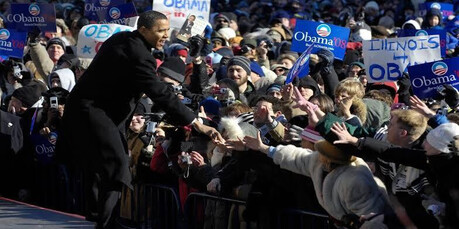
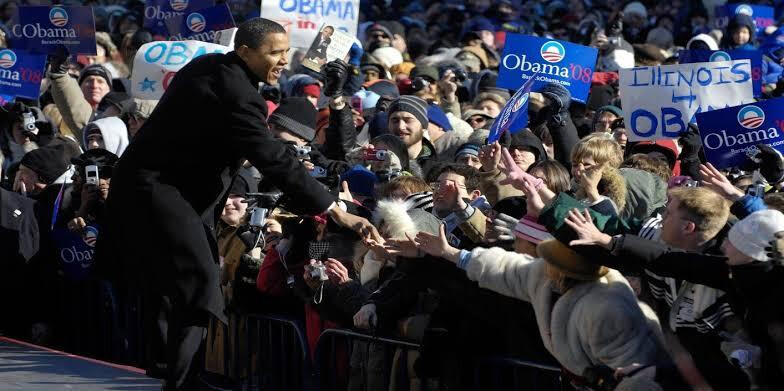
These were the frustrated words of a voter who joined the crowd early in the morning to hear former U.S. President Barack Obama speak. Exactly ten days ahead of the November 3 midterm elections, at 10:00 a.m. on October 24 (local time), a massive crowd stretched over a kilometer through downtown Cleveland, winding past streets, parks, and buildings, waiting to attend Obama’s 1:00 p.m. campaign speech.
James, who had been standing in line since 6:00 a.m., said, "I wanted to see Obama in person and feel his energy, so I came out early. People are deeply dissatisfied with the current economic situation and political division. This time, they are heading to the polls to give the Democrats a real chance."
A 1-Kilometer Queue in Downtown Cleveland
The sprawling line featured a diverse demographic: Black and white voters, young parents holding their children's hands, groups of young adults in their twenties, and elderly citizens leaning on canes. Some supporters even wore faded "Obama ’08" T-shirts reminiscent of the historic election 18 years ago. Susan, who has supported Obama since 2008, emphasized, "Ohio is a place that chose Obama twice. If people actually make it to the ballot box, we can spark change here once again."
As doors opened at 10:30 a.m., the venue filled to capacity in an instant. Taking the stage toward the end of the rally, former President Obama urged support, stating, "Democracy is not a spectator sport, and cynicism and bystanders will never change politics. Instead of politics that divide us, please unite behind candidates who protect the lives of workers and the middle class."
Ohio has long been considered the quintessential "bellwether" of American politics. From 1964 to the 2016 presidential election, every candidate who won Ohio went on to enter the White House, serving as a reliable gauge of national sentiment. In the 2008 and 2012 elections, Ohio voted consecutively for Barack Obama, acting as a defensive bulwark for the Democrats in the Rust Belt.
However, as the decline of manufacturing and the deprivation of white working-class communities deepened, Ohio turned sharply conservative following the rise of Donald Trump. Trump won consecutive landslide victories in the state, turning it into a "reliable Republican stronghold"—a territory where Vice President and leading potential 2028 Republican presidential contender JD Vance previously served as a senator. Today, a high-stakes clash is unfolding in Cleveland as Democrats strive to reclaim its competitive battleground status, while Republicans fight to protect their stronghold in Vance’s home turf.
"Utility Bills Tripled": Outcry Over Soaring Living Costs
Behind the heated enthusiasm of the rally lay the grim and exhausting reality of the Rust Belt, weighed down by skyrocketing living costs. Speaking at an early voting station in downtown Cleveland on October 23, voters across the political spectrum voiced deep anger over a "cost-of-living bomb."
A woman in her sixties, exiting a polling station, shared her frustration: "I went to the dry cleaners a few days ago, and the cleaning fee for a sweater that usually cost $9 jumped to $16. Seeing this outrageous inflation made me come out early to vote because the Republican monopoly must be brought to an end." Mary Anderson, 58, who declined to state her political affiliation, pointed out, "Since Trump took office, electricity and gas bills have tripled." Another female voter, accompanied by her husband, lamented, "The gap between the haves and have-nots is widening, and our salaries no longer stretch as far as they used to."
Shakeel, a 32-year-old voter who has to juggle two or three jobs just to keep his household afloat, let out a deep sigh. "Grocery prices and gas have skyrocketed to astronomical heights. Unless you're an influencer, it's structurally nearly impossible for an ordinary wage earner to raise a child and survive," he said.
This harsh economic climate is acting as a catalyst driving voters to the polls. According to an AP analysis of early in-person and mail-in voting data in Ohio conducted on October 22, turnout surged by over 30% (approximately 156,000 ballots) compared to the same period during the 2022 midterms. The fiercely contested special election for the Senate seat vacated by Vice President Vance has poured an astronomical $500 million (approx. 700 billion KRW) into advertising, further fueling voter enthusiasm.
The Resilient Base and the Opposition's Gamble
Despite the powerful "regime judgment" sentiment visible at early voting sites and rallies, Ohio's grassroots sentiment—which previously handed victories to Trump on his promise to revitalize American manufacturing—remains firmly intact. In particular, the local standing of Vice President Vance, the second-in-command of the administration and an emerging power player for the future, remains robust.
"I still plan to vote for the Republican candidate in this election," said a worker living on the outskirts of Cleveland. "While I'm frustrated and dissatisfied with soaring grocery prices, it was Trump and Vance who stepped up to revive broken Rust Belt jobs and rebuild manufacturing. I have no intention of returning to the Democrats."
Michael Thompson, a 58-year-old small business owner, echoed this sentiment: "Vance comes from a poor working-class family in southern Ohio; he intimately knows the deprivation we've endured. Some criticize his rhetoric as harsh, but what we need isn't smooth-talking rhetoric, but the practical capability to put America first." Thompson added, "If Vance runs for president in 2028, I’ll vote for him without hesitation. Many local small business owners believe that Republican tax cuts and deregulation are ultimately the path to survival, far better than Democratic populism."
Even Shakeel, a registered Democrat, acknowledged Vance's strong political gravity in a conservative-leaning Ohio when asked about the Vice President's coattail effect: "I'd put the Republican candidate's odds of winning at around 60%." However, he noted, "In an election, when a 40% opposition vote mobilizes, unexpected upsets can instantly overturn a leading 60% advantage."
[Copyright (c) Global Economic Times. All Rights Reserved.]