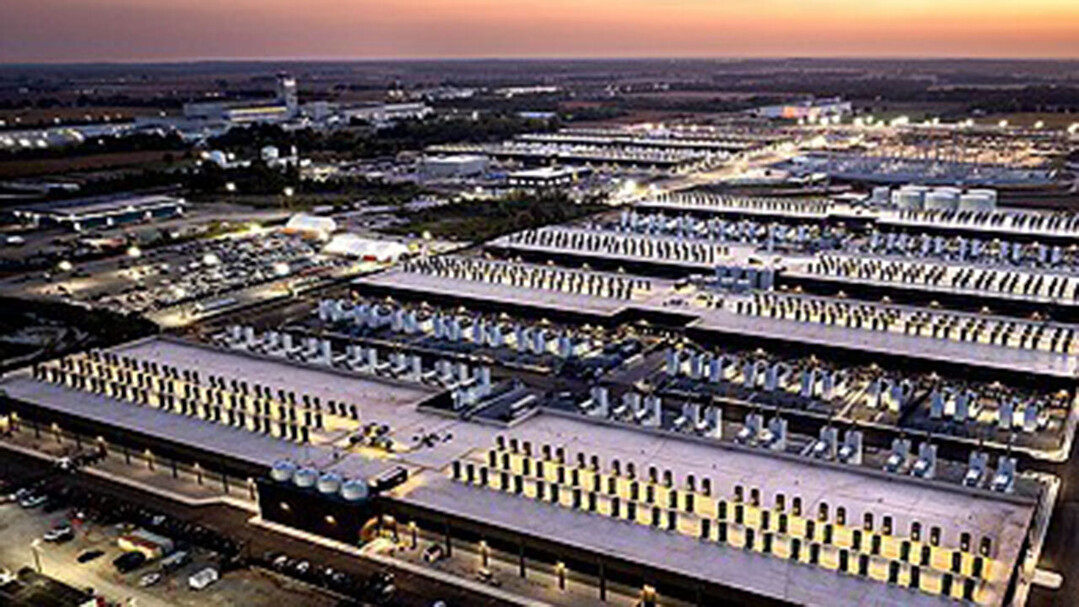
The staggering rush to build artificial intelligence infrastructure in the United States is hitting major roadblocks. Once hailed as a "golden goose," data center construction projects are increasingly facing severe market skepticism, soaring financial pressures, and fierce local backlash.
According to reports by the Financial Times (FT) and other major foreign media outlets, the massive U.S. AI infrastructure investment boom—estimated at a staggering $10 trillion (approx. 14,000 trillion won)—is showing cracks. Data center developers are struggling to secure necessary permits amid power shortages and community opposition, while companies heavily reliant on debt are buckling under mounting financing costs. Even upon completion, uncertainties remain over whether these projects will generate sufficient returns to recoup their massive investments.
"The project execution model that prioritized sheer speed is now colliding with harsh economic and logistical realities," the Financial Times noted.
1. Surging Delays and Financial Distress
Citing data from regulatory tracking firm RegLayers, the FT reported that at least 47 large-scale data center projects were delayed, withdrawn, or blocked from approval this year alone. Investment bank Bernstein further estimates that only 35% of planned U.S. data center projects are actually viable.
Financial conditions are deteriorating rapidly. Driven by rising interest rates and a tightening bond market, "neocloud" companies that lease and operate AI data centers are finding it increasingly difficult to raise capital. CoreWeave, a prominent U.S. AI cloud provider that purchases high-performance Nvidia GPUs to deliver computing services to OpenAI and Microsoft, saw its stock plunge by roughly 24%, with some of its corporate bonds trading in distressed territory.
Other major players are facing similar funding crunches. SoftBank-backed SB Energy and Perthus Grid (backed by Nvidia) have delayed or postponed their public listing plans. Timelines for "Stargate," the mega-data center project spearheaded by OpenAI, Oracle, and SoftBank, have also slipped. The New York Times highlighted these financial struggles, warning that "debt burdens could spill over from individual companies into systemic risks for the entire industry."
2. A Bubble Bigger Than the Dot-Com Era
The heavy interest burdens and construction delays have raised fears that financial distress could morph into broader credit instability. Doubts are also growing over whether the profitability of Big Tech firms—which are heavily subsidizing these ventures—can improve faster than their soaring capital expenditures. Financial markets were rattled when Meta reported in its Q3 earnings release that it had slipped into a negative free cash flow for the first time since going public in 2012, fueled by growing anxiety over AI-driven credit risks.
Experts warn that the speed-driven expansion of infrastructure has eclipsed past historical bubbles. In a Brookings Institution paper, Columbia Business School Professor Stijn Van Nieuwerburgh estimated that U.S. AI infrastructure spending between 2025 and 2032 will reach $10.3 trillion, accounting for 3.6% of average annual U.S. GDP. This scale is roughly 1.5 times the peak of the 19th-century railroad boom and three times that of the internet boom. If this pillar collapses, it could threaten not only America's growth momentum but the global AI investment frenzy as well. Tech media outlet The Information predicts that "hundreds of neocloud companies will likely consolidate down to just 7 to 10 within a few years."
3. Intense Local Backlash and New Political Pressures
Public sentiment in local communities has turned sharply hostile. According to Data Center Watch, an organization tracking resistance movements, community opposition halted or delayed at least 75 projects valued at $130 billion in the first quarter of this year alone.
Residents are pushing back as data centers consume massive amounts of electricity and water, generate noise and heat, drive up local utility bills, and degrade living conditions. Job creation, meanwhile, remains minimal—spiking temporarily during construction before dropping sharply upon completion. In eastern Pennsylvania, despite a developer offering $10,000 (approx. 13.24 million won) per household in compensation, local residents flatly rejected the proposal.
Political pressure is mounting as well. U.S. President Donald Trump posted on Truth Social demanding that companies building data centers generate their own power and pay dividends to local residents. As public anxiety over surging electricity bills intensifies, the administration is leaning on corporations to absorb power supply costs and share profits. While the Wall Street Journal noted that encouraging corporate self-power generation is not entirely new, mandating or heavily pressuring such measures marks a significant shift.
According to a Gallup poll, 71% of Americans oppose data center construction in their residential areas—surpassing even the 53% opposition rate recorded for nuclear power plants. Negotiating local consent and shouldering escalating costs have emerged as critical variables for the future of AI infrastructure.
An industry insider in South Korea remarked, "The old assumption that simply securing AI computing resources first would automatically guarantee profits is no longer sufficient. Moving forward, the expansion of AI infrastructure will depend less on raw semiconductor supply or sheer capital, and more on finding harmony with local communities and respecting regional values."
[Copyright (c) Global Economic Times. All Rights Reserved.]