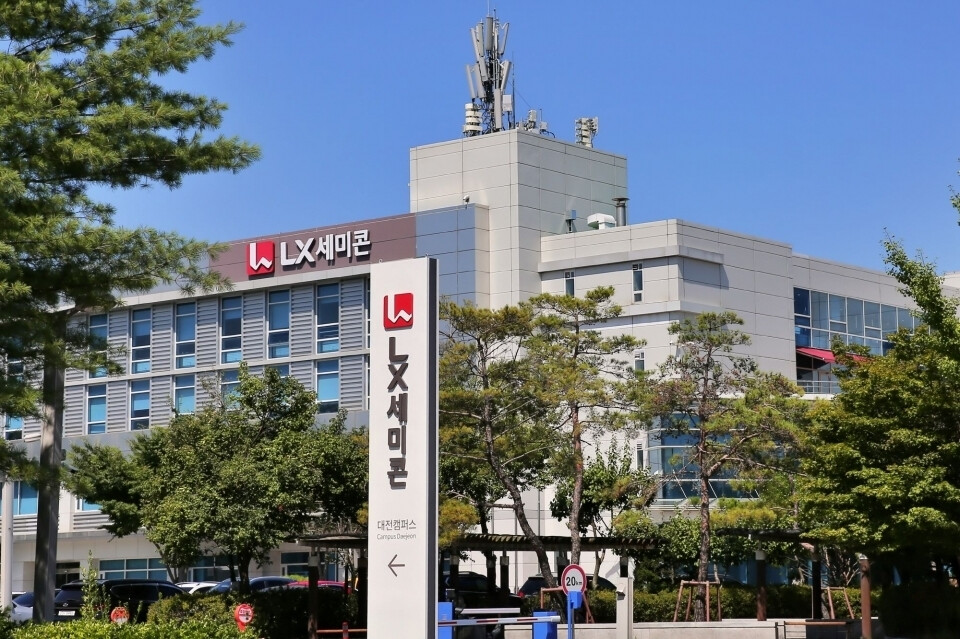
Five years after LX Semicon ventured into new businesses to reduce its heavy reliance on display driver ICs (DDIs), the impact of its business diversification remains limited. Although thermal dissipation substrates and automotive semiconductor businesses—into which about 100 billion won ($73 million approx.) was poured—have entered mass production, they have yet to offset the revenue decline of its flagship DDI segment. Furthermore, as sales from its second-largest customer recently plummeted, its dependence on its top customer surged to 62.1%. While nurturing new businesses, the company has failed to resolve its lingering vulnerabilities: core business sluggishness and heavy customer concentration.
5 Years of Investment, But New Businesses Have Yet to Fill the DDI Void
According to the Financial Supervisory Service's electronic disclosure system on the 21st, LX Semicon’s consolidated revenue for the first half of this year recorded 789.9 billion won, down 7.6% from 854.8 billion won in the same period last year. The primary driver was a drop in DDI revenue, which fell by 85.8 billion won from about 768.1 billion won to 682.3 billion won. Meanwhile, revenue from the "SoC and others" product group—which includes new businesses—grew by a mere 20.8 billion won, from about 86.8 billion won to 107.6 billion won. With the revenue drop in legacy products outpacing the growth of other product lines by more than four times, overall revenue reversed downward. Consequently, operating profit plunged 39.1% from 69.9 billion won to 42.6 billion won, with the operating margin dropping from 8.2% to 5.4%.
LX Semicon is a fabless company that designs DDIs, timing controllers (T-Cons), and power management ICs (PMICs). As of the first half of this year, DDIs accounted for 86.4% of total sales. To transform this business structure, the company expanded its investments in new businesses starting in 2021.
Key milestones included acquiring Silicon Carbide (SiC) power semiconductor-related assets from LG Innotek, and securing a 30% stake and related assets in Japanese thermal management material firm FJ Composite Materials for roughly 7 billion won. In 2022, the company broke ground on a thermal dissipation substrate plant in Siheung, Gyeonggi Province, and secured a stake in automotive semiconductor firm Telechips to drive its automotive microcontroller (MCU) business.
However, it took time for these investment outcomes to translate into revenue expansion. The thermal dissipation substrate plant, which cost roughly 100 billion won, began mass production in April of last year, while automotive MCUs entered mass production in August of this year following selection as a supplier for Hyundai Motor (005380) and Kia (005270) in 2023. Although the "SoC and others" product group accounted for 13.6% of sales in the first half, it also includes legacy T-Cons and PMICs, making it difficult to isolate the exact revenue contribution of the new businesses alone.
While the scale of new businesses remains limited, research and development (R&D) burdens persist. LX Semicon executed R&D expenditures of 231.7 billion won in 2024 and 227.1 billion won last year, while pouring another 112.9 billion won into the first half of this year. Cumulative R&D spending over the past two and a half years amounts to 571.7 billion won. Due to declining revenue, the ratio of R&D expenses to sales rose from 13.0% in the same period last year to 14.3%.
Plunge in Orders From No. 2 Customer Drives Top Customer Dependency to 62%
Compounding these issues, the customer structure of the legacy business has failed to improve. In the first half, sales to the company's second-largest customer (Customer B) dropped 38.2% from 253.5 billion won to 156.7 billion won. Conversely, sales to the top customer (Customer A) rose 7.7% from 455.2 billion won to 490.2 billion won. As a result, Customer A's sales share climbed from 53.3% to 62.1% of the total. Combined sales to these two customers account for 81.9% of the total.
This heavy customer concentration poses risks of earnings volatility. In its semi-annual report, the company explained that panel makers place orders on a rolling 10-week cycle rather than via long-term contracts. This structure allows changes in orders from major clients to reflect rapidly in revenue. In fact, inventories increased 11.7% in the first half from 193.1 billion won at the end of last year to 215.9 billion won, while inventory disposal losses climbed 65.1% to 9.5 billion won compared to the previous year's 5.7 billion won.
In reality, revenue contraction and profitability deterioration stemming from customer concentration have persisted since last year. The company's annual revenue shrank 12.1% from 1.8656 trillion won in 2024 to 1.6391 trillion won last year, while operating profit dropped 34.8% from 167.1 billion won to 108.9 billion won. The company attributed this downturn to intensified competition fueled by Chinese panel makers strengthening their market dominance and expanding supplies of Chinese-made ICs. Although operating profit for the second quarter of this year surged 115.1% year-on-year to 22 billion won from 10.2 billion won, quarterly customer sales figures are not publicly disclosed, leaving it unconfirmed whether the rebound was driven by the recovery of specific client orders.
Ultimately, while LX Semicon's business diversification has successfully brought new ventures to the mass production stage, it has yet to bridge the revenue gap left by its core business. With DDI sales shrinking and reliance on its top customer deepening simultaneously, the key going forward will be how effectively new businesses can translate into real revenue growth to alleviate legacy business stagnation and customer concentration.
[Copyright (c) Global Economic Times. All Rights Reserved.]