![[등록] 2026-09-01 15:48:31](/support/_updata/banner2/tl181982910_6749.png)


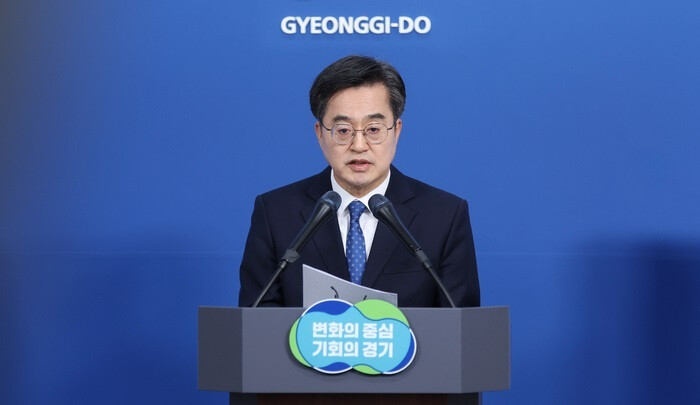
(C) Gyeonggi Province
YONGIN, South Korea — In a decisive move to maintain South Korea’s hegemony in the global chip war, Gyeonggi Province Governor Kim Dong-yeon announced a massive administrative overhaul to fast-track the development of the Yongin Semiconductor Mega-Cluster.
Speaking at the "K-Semiconductor Mega-Cluster Win-Win Town Hall Meeting" held at Dankook University’s Glocal Industry-Academic Cooperation Hall on February 27, 2026, Governor Kim emphasized that "speed is the ultimate weapon" in the volatile semiconductor industry.
The 'All-Care TF': Eliminating Bureaucratic Bottlenecks
The centerpiece of this acceleration strategy is the official launch of the 'Semiconductor All-Care Task Force (TF).' This specialized unit, evolved from the previous year's preliminary response team following the passage of the Special Act on Semiconductors in early 2026, is designed to be a "one-stop shop" for industry giants and suppliers alike.
Led by the Vice Governor for Economic Affairs, the TF consists of three dedicated divisions:
Planning & Policy: Aligning regional goals with national chip strategies.
Infrastructure Foundation: Coordination of power, water, and land use.
Human Resources & Technology Support: Scaling the workforce and R&D.
"We are introducing a 'Permit Shortening Target System'," Governor Kim stated. "By providing integrated pre-consultation before the investment stage, we will eliminate the unpredictability that often haunts large-scale infrastructure projects."
On-Site Inspection with Samsung and SK Hynix
Following the meeting, Governor Kim conducted a field inspection of the expansion sites for Local Roads 318 and 321—critical arteries for the Yongin cluster. He was joined by high-ranking industry executives, including Kim Yong-kwan, President of Samsung Electronics, and Park Ho-hyun, Vice President of SK Hynix.
The delegation reviewed the progress of Local Road 321, which is currently being expanded from two lanes to four. This road is vital for connecting the Yongin Advanced System Semiconductor National Industrial Complex (Idong/Namsa) with the SK Hynix Semiconductor Cluster (Wonsam).
Furthermore, a landmark agreement with the Korea Electric Power Corporation (KEPCO) and the Korea Water Resources Corporation (K-water) ensures that underground power grids will be built simultaneously with road construction on Local Road 318, significantly reducing the "time-to-power" for upcoming fabrication plants (fabs).
Dismissing 'Industrial Complex 2.0' Skepticism
Governor Kim took a firm stance against recent political rhetoric suggesting a "Semiconductor Complex 2.0"—a concept involving the relocation or diversification of the cluster to other regions.
"The ecosystem of equipment, materials, and components (So-Bu-Jang) has been meticulously built over 40 years in Gyeonggi Province. Attempting to shift this ecosystem now is not only unrealistic but a dangerous waste of time," Kim argued. "In the midst of an international 'time war,' we will push forward without hesitation."
Future Outlook: Talent and Tech
Beyond physical infrastructure, Gyeonggi Province is doubling down on "soft power." The province currently produces over 2,600 semiconductor specialists annually through dedicated training programs. Plans are also underway to expand "Mini-Fabs"—scaled-down manufacturing environments—where small and medium-sized enterprises (SMEs) can test their technologies without the prohibitive costs of full-scale production.
As cranes dominate the skyline of Wonsam-myeon, the message from Gyeonggi Province is clear: The Yongin Mega-Cluster is no longer just a plan; it is an accelerating reality intended to serve as the global heart of AI and system semiconductor manufacturing.
[Copyright (c) Global Economic Times. All Rights Reserved.]