• 2026.06.05 (Fri)
  • All articles
  • LOGIN
  • JOIN
Global Economic Times
fashionrunwayshow2026
  • Synthesis
  • World
  • Business
  • Industry
  • ICT
  • Distribution Economy
  • Well+Being
  • Travel
  • Eco-News
  • Education
  • Korean Wave News
  • Opinion
  • Arts&Culture
  • Sports
  • People & Life
    • International Student Report
    • With Ambassador
  • Column
    • Cho Kijo Column
    • Cherry Garden Story
    • Ko Yong-chul Column
    • Kim Seul-Ong Column
    • Lee Yeon-sil Column
  • Photo News
  • New Book Guide
MENU
 
Home > Distribution Economy

From Safety Drivers to Fully Autonomous: South Korea to Launch First Unmanned Trucking Service in June

Hwang Sujin Reporter / Updated : 2026-04-19 05:52:40
  • -
  • +
  • Print


SEOUL — The landscape of South Korea’s logistics industry is set for a historic shift this summer. Starting in June, autonomous trucks will officially begin transporting commercial freight on major expressways, marking the nation's first authorized step toward a fully unmanned delivery system.

A Milestone for Autonomous Freight
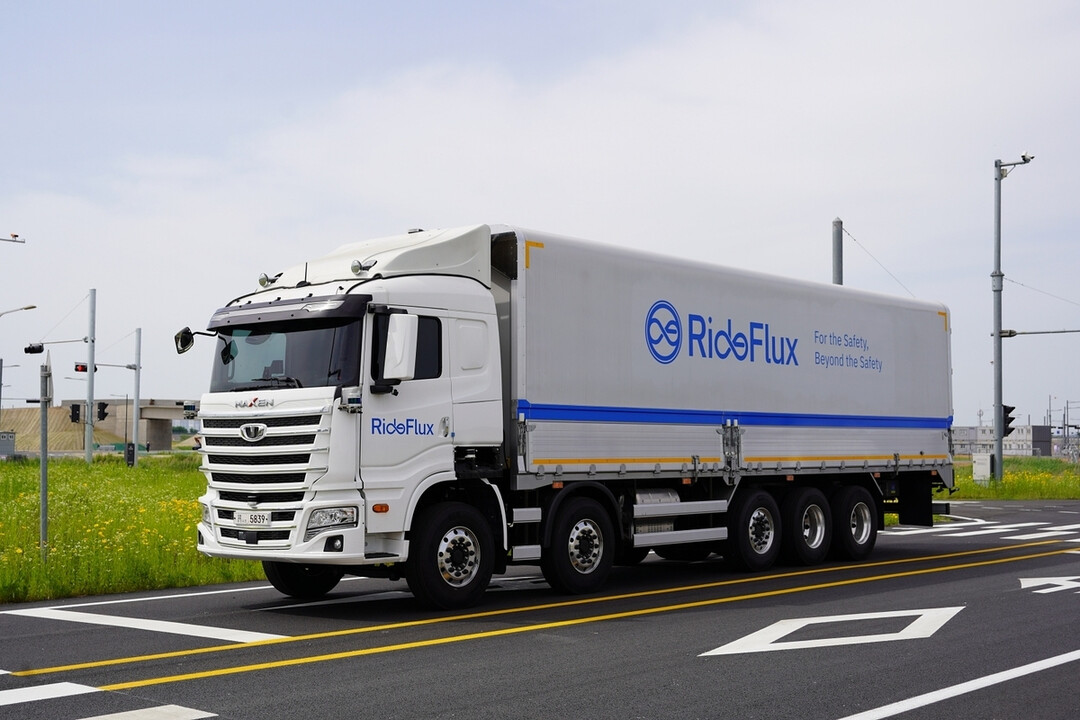
The Ministry of Land, Infrastructure, and Transport (MOLIT) announced on April 16, 2026, that it has granted the first-ever license for paid autonomous freight transportation to RideFlux, a leading domestic autonomous driving startup. This approval signals the beginning of a new era where self-driving technology moves beyond passenger cars and into the heavy-duty world of logistics.

RideFlux is scheduled to operate a 25-ton Tata Daewoo Mobility "MAXEN" truck on a 112-kilometer long-haul route. The route connects the Southeast Logistics Center in Songpa-gu, Seoul, to the Lotte Global Logistics Jincheon Mega Hub Terminal in North Chungcheong Province via the Jungbu Expressway.

Operational Details and Safety Protocols
To ensure safety and minimize disruption to regular traffic, the service will operate three times a week during off-peak hours—specifically between 8:00 PM and 5:00 AM the following day. The truck is programmed to maintain a steady speed of 90 km/h, the standard limit for heavy-duty vehicles on South Korean highways.

The project will follow a rigorous three-stage roadmap to reach full autonomy:

Stage 1 (Current): A safety driver sits in the driver’s seat to intervene if necessary.
Stage 2 (2027 Projected): The safety driver moves to the passenger seat, monitoring the system remotely or via onboard consoles.
Stage 3 (Final): Transitioning to a completely unmanned operation where the vehicle navigates the entire route independently.

Expanding the Horizon of Logistics
The partnership between RideFlux and Lotte Global Logistics is more than just a trial; it is a commercial contract for paid transportation. This economic viability is what sets this project apart from previous pilot tests. Following the initial Seoul-Jincheon route, RideFlux plans to expand its autonomous network to other major hubs, including Jeonju, Gangneung, and Daegu, by the end of this year.

"The first license for paid autonomous freight transport is a monumental leap for the commercialization of this technology," said Park Jun-hyung, Director General for Mobility and Automobiles at MOLIT. "We expect this to address chronic issues in the trucking industry, such as driver fatigue and labor shortages, while significantly enhancing road safety."

The Future of "No-Contact" Delivery
Industry experts suggest that if successful, this initiative will revolutionize the cost structure of the delivery market. Autonomous trucks do not require mandated rest periods, potentially allowing for 24/7 logistics cycles that could reduce delivery times and carbon emissions through optimized fuel consumption.

As South Korea pushes toward a "fully unmanned" goal, the eyes of the global tech community are on the Jungbu Expressway. The success of this 112-kilometer journey could very well dictate the speed at which the rest of the world adopts autonomous freight.

[Copyright (c) Global Economic Times. All Rights Reserved.]

  • #Hormuz Impasse
  • #globaleconomictimes
  • #micorea
  • #mykorea
  • #nammidonganews
  • #singaporenewsk
  • #Samsung
  • #Daewoo
  • #Hyos
Hwang Sujin Reporter

Popular articles

  • SK hynix CEO Kwak Noh-jung Meets Bill Gates and Satya Nadella to Solidify AI Memory Alliance

  • Hyundai Mobis Completes Independent EV 'Heart' Lineup: A Major Leap Toward Global Leadership in Power Electric Systems

  • "Singer of Filial Piety" Hyun Sook: "I Visit the Marginalized to Honor My Mother’s Memory"

I like it
Share
  • Facebook
  • X
  • Kakaotalk
  • LINE
  • BAND
  • NAVER
  • https://globaleconomictimes.kr/article/1065559860845293 Copy URL copied.
Comments >

Comments 0

Weekly Hot Issue

  • Samsung Electronics Super-Enterprise Union Loses Majority Status Amid Backlash Over Bonus Disparities
  • Samsung to Embed Vital Signs and Heart Health Scores in Upcoming Galaxy Watch9 Lineup
  • Apple Honors Digital Excellence: 12 Exceptional Apps and Games Celebrated at the 2026 Design Awards
  • Nexon Revamps Signature Youth Coding Competition into AI-Driven 'Nexon Young Programmers Cup'
  • Tech University of Korea Gathers 200 Game and AI Researchers to Discuss Industrial Expansion
  • Major Korean Telcos Trim Online-Exclusive Plans by Up to 50% Amid Shift to Unified Mobile Tariffs

Most Viewed

1
From a moment of collective sacrifice to a moment of collective democracy: The Timing of the Election in Ethiopia and Korea
2
U.S. Holds Off on Immediate Comprehensive Semiconductor Tariffs, but Pressure Mounts for Samsung and SK Hynix to Accelerate Domestic Investments
3
[Interview] "Halal is Not a Religious Regulation, but a 'Trust Infrastructure'… Creating a Premium 'K-Halal' Centered on Data and Platforms"
4
‘600 Million Won Bonus’ at Samsung Electronics Triggers Deep Sense of Relative Deprivation Among Korean Workers
5
Musk’s SpaceX Secures Space Hegemony with Flawless Starship V3 Recovery Ahead of Historic IPO
광고문의
임시1
임시3
임시2

Hot Issue

Murata Unveils Next-Gen Resin Electrode MLCC for Automotive Applications

Samsung to Embed Vital Signs and Heart Health Scores in Upcoming Galaxy Watch9 Lineup

L&F Plus Secures KRW 220 Billion from National Growth Fund to Anchor South Korea’s First Mass LFP Cathode Production

Samsung Electronics Super-Enterprise Union Loses Majority Status Amid Backlash Over Bonus Disparities

Fashion Runway Show 2026

Global Economic Times
korocamia@naver.com
CEO : LEE YEON-SIL
Publisher : KO YONG-CHUL
Registration number : Seoul, A55681
Registration Date : 2024-10-24
Youth Protection Manager: KO YONG-CHUL
Singapore Headquarters
5A Woodlands Road #11-34 The Tennery. S'677728
Korean Branch
Phone : +82(0)10 4724 5264
#304, 6 Nonhyeon-ro 111-gil, Gangnam-gu, Seoul
Copyright © Global Economic Times All Rights Reserved
  • 에이펙2025
  • APEC2025가이드북TV
  • 반달곰 프로젝트
Search
Category
  • All articles
  • Synthesis
  • World
  • Business
  • Industry
  • ICT
  • Distribution Economy
  • Well+Being
  • Travel
  • Eco-News
  • Education
  • Korean Wave News
  • Opinion
  • Arts&Culture
  • Sports
  • People & Life 
    • 전체
    • International Student Report
    • With Ambassador
  • Column 
    • 전체
    • Cho Kijo Column
    • Cherry Garden Story
    • Ko Yong-chul Column
    • Kim Seul-Ong Column
    • Lee Yeon-sil Column
  • Photo News
  • New Book Guide
  • Multicultural News
  • Jobs & Workers