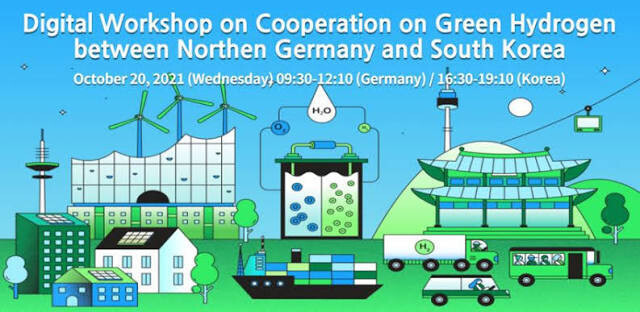
Government, industry, and research institute representatives from South Korea and Germany shared technology development trends across the entire hydrogen industry—ranging from hydrogen production, storage, and transportation to utilization, safety, and standardization—while discussing cooperative measures.
The two countries explored practical cooperation possibilities, including joint research and development (R&D), demonstrations, and business cooperation, alongside hydrogen policies and market expansion strategies.
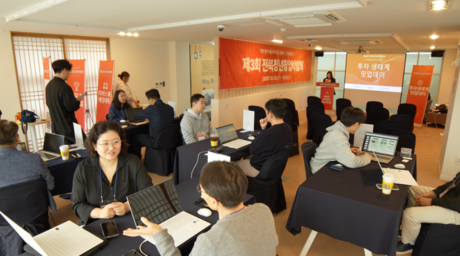
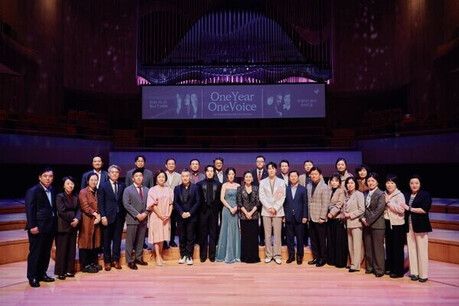
The Korea Hydrogen Alliance hosted the "7th Germany-Korea Hydrogen Conference" in Hamburg on the 21st. The conference was held in conjunction with the "Hydrogen Technology World Expo 2026," a global hydrogen specialist exhibition taking place in Hamburg from October 20 to 22.
The event was attended by South Korean representatives from the Consulate General of the Republic of Korea in Hamburg, the Korea Hydrogen Alliance, the Korea Institute of Energy Technology (KENTECH), the Korea Institute of Civil Engineering and Building Technology (KICT), and Hilium Industries, alongside the German Federal Ministry for Economic Affairs and Energy. From the German side, government, research, academic, and corporate figures participated—including the Federal Institute for Materials Research and Testing (BAM), the Fraunhofer Society, Anhalt University, H2Global, and Linde—bringing the total number of attendees to around 200.
The conference focused on five key areas: Policy & Market, Storage & Transportation, Utilization, Safety & Standardization, and Production. Participants reviewed the current status of hydrogen policies and markets in both countries, discussed technological development trends, and explored industrial cooperation measures.
During the Policy & Market session, attendees shared hydrogen policies of both nations, South Korea’s current R&D status in hydrogen, and public-private financial support measures aimed at expanding the German hydrogen market. Germany revised its National Hydrogen Strategy in 2023, designating hydrogen as a core instrument for decarbonizing hard-to-abate industries such as steel and chemical manufacturing. Furthermore, through diverse support programs like climate protection contracts and H2Global, alongside infrastructure financing support, Germany is expanding its international hydrogen partnerships and recognizes South Korea as a key policy and industrial cooperation partner.
In the Storage & Transportation sector, discussions centered on liquid hydrogen storage technologies, hydrogen transportation methods, and underground hydrogen storage technologies. The Utilization sector covered trends in the hydrogen mobility market of both nations and technological development status for expanding hydrogen utilization.
In the Safety & Standardization session, participants discussed the safety of hydrogen pipelines and liquid hydrogen, as well as hydrogen leak detection and monitoring technologies. The Production sector introduced biomass-based hydrogen production technologies and operation/performance enhancement technologies for water electrolysis systems.
In particular, this conference served as an occasion to examine collaboration possibilities across the entire hydrogen industry value chain by extensively addressing not only hydrogen production, storage, transportation, and utilization technologies, but also safety and standardization.
Kim Jae-hong, Chairman of the Korea Hydrogen Alliance, stated, "Celebrating its seventh year, the Germany-Korea Hydrogen Conference is a representative exchange event that has shared the hydrogen policies, industrial, and technological trends of both nations while broadening the foundation for cooperation." He added, "We expect this conference to serve as an opportunity to elevate past cooperation to the next level, leading to concrete outcomes such as joint R&D, demonstrations, and business cooperation between enterprises and research institutes of both countries."
Meanwhile, South Korea and Germany have maintained government-to-government cooperation in energy transition and the hydrogen sector through the "Korea-Germany Energy Partnership" since 2019. Since 2020, they have also expanded private-sector industrial and technological exchanges by hosting the Germany-Korea Hydrogen Conference.
[Copyright (c) Global Economic Times. All Rights Reserved.]