


(C) Pixabay
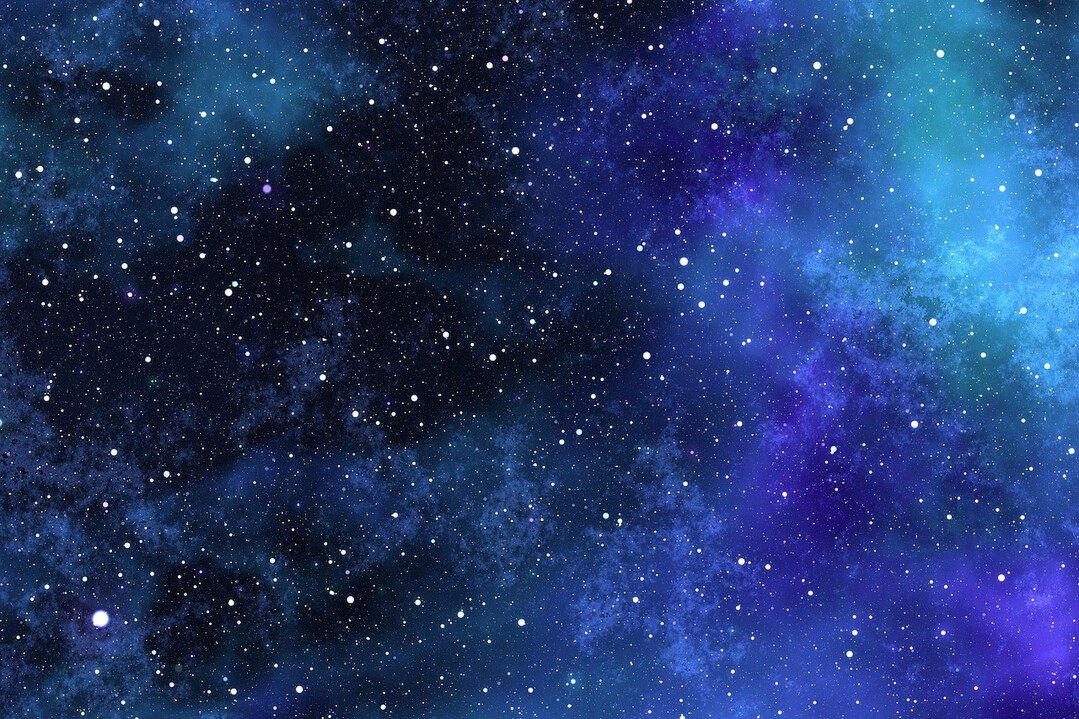
Comparing the sun, the moon, and the stars, the clear winner is the Sun, the Tae-yang (Solar). All the world lives off its sunlight. The Moon, visible in the night sky, is only taken as a friend when one is lonely. Compared to these, the stars are truly '별볼일 없는' (insignificant/trivial) existences. On a clear night, you can see the Milky Way, and occasionally a shooting star. If you are lucky, you can see a meteor shower (流星雨, yuseong-u). A meteor shower pours down like chestnuts falling in a gust of wind. A shooting star that doesn't completely burn up and falls to Earth is a meteorite (隕石, unseok). Because it is precious and good for what is basically 'dung' (poop, referring to 'star dung' or byeol-ttong), people sometimes hit the jackpot by picking up a star dung (meteorite).
The stars that revolve around the sun are fewer than ten, at best. In order from nearest to the Sun, they are Mercury, Venus, Earth, Mars, Jupiter, Saturn, Uranus, and Neptune. Pluto, a former member, was tiny and subsequently expelled. Halley's Comet, which orbits with a very long period, circulates within the solar system, passing near Earth about every 75–76 years. It passed near Earth on February 9, 1986, and is expected to reappear around July 28, 2061. Will one be able to see it, even if they want to?
It's confusing to memorize these planets in English because they aren't used often. So, I know them from overhearing children memorizing them. They remember the first letters of "My Very Educated Mother Just Served Us Nine Pizzas." However, since Pluto was classified as a dwarf planet and excluded, "Nine Pizzas" changed to "Nachos." The names of the planets are the names of gods from Roman mythology. The latter is the corresponding god from Greek mythology: Mercury (Hermes), Venus (Aphrodite), Earth, Mars (Ares), Jupiter (Zeus), Saturn (Cronos), Uranus, Neptune (Poseidon), and Pluto (Hades).
Among these, Venus (金星, Geumseong) is familiar to us. It can be seen in the eastern sky before sunrise or the western sky after sunset. Because it is the brightest star, it seems to be called Geumseong, the 'gold star' of the gold medal. When it appears in the eastern sky at dawn, it is called the Morning Star of Hope (saetbyeol), and when it appears in the western sky in the evening, during the time one feeds their dog, it is called Dog Star (gaebabbalagi). It is also called Gye-myeong-seong (啟明星, star that announces the dawn), Tae-baek-seong (太白星, bright star), and Jang-gyeong-seong (長庚星).
Earth (Jigu; 地球) is the Ji (地) of Cheon-ji-in (天地人, Heaven, Earth, Man), the land, the soil, and the foundation of life. By size, it is insignificant compared to the infinitely large Cheon (Heaven), but the even smaller In (Man) seems to be a universe (Uju, 宇宙) greater than heaven. It was said, Innaecheon (人乃天, Man is Heaven). Humans are born from the soil and return to the soil, so we are the Sin-to (身土, body and soil) of Sin-to-bul-i (身土不二, body and soil are not separate).
The planets revolving around the Sun have regular orbital periods. There comes a day for a "planetary parade" when these planets, each revolving at its own speed, eventually form a straight line or come close together. On February 28th, you could see Mercury, Venus, Mars, Jupiter, Saturn, and Uranus with the naked eye and Neptune with a telescope. More recently, on August 10th, six planets, excluding Mars, aligned. This coming mid-to-late September, five planets—Mercury, Venus, Jupiter, Saturn, and Uranus—are said to align. This rare alignment of the seven major planets is only expected to be visible again in 2492. This upcoming Chuseok (October 6th) is a golden holiday. It would be wonderful to see the Dog Star, Jupiter, and the fully risen full moon.
On a clear night, the North Star (Bukgeukseong) and the Big Dipper (Bukduchilseong) are easily found in the night sky and barely move, serving as a directional standard for navigators, explorers, and astronomers. The Big Dipper was revered as Chil-seong-nim (Seven Stars Deity), a spiritual entity that cures diseases and protects descendants. In Buddhist temples, you can find the Chil-seong-do (七星圖, Seven Stars Painting) in the Sansin-gak (Mountain God Shrine) or Chilseong-gak (Seven Stars Shrine). People prayed to Chil-seong-nim to ward off misfortune and wish for a long life free of disease. The Big Dipper is a ladle-shaped cluster of seven stars, and if you look closely at the second star from the end of the handle, you'll see a tiny star next to it. If you can see this small star, you have good eyesight even without glasses.
On a midsummer night, lying on a bamboo-split folding bed with a hemp sheet covering you, looking up at the sky, you see the milky, faint Milky Way stretching across. How much I waited for the time when it pointed to our kitchen, as it meant we could eat newly harvested rice... I wore only a short-sleeved shirt all summer, so I counted down the days to Chuseok when I could wear new, long-sleeved clothes. This Earth, sick from being carelessly used, is sweating heavily from global warming, and air pollution makes it difficult to see the stars. I miss the time when I would count the stars in the night sky and gently drift off to sleep.
[Copyright (c) Global Economic Times. All Rights Reserved.]