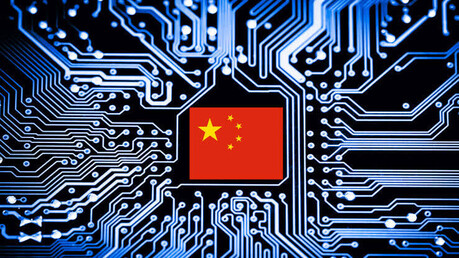
When evaluating the semiconductor race, industry observers typically focus on raw chip performance. However, recent developments across China’s technology sector suggest that hardware specifications alone no longer tell the whole story. As Washington tightens restrictions on advanced graphics processing units (GPUs), four major Chinese AI players—DeepSeek, Alibaba, Huawei, and Infinigence AI—are responding from different angles, weaving their individual strategies into a single, self-sustaining ecosystem.
The Supply Crunch
According to records released on November 19 by U.S. House Foreign Affairs Committee Chairman Brian Mast, Chinese firms applied to import 3.44 million Nvidia and AMD chips through May 2026, yet the U.S. government approved only about 879,000—roughly one-quarter of demand. Alibaba led the applications with nearly 949,000 requests. Meanwhile, China’s daily AI token volume surged 5,000-fold, jumping from 100 billion in early 2024 to roughly 500 trillion by June 2026.
To bridge the gap, Chinese firms previously relied on renting computing power from Southeast Asian data centers. However, following scrutiny over Singapore-based Megaspeed—which allegedly funneled part of its $4.8 billion Nvidia hardware stockpile to China—Washington closed that loophole on November 16. New rules require U.S. licenses for any data center globally providing large-scale compute to Chinese firms, as well as for high-end AI chip exports to five countries, including Singapore and Malaysia. Consequently, market tracker TrendForce projects domestic chips will account for nearly 90 percent of China’s high-end AI market this year—a shift driven less by preference than by necessity.
1. DeepSeek: Rationing Access to Build Massive Infrastructure
DeepSeek has emerged as the world's most heavily utilized AI model developer. Data from OpenRouter shows DeepSeek V4.1 Flash logged 59.2 trillion tokens in the second week of November—ranking first globally and quadrupling its volume from two months prior. Faced with severe hardware constraints, the company capped daily usage and conversation lengths for free users on November 16 to prioritize paying API clients.
This rationing appears temporary. After previously avoiding outside capital, DeepSeek raised over 50 billion yuan in June and roughly 100 billion yuan in October, totaling approximately 150 billion yuan ($21 billion) this year. The bulk of this funding is earmarked for gigawatt-scale proprietary data centers, bulk chip procurement, and custom inference chips tailored to its models. Industry sources also indicate that Huawei engineers have been embedded at DeepSeek to co-design next-generation hardware, with DeepSeek slated to begin pre-training on Huawei’s Ascend 950DT chips by year-end.
2. Alibaba: Vertical Integration from Silicon to Commerce
On November 19, Alibaba CEO Eddie Wu announced that the company’s Qwen models are already training on chips developed by its semiconductor subsidiary, T-Head. Its upcoming Zhenwu V900—a dual training-and-inference chip boasting triple the performance of its predecessor—is scheduled for mass production in the first quarter of 2027.
For a cloud provider whose external revenue jumped 67 percent, relying on U.S. export approvals for compute capacity is an untenable risk. Alibaba is pairing its hardware push with software efficiency: its newly unveiled Qwen4-Max model cut token consumption nearly in half during agent benchmarks, lowering task costs by 58 percent and effectively doubling customer capacity per chip. By linking proprietary silicon, cloud infrastructure, efficient models, and its vast e-commerce and payment networks, Alibaba is constructing an end-to-end domestic stack.
3. Huawei: Cultivating a Partner Ecosystem
Acting as the anchor of China’s hardware sector, Huawei is using its capital and scale to build out the surrounding operational layer. While collaborating with DeepSeek on chip architecture, Huawei has turned to Qingmao AI—a startup founded by Tsinghua University alumni and former Huawei engineers, backed by Huawei’s Hubble Investment—to maximize hardware utilization.
On November 17, Qingmao AI announced plans to co-operate a 10,000-chip Ascend 950DT "token factory" with the Huawei ecosystem starting in 2027, scaling to 100,000 chips within five years. By optimizing workload scheduling, Qingmao AI aims to boost chip utilization rates from 30–40 percent to roughly 80 percent. Much like Nvidia’s strategic backing of CoreWeave, Huawei is securing both ends of its supply chain by co-designing with top model makers and investing in specialized operators.
4. Infinigence AI: Unifying Fragmented Compute with AI Agents
Operating independently of Huawei’s ecosystem, Tsinghua spin-off Infinigence AI—valued at 14.3 billion yuan ahead of its IPO—focuses on software that unites disparate hardware. Rather than building data centers, the company orchestrates cross-chip computing across existing facilities. It currently manages 37,000 petaflops across 16 different chip types, successfully training a 70-billion-parameter model at 97.6 percent utilization by combining four domestic chip brands with two foreign ones.
Infinigence AI has linked data centers 4,000 kilometers apart—from Hami in Xinjiang to Shenzhen in Guangdong—into single training runs, and launched the "Tianwen" alliance in July alongside domestic chipmakers MetaX, Biren, and Enflame.
Looking ahead, the company is deploying "infrastructure agent swarms" to autonomously detect bottlenecks and optimize live data centers, claiming a 100-fold expansion in operational capacity per staff member. Alongside Tsinghua University, it also introduced Uni3Sim, a virtual simulation platform that stress-tests supernode clusters before physical construction. As CEO Xia Lixue noted, inefficiencies discovered by AI agents today directly inform the blueprints for tomorrow's facilities.
An Unstoppable Ecosystem
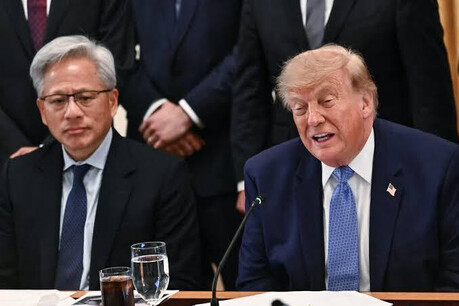
In the classic Chinese parable The Foolish Old Man Removes the Mountains, an elderly man vows to dig away two massive peaks blocking his home, trusting that future generations will finish the job if he cannot. China’s tech sector appears to be moving its own mountains in a fraction of that time. While U.S. export controls can restrict access to individual components, they cannot easily halt a coordinated response uniting state policy, massive capital, big-tech ecosystems, and agile startups. Even U.S. President Donald Trump, speaking to CNBC after returning from the APEC summit in Shenzhen, acknowledged the shift, noting that China is now making its own chips and boasts "some incredible companies."
[Copyright (c) Global Economic Times. All Rights Reserved.]