![[등록] 2026-09-01 15:48:31](/support/_updata/banner2/tl181982910_6749.png)


- "Convenience comes at a cost": Preservatives in wet wipes may ingest via cutlery
- Safe alternatives: Why dry kitchen towels might be your best bet
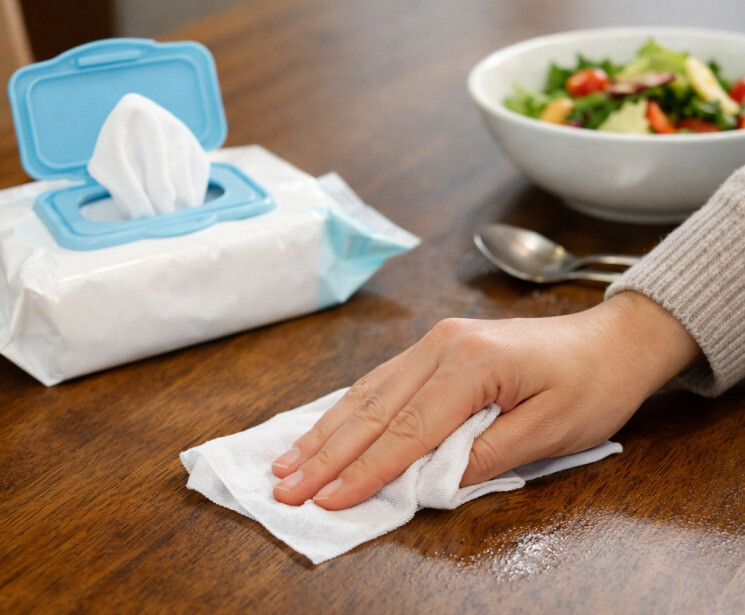
It has become a ubiquitous sight in modern households: reaching for a disposable wet wipe to quickly clean the dining table after a meal. While the practice is lauded for its convenience—eliminating the need to wash, dry, and boil traditional rags—health experts are now raising alarms. Recent warnings suggest that this "shortcut" may be leading to the gradual accumulation of synthetic chemicals within the human body.
The "Invisible Residue" on Your Plate
Dr. Choi Eun-jung, a Professor of Science Education at Ewha Womans University, recently addressed these concerns on the popular health-focused YouTube channel 'Dr. Lee Dong-hwan's Education TV'. According to Dr. Choi, the primary danger lies not in the wipe itself, but in the residue it leaves behind on the surfaces where we eat.
"Because managing traditional dishcloths is cumbersome, many families have switched to wet wipes," Dr. Choi explained. "However, the chemical components in these wipes remain on the table surface. When we place our spoons, chopsticks, or fallen bits of food directly onto that surface, these trace amounts of chemicals can be ingested."
While a single exposure is unlikely to cause immediate symptoms, Dr. Choi warns of the "cocktail effect." Over long periods, these substances can accumulate in the system and potentially interact with other environmental toxins, leading to unpredictable health impacts.
More Than Just Wet Paper: The Composition Crisis
A common misconception is that wet wipes are simply "damp tissues." In reality, they are complex industrial products. Unlike standard tissues made from natural wood pulp, most wet wipes are crafted from synthetic fibers like polyester.
To prevent the growth of bacteria and mold in a moist environment for months at a time, manufacturers must include preservatives. Common ingredients include:
Sodium Benzoate: A preservative also used in food, but subject to strict limits.
Ethanol/Alcohol: Used for sterilization but can strip protective coatings off furniture.
Artificial Fragrances: Often containing phthalates or other volatile organic compounds (VOCs).
While products sold in South Korea are strictly regulated by the Ministry of Food and Drug Safety and are generally deemed safe within permissible limits, the concern is the frequency of exposure in a high-contact area like a dining table.
The Endocrine Concern
Dr. Choi noted that even if individual chemicals are below safety thresholds, simultaneous exposure to multiple substances—known as "combined toxicity"—could potentially interfere with the endocrine system. "While I wouldn't label it as 'critically dangerous' due to the low concentrations, we must be mindful of how and how often we use them," she cautioned.
The Solution: Back to Basics with a Twist
For those looking to balance convenience with safety, experts suggest a simple alternative: Dry Kitchen Towels.
Since kitchen towels are stored dry, they do not require the chemical preservatives or anti-fungal agents found in wet wipes. Dr. Choi recommends wetting a high-quality kitchen towel with tap water to wipe the table.
"Most kitchen towels currently on the market are free of fluorescent whitening agents," Dr. Choi added. However, she urged consumers to remain vigilant by checking labels for MFDS (Ministry of Food and Drug Safety) certification to ensure no harmful bleaching agents were used during production.
As the debate over "micro-toxicity" grows, the message from experts is clear: the most convenient cleaning method may not always be the healthiest. A small shift in household habits today could prevent a significant chemical burden tomorrow.
[Copyright (c) Global Economic Times. All Rights Reserved.]