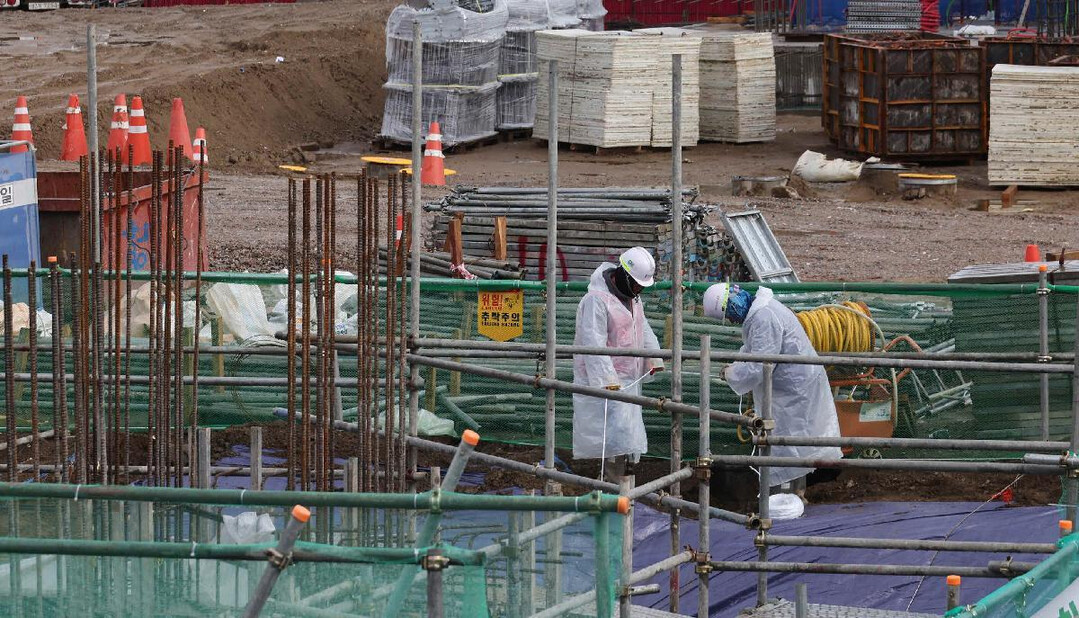
In Seoul’s reconstruction and redevelopment sites, construction costs agreed upon by housing associations and contractors following disputes have risen by an average of 39% compared to previous levels. Among 10 project sites where the scale of increases has been confirmed, 3 saw construction costs skyrocket by more than 50%. In some sites, ongoing conflicts—such as contractors demanding nearly double the original contract amounts—are raising concerns over disruptions in the commencement of urban maintenance projects, which are central to housing supply in Seoul.
According to an analysis by Maeil Business Newspaper of data on maintenance project construction cost disputes and mediations submitted by the Seoul Metropolitan Government to the National Assembly audit, a total of 69 construction cost disputes and mediation cases occurred in Seoul from 2023 to this year. Among them, the average increase rate for 55 cases with confirmed pre- and post-change construction costs stood at 39.0%. In 16 cases (29.1%), construction costs surged by 50% or more, and 3 cases saw increases more than double the original contracts.
The average increase rates by year of dispute were 41.4% in 2023, 33.0% in 2024, and 51.9% last year, remaining above 30% for three consecutive years. Among the 15 disputes that arose this year, the average increase rate for 9 recently agreed-upon cases was 26.5%.
At individual project sites, cases of construction costs rising by over 50% are popping up continuously. In February, the Sinbanpo 21st Reconstruction Association in Seocho-gu, Seoul, agreed with contractor POSCO E&C to raise the construction cost per 3.3 square meters by 66.4%, from 6.78 million won to 11.28 million won. Although lower than the 16.09 million won initially demanded by the contractor, this amount represents an increase of 4.50 million won over the existing contract.
Bongcheon District 4-1-3 in Gwanak-gu also agreed to raise the construction cost per 3.3 square meters by 62.3%, from 4.77 million won to 7.74 million won. Noryangjin District 7 in Dongjak-gu and Jangwi District 6 in Seongbuk-gu saw increases of 41.7% and 40.7%, respectively.
For project sites currently undergoing negotiations, the demands for hikes are even larger. In Noryangjin District 4, Dongjak-gu, which aims to break ground within the year, contractor Hyundai Engineering & Construction is demanding a 97.1% increase in construction costs per 3.3 square meters, from the existing 4.78 million won to 9.42 million won—a level nearly double the original contract.
At neighboring Noryangjin District 5, Daewoo Engineering & Construction demanded 8.93 million won per 3.3 square meters, a 62.7% increase from the previous 5.49 million won. In Susaek District 8, Eunpyung-gu, SK ecoplant has requested a 63.2% increase from 5.08 million won to 8.29 million won. Contractors cite rising material and labor costs, extended construction periods, and expanded construction areas due to design changes as the reasons for the hikes.
The rise in construction costs is driven by a complex combination of soaring material and labor costs, prolonged construction periods, and design changes. According to the Korea Institute of Construction Technology, the construction cost index rose 8.5% from an average of 127.90 in 2023 to 138.74 in August of this year.
However, it is difficult to simply compare the construction cost increase rates of individual maintenance projects with the overall construction cost index. This is because each site has a different initial contract timing, and the increased construction costs also include expenses resulting from design modifications and expanded construction areas. Nevertheless, as the adjusted construction costs finalized through disputes have surged, the financial burden on associations has grown.
The longer the tug-of-war over construction costs continues, the heavier the burden on housing supply schedules. If contractors and housing associations fail to reach an agreement on the scale of the increase, groundbreaking can be delayed, or conflicts regarding additional construction costs may reignited even after construction begins.
To prevent such conflicts from leading to housing supply delays, the Seoul Metropolitan Government launched the "Construction Cost 120 Center" starting on the 21st. It is an integrated service counter supporting everything from contractor selection and construction contracts to construction cost verification, dispute mediation, and post-agreement management. It operates a pool of 33 professional consulting personnel, including lawyers and urban planning experts.
Recently, 11 maintenance project associations, 5 contractors, and 8 autonomous districts pushing for within-the-year groundbreaking signed a joint agreement presided over by Seoul Mayor Oh Se-hoon. The initiative aims to minimize construction cost conflicts and stick to scheduled groundbreaking timelines.
Experts point out that the grounds for construction cost increases must be transparently disclosed and the effectiveness of dispute mediation enhanced. Jung Jae-hoon, a professor of urban planning and real estate at Dankook University, noted, "The core reason for the prolonged construction cost conflicts in maintenance projects lies in information asymmetry and opaque contract structures between associations and contractors," adding, "Institutions must be improved so that standard detailed cost statements are made mandatory from the early stages of construction, and objective verification results translate into substantive mediation."
Warnings have also been raised that even if agreement on pre-construction cost hikes is reached, conflicts over further increases during the construction process may still arise. Baek Jun, CEO of J&K, stated, "After general sales, it is difficult to secure additional revenue, meaning association members will have to bear the increased construction costs," emphasizing that "devices to objectively verify and monitor the reasons and scale of increases are necessary."
[Copyright (c) Global Economic Times. All Rights Reserved.]