Mr. Kim (56), an executive working at a financial company, was an early investor who caught onto Bitcoin early on. He also trades stablecoins, which have emerged as a major issue in domestic and international financial markets. Regarding the size of his stablecoin investment, Mr. Kim said, "It's not in the hundreds of millions of won, but rather in the tens of millions." He holds them for the purpose of purchasing virtual assets like Bitcoin or Ethereum, and stated that "looking solely at the investment return of the stablecoins themselves, it's roughly a 'break-even' point."
Domestic investors like Mr. Kim typically trade by opening accounts on domestic virtual asset exchanges and purchasing stablecoins such as Tether through them. The process involves installing an exchange app, completing identity verification, and using Korean won deposited into bank accounts affiliated with each exchange to buy coins listed on the exchange. After buying stablecoins with won on the exchange, domestic investors often send them to overseas exchanges like Binance or Bybit to use for currency exchange and derivatives/futures trading.
Park Jun-hong, head of the Payment Systems Department at the Bank of Korea, said, "Globally speaking, the scale of stablecoin holdings and trading by South Koreans is not a small level," adding, "We understand that they are mostly held for the purpose of investing in cryptocurrencies like Bitcoin." He explained that they serve as a standby "ammunition" character to buy highly volatile Bitcoin, Ethereum, and others that are not pegged to real assets.
Much like putting deposit money into a securities firm account when trading stocks and waiting for the right investment timing, investors hold onto funds in the form of stablecoins—which have low volatility—and immediately step in to buy when Bitcoin prices fall. While Bitcoin can also be purchased with won in linked bank accounts, this route involves time delays and transfer fees during the transfer process.
According to data secured by the office of People Power Party lawmaker Lee Jong-wook, the number of account holders across South Korea's top five exchanges (Upbit, Bithumb, Coinone, Korbit, and Gopax) reached 11.155 million as of the end of June this year. Trading volume for stablecoins, including Tether, stood at 7.3 trillion won for the month of June, averaging 2400 billion won per day. In the first half of this year, it decreased compared to last year, pushed aside by the stock market boom.
Director Park explained, "Even though stablecoins are pegged to the dollar, their value volatility is bound to be greater than that of general currencies." This is because the underlying dollar value moves and the prices of reserve assets (such as U.S. Treasuries) backing the stablecoins fluctuate. Stablecoin issuers are required to secure cash-equivalent assets equal to the amount of coins issued in order to maintain the coin's value at $1 at all times. They usually hold U.S. Treasury bonds as collateral.
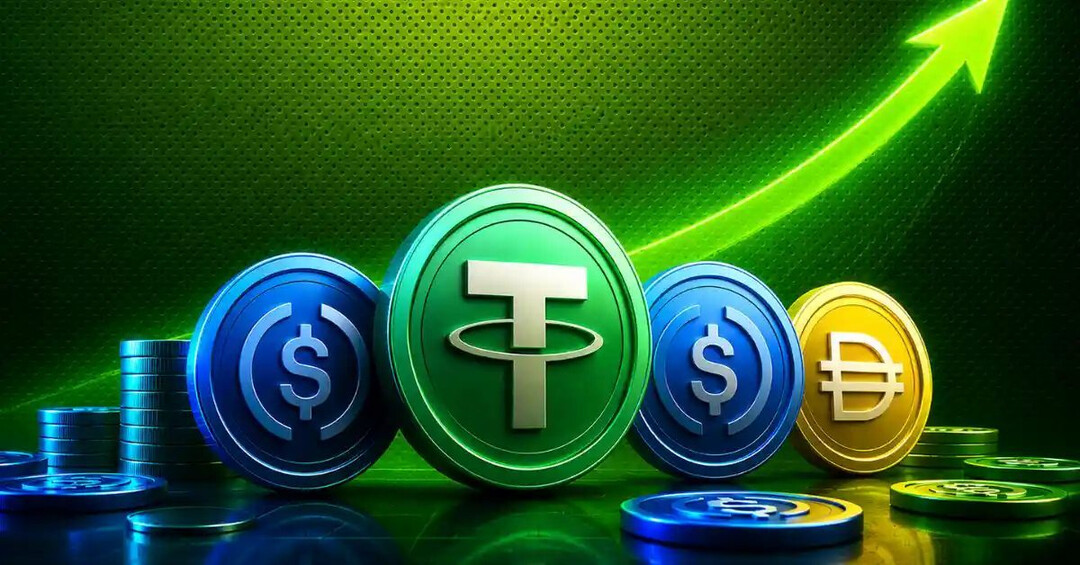
Looking at the won-based price of Tether—which accounts for about 70% of the stablecoin market—based on a weighted average across domestic exchanges, it was around 1,440 won at the end of last year, 1,545 won at the end of June this year, and 1,359 won at the end of September. The won-based price fluctuated in tandem with movements in the won-dollar exchange rate. In overseas virtual asset markets, because they are pegged to the dollar, they are practically fixed near $1. Even overseas, minor fluctuations can occur in dollar terms. For instance, prices shift depending on supply and demand when a rush of people tries to sell Tether and buy Bitcoin, or conversely, when an increasing number of people dump Bitcoin and switch back to Tether.
According to data from on-chain data analysis platform DefiLlama, the global stablecoin market size (market capitalization) stood at approximately $301.4 billion as of the 22nd of this month. It expanded explosively from $26.9 billion at the end of 2020—the early stage of market formation—to over 10 times that at $302.4 billion by the end of 2025. It continued an upward trend into this year, reaching a peak of $313.1 billion in May before declining slightly. In the global stablecoin market, dollar-backed assets account for 98% to 99%, with Tether (USDT) and USD Coin (USDC) making up the majority.
Hwang Sei-woon, a senior research fellow at the Korea Capital Market Institute, analyzed in a research report regarding the explosive expansion of the stablecoin market since 2020 that it was driven by regulatory refinements in the U.S. around that time. One example is the U.S. permission in the second half of 2020 for banks to custody and store reserve assets for stablecoin issuers. Another factor was the Trump administration's implementation of policies to foster stablecoins. In addition, outside the U.S., dollar stablecoin trading has been active in South American countries with unstable domestic currency values as a means to hedge against inflation risks.
Due to a lack of domestic legal frameworks, won-backed stablecoins cannot yet be issued. The government is pushing for the enactment of a Digital Asset Basic Act containing the legal institutionalization of won stablecoins, and several related bills have been submitted to the National Assembly's Political Affairs Committee. Major financial institutions such as KB Financial, Shinhan Financial, and Hana Financial are conducting preliminary preparations to issue won stablecoins in line with this.
Trading dollar stablecoins also carries risks. If the credibility of the coin issuer drops or a sense of panic spreads in the market, the "1 coin = 1 dollar" formula could break. Because they are assets issued by private corporations, issuers may fail to build up sufficient reserve assets contrary to their initial promises, putting them at risk of insolvency in the event of a crisis. A prime example is the "Terra-Luna incident" of 2022.
The rapid growth of the stablecoin market amid these circumstances has also led to interpretations that it is being abused as a conduit for illegal capital outflows or money laundering, categorized as "dark transactions." This involves buying Tether with won in South Korea, transmitting it to the electronic wallet of an acquaintance overseas, and exchanging the Tether for dollars or local currency locally. In effect, it serves as a bypass to commercial banks' requirements for proving the source of funds or remittance limit restrictions.
If assets are transferred multiple times online to personal electronic wallets issued by overseas exchanges in countries like the U.S. or Brazil, they vanish outside the monitoring network of domestic financial and monetary authorities. This point gives rise to analyses that they can be utilized for anomalous transactions such as evading inheritance and gift taxes. According to data from lawmaker Lee Jong-wook's office, the net outbound flow (withdrawals minus deposits) of stablecoins leaving domestic top-five exchanges for overseas from January 2025 to June 2026 was tallied at 14.9 trillion won. This is why stablecoins have emerged simultaneously as an innovative model reshaping the existing financial order, a new investment destination, and a homework assignment for foreign exchange and financial authorities.
[Copyright (c) Global Economic Times. All Rights Reserved.]