![[등록] 2026-09-01 15:48:31](/support/_updata/banner2/tl181982910_6749.png)


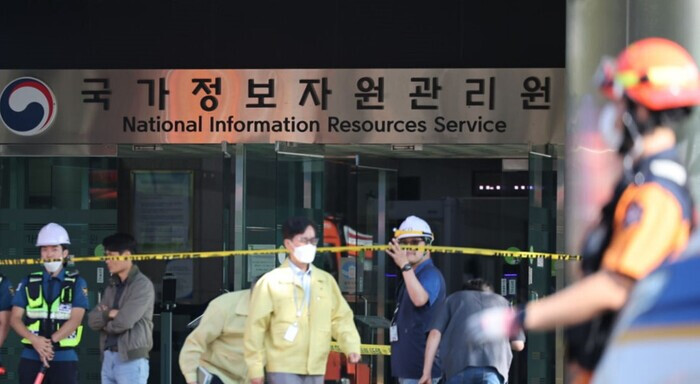
On September 26, around 8:15 PM, a fire at the Daejeon main branch of the National Information Resources Service (NIRS), which is the heart of the government's administrative network, caused an unprecedented paralysis of the entire administrative system of the Republic of Korea. The fire, which occurred during the replacement of lithium-ion batteries for an uninterruptible power supply (UPS), was extinguished after 22 hours. However, this incident halted a staggering 647 government services, including Government24, the National Secretary, and Internet Post Office, causing severe confusion and inconvenience to the daily lives of all citizens and disrupting economic activities such as finance and real estate transactions.
Repeated Disasters, a Calamity Fostered by Complacent Response
The direct cause of the fire was a lithium-ion battery, the same issue that led to the 'Kakao outage' incident three years ago when a fire at the SK C&C Pangyo Data Center stopped Kakao's services. At that time, the government imposed stringent 'redundancy obligations' on the private sector, such as building cloud servers. However, it was revealed that the critical national facility, NIRS, failed to implement adequate disaster preparedness 'redundancy measures,' such as setting up identical systems in physically separate locations.
The battery in the computer room at the time of the fire was an outdated one, past its 10-year warranty period. The accident occurred during an operation to move the batteries underground to mitigate fire vulnerability. This inescapable fact leads to criticism that the government's complacent response and negligence in management towards a foreseeable risk amplified this incident into a man-made disaster. The structural problem of servers and electrical facilities being located on the same floor, coupled with the mass paralysis of national administrative services due to a fire in just one computer room, clearly exposed a fundamental vulnerability in the national system—one that should not stop even in emergencies like war or earthquakes.
Presidential Directives: Urgent Need for Fundamental Complementary Measures
On the 28th, President Lee Jae-myung ordered "swift restoration and minimization of public inconvenience" while also calling for fundamental complementary measures, such as a 'dual operating system'. Although this is an expected action after such an incident, the fact that preemptive safety measures were not put in place within the government sector despite having learned a lesson from a previous large-scale disaster warrants holding the Ministry of the Interior and Safety accountable for its complacent administration.
In an era of accelerating digitalization of various data and information, the criticality of server management is growing daily. There is an urgent need to establish comprehensive and effective safety management measures, including not only simple fires but also the increasingly frequent server hacking incidents. This incident goes beyond merely restoring the network; it demands a paradigm shift in the national disaster response system and the management of critical infrastructure. Starting with a thorough investigation into the cause of the fire and the reasons for the lack of redundancy, and the severe reprimand of responsible parties, it is imperative to legislate strict redundancy and multi-redundancy obligations to ensure the national administrative network remains uninterrupted under any disaster scenario, and to fundamentally innovate the management system.
The NIRS fire incident, which caused administrative paralysis due to the complacency of 'it won't happen to us,' demands deep introspection and reflection on the system safety insensitivity that has persisted across successive governments.
[Copyright (c) Global Economic Times. All Rights Reserved.]