• 2026.11.13 (Fri)
  • All articles
  • LOGIN
  • JOIN
Global Economic Times
[등록] 2026-09-01 15:48:31
  • Synthesis
  • World
  • Business
  • Industry
  • ICT
  • Distribution Economy
  • Well+Being
    • Pet Life
    • Halal Horizon
  • Travel
  • Eco-News
  • Education
  • Korean Wave News
  • Opinion
  • Arts&Culture
  • Sports
  • People & Life
    • International Student Report
    • With Ambassador
  • Column
    • Cho Kijo Column
    • Cherry Garden Story
    • Ko Yong-chul Column
    • Kim Bong-seon's Photo Column
    • Kim Seul-Ong Column
    • Lee Yeon-sil Column
  • Photo News
  • New Book Guide
MENU
 
Home > World

Russia Suffers Massive Casualties in Ukraine War, with Losses Exceeding 450,000

Pedro Espinola Special Correspondent / Updated : 2026-11-13 19:11:55
  • -
  • +
  • Print


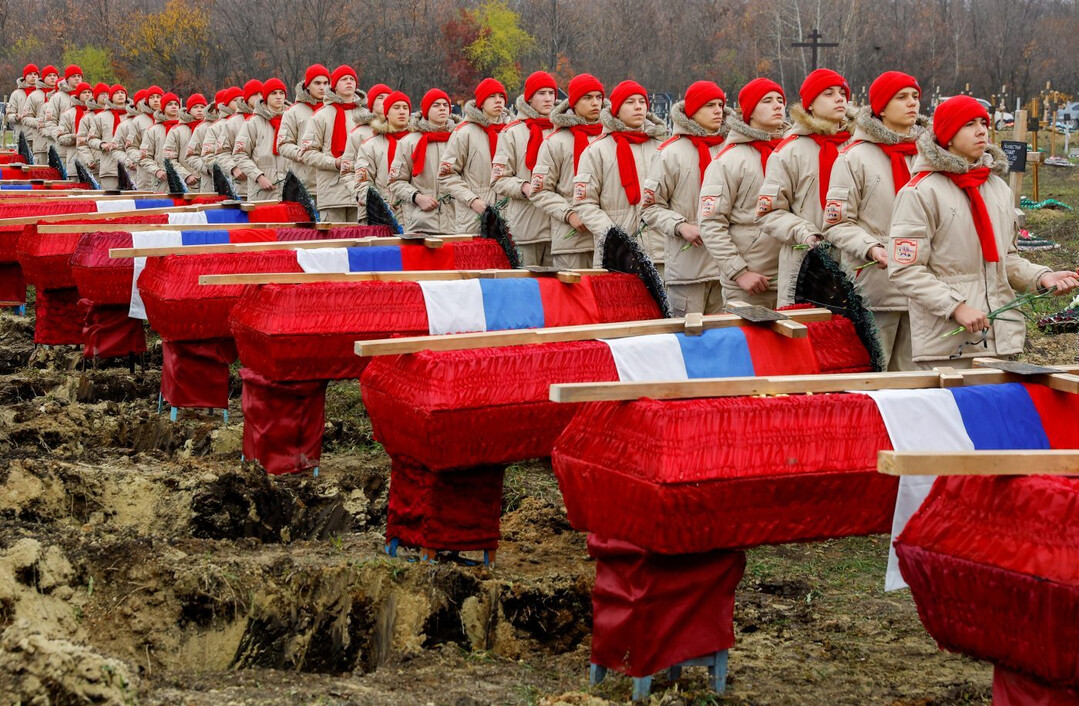
Russia has lost at least 450,000 lives since its full-scale invasion of Ukraine through this past summer, equating to roughly 1 out of every 300 residents in the country. Accounting for reporting delays, actual fatalities are estimated to be significantly higher.

According to the Financial Times (FT) on the 13th (local time), an analysis of leaked Russian Federal State Statistics Service (Rosstat) data obtained via a cyberattack indicates that at least 450,000 Russians have died due to the war as of this summer. This accounts for approximately 0.3% of Russia's total population of 143.39 million, as estimated by the United Nations.

The leaked data was made public by Belarusian and Ukrainian activist groups, "Cyberpartisans BY" and "Silent Crow." The records contain official data on 11.5 million deaths held by the Russian government as of August of this year.

Among these, approximately 410,000 individuals are directly classified as war-related deaths. While the majority are military personnel, some civilians may be included. The FT added roughly 12,000 suspected service members—such as military-aged men who died near the front lines—and 42,000 individuals whose deaths were confirmed through court proceedings due to unrecovered bodies.

Actual fatalities are expected to be even higher due to delayed death registrations. Documentation regarding casualties from the 2002 Mariupol siege, for instance, is reportedly still being filed this year.

Based on records already processed, the FT estimates that war-related deaths reached approximately 550,000 by early August, nearly all of whom were men. If the fatality rate observed since January continues through the end of the year, the death toll is projected to reach 650,000 by December.

Casualties have been heavily concentrated in specific frontline regions. About 120,000 individuals—one-third of those with recorded death locations—perished in the area encompassing Avdiivka and Pokrovsk. Another 48,000 died in the vicinity of Bakhmut. Battles surrounding just one of these cities resulted in greater casualties than the official death toll from the former Soviet Union's invasion of Afghanistan (1979–1989), which stood at approximately 15,000.

Jannis Kluge, a researcher at the German Institute for International and Security Affairs (SWP), asserted that such losses will make it difficult for Russia to sustain similar offensive operations going forward. He noted, "During the peak months of last year's offensive, tens of thousands died each month. The official recruitment target is 35,000 per month, but even this is consistently unmet. The recruitment pace is insufficient to absorb losses of this scale."

Kluge added, "Tracking families receiving death compensation through budget data shows that the casualty rate did not slow down even through October."

The average age of fallen soldiers is also rising. The average age of those who died last year was 40, six years older than the 34-year average recorded in the first year of the war. Soldiers aged 35 to 44 accounted for the largest group, with 158,000 deaths.

The data further revealed that casualties are disproportionately concentrated among ethnic minorities and impoverished regions. In the Zabaykalsky Krai, heavily populated by the ethnic Buryat minority, about 12,300 people died—translating to 1 out of every 80 residents.

Foreign casualties were recorded at 4,141 individuals. Many hailed from Central Asian nations such as Uzbekistan (807) and Tajikistan (598), while about 500 held Belarusian passports. Notably, no North Korean soldiers supporting Russia appeared on the roster.

[Copyright (c) Global Economic Times. All Rights Reserved.]
  • #Cherry Garden
  • #HalalFood
  • #Halal
  • #Petlife
  • #Halalhorizone
  • #Hormuz Impasse
  • #Joseon
  • #globaleconomictimes
  • #micore
Pedro Espinola Special Correspondent

Popular articles

  • Gold Trade Without US Dollars: China's New Channel for Yuan Internationalization

  • China’s First AI-Generated Film Bombs at the Box Office, Failing to Recover Even a Fraction of Its Budget

  • Asian Semiconductor Hubs Shaken as Taiwan’s TAIEX Slumps 9% Amid AI Sell-Off

I like it
Share
  • Facebook
  • X
  • Kakaotalk
  • LINE
  • BAND
  • NAVER
  • https://globaleconomictimes.kr/article/1065607859158007 Copy URL copied.
Comments >

Comments 0

Weekly Hot Issue

  • Papal Visit to Argentina Casts a Shadow Over Milei’s Economic Blueprint
  • U-23 Baseball Team Advances to Super Round After Defeating South Africa in World Championship
  • "We Discuss Weapons Over the Future of Generations": Global Leaders at COP31 Demand Urgent Climate Action
  • US Officials Urge Caution in Probe of Ex-Nvidia CEO’s Ex-Paramour Amid Espionage Claims
  • Seoul's Reusable Delivery Container Program Turns Four, but Consumers and Restaurants Allege Inconvenience
  • Global Emission Reduction Targets Spark Greenwashing Accusations

Most Viewed

1
South Korea and Ethiopia Sign Trilateral MOU to Introduce Liquid-Based Cytology (LBC) Technology for Cervical Cancer Diagnosis
2
US Army Conducts Rare Temporary Burial Drills to Prepare for Worst-Case Large-Scale War Scenarios
3
From Kim Whanki to Pokémon Cards... Seoul Auction Opens the Floodgates
4
Meeting Christmas Early!… Busan Dessert Sales Event "Daldal The Market" Held
5
World Citizens are Flying Directly to Busan... The Era of 4 Million Foreigners is Just Around the Corner
체리가든 스토리
nutri huevos
로타리
동포저널

Hot Issue

Collette Kress Steps In as Interim NVIDIA CEO Following Jensen Huang’s Departure

NVIDIA Chief Jensen Huang Steps Down After Three Decades at the Helm

Corporate Misconduct and Leadership Exits: A Retrospective on Tech and Retail Chief Executives

Fashion Runway Show 2026

Let’s recycle the old blankets in Jeju Island’s closet instead of incinerating them.

Global Economic Times
korocamia@naver.com
CEO : LEE YEON-SIL
Publisher : KO YONG-CHUL
Registration number : Seoul, A55681
Registration Date : 2024-10-24
Youth Protection Manager: KO YONG-CHUL
Singapore Headquarters
5A Woodlands Road #11-34 The Tennery. S'677728
Korean Branch
Phone : +82(0)10 4724 5264
#304, 6 Nonhyeon-ro 111-gil, Gangnam-gu, Seoul
Copyright © Global Economic Times All Rights Reserved
  • News K
  • 반달곰 프로젝트
  • 광고문의
Search
Category
  • All articles
  • Synthesis
  • World
  • Business
  • Industry
  • ICT
  • Distribution Economy
  • Well+Being 
    • 전체
    • Pet Life
    • Halal Horizon
  • Travel
  • Eco-News
  • Education
  • Korean Wave News
  • Opinion
  • Arts&Culture
  • Sports
  • People & Life 
    • 전체
    • International Student Report
    • With Ambassador
  • Column 
    • 전체
    • Cho Kijo Column
    • Cherry Garden Story
    • Ko Yong-chul Column
    • Kim Bong-seon's Photo Column
    • Kim Seul-Ong Column
    • Lee Yeon-sil Column
  • Photo News
  • New Book Guide
  • Overseas Koreans
  • Multicultural News