• 2026.11.13 (Fri)
  • All articles
  • LOGIN
  • JOIN
Global Economic Times
[등록] 2026-09-01 15:48:31
  • Synthesis
  • World
  • Business
  • Industry
  • ICT
  • Distribution Economy
  • Well+Being
    • Pet Life
    • Halal Horizon
  • Travel
  • Eco-News
  • Education
  • Korean Wave News
  • Opinion
  • Arts&Culture
  • Sports
  • People & Life
    • International Student Report
    • With Ambassador
  • Column
    • Cho Kijo Column
    • Cherry Garden Story
    • Ko Yong-chul Column
    • Kim Bong-seon's Photo Column
    • Kim Seul-Ong Column
    • Lee Yeon-sil Column
  • Photo News
  • New Book Guide
MENU
 
Home > Synthesis

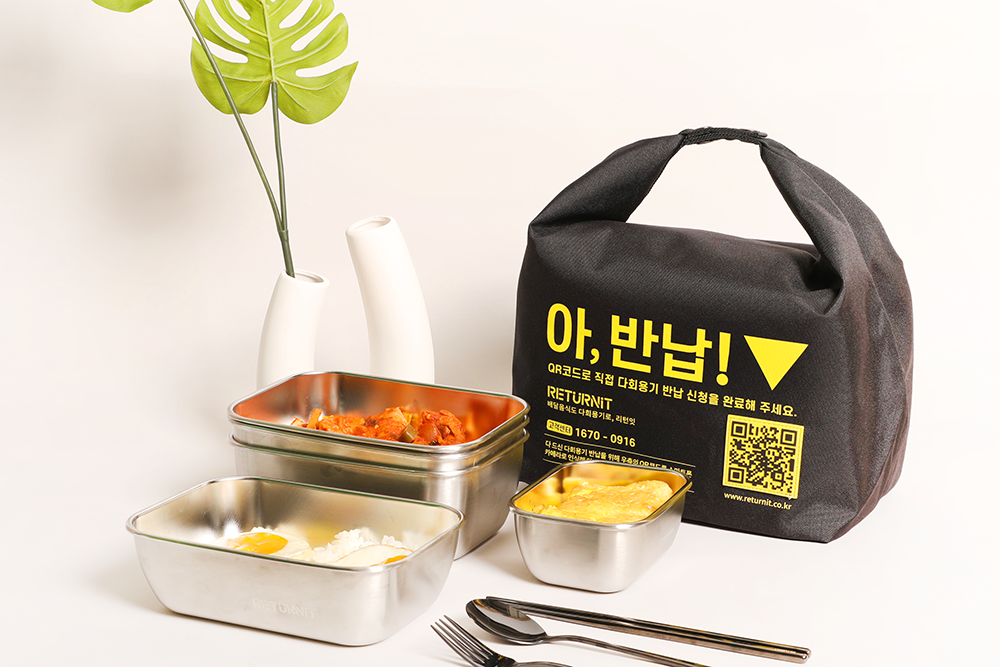
Seoul's Reusable Delivery Container Program Turns Four, but Consumers and Restaurants Allege Inconvenience

Kim Young Min Reporter / Updated : 2026-11-13 19:06:52
  • -
  • +
  • Print


"Where on earth is the return bin?"

Ordering food to a temporary delivery zone at Seoul's Yeouido Hangang Park made finding a return bin far from straightforward. After an eight-minute walk to delivery zone 3, the bin finally came into view. Only three of the park's four delivery zones feature return bins, and the temporary zone lacked any return signage, leaving visitors to wander in confusion.

The return process proved equally bewildering. Scanning the QR code on the delivery bag prompted a demand for a precise address. Because the park's delivery zones could not be registered as return locations, an arbitrary nearby address had to be entered to complete the request. The rationale behind requiring a separate address for an outdoor return remains unclear.

Ordering food in reusable containers presented its own hurdles. Finding a dedicated reusable container tab on some delivery apps proved difficult, and even after locating it, numerous restaurants lacked actual containers. When asked about reusable packaging, one salad shop simply replied, "We don't have any right now."

Even when an order successfully arrived in reusable containers, beverage and sauce containers frequently came in single-use plastic. While Seoul's official guidelines state that sauce-specific reusable containers are supplied, few actual eateries provide them with deliveries. The absence of suitably sized reusable containers for drinks and sauces drives this ongoing mixed usage.

Consumers are not the only ones facing frustration; restaurants tasked with providing the containers are also speaking out. The primary grievance centers on order verification. Checking whether an incoming order requires reusable containers during busy rush hours is exceptionally cumbersome. Storing the containers presents another logistical headache. One restaurant owner noted, "Because of the hassle of storing both single-use and reusable containers, we are considering canceling the service."

As ordering and returning remain inconvenient for consumers, and order checking and container storage remain burdensome for restaurants, the number of orders for Seoul's municipal reusable container delivery service is declining.

According to the Seoul Metropolitan Government, reusable delivery orders totaled 109,070 between January and September of this year. At the current pace, the year-end total is projected to reach roughly 134,500—a 22 percent drop compared to last year's 173,499 orders.

When asked about the reasons behind the declining order forecast and potential countermeasures, a Seoul city official emphasized the importance of publicity, explaining that plans are underway to inform citizens using banners and other promotional materials.

Yet, firsthand experience suggests that promotional efforts alone will not resolve these inconveniences. Strengthening publicity fails to solve restaurant container shortages or storage difficulties.

Consequently, critics argue that fulfilling the genuine intent of the reusable container initiative requires more than just service expansion and promotion; fundamental measures to alleviate the operational burdens and container supply issues faced by restaurants are urgently needed. Reducing the inconveniences and complaints of participating restaurants is seen as a prerequisite for making reusable ordering more convenient for consumers. As one consumer pointed out, "Achieving practical results rather than relying on showmanship requires building a universal circular system."

[Copyright (c) Global Economic Times. All Rights Reserved.]

  • #Cherry Garden
  • #HalalFood
  • #Halal
  • #Petlife
  • #Halalhorizone
  • #Hormuz Impasse
  • #Joseon
  • #globaleconomictimes
  • #micore
Kim Young Min Reporter

Popular articles

  • Hollys Suffers Personal Information Leak… "Please Change Your Membership Password Immediately"

  • Global Credit Spreads Widened to 17-Month High Amid AI Investment Concerns

  • Jeonbuk Special Self-Governing Province Hosts Integrated Animal Healthcare Industry and Pet Culture Exposition

I like it
Share
  • Facebook
  • X
  • Kakaotalk
  • LINE
  • BAND
  • NAVER
  • https://globaleconomictimes.kr/article/1065607526387520 Copy URL copied.
Comments >

Comments 0

Weekly Hot Issue

  • Papal Visit to Argentina Casts a Shadow Over Milei’s Economic Blueprint
  • U-23 Baseball Team Advances to Super Round After Defeating South Africa in World Championship
  • "We Discuss Weapons Over the Future of Generations": Global Leaders at COP31 Demand Urgent Climate Action
  • US Officials Urge Caution in Probe of Ex-Nvidia CEO’s Ex-Paramour Amid Espionage Claims
  • Russia Suffers Massive Casualties in Ukraine War, with Losses Exceeding 450,000
  • Global Emission Reduction Targets Spark Greenwashing Accusations

Most Viewed

1
South Korea and Ethiopia Sign Trilateral MOU to Introduce Liquid-Based Cytology (LBC) Technology for Cervical Cancer Diagnosis
2
US Army Conducts Rare Temporary Burial Drills to Prepare for Worst-Case Large-Scale War Scenarios
3
From Kim Whanki to Pokémon Cards... Seoul Auction Opens the Floodgates
4
Meeting Christmas Early!… Busan Dessert Sales Event "Daldal The Market" Held
5
World Citizens are Flying Directly to Busan... The Era of 4 Million Foreigners is Just Around the Corner
체리가든 스토리
nutri huevos
로타리
동포저널

Hot Issue

Collette Kress Steps In as Interim NVIDIA CEO Following Jensen Huang’s Departure

NVIDIA Chief Jensen Huang Steps Down After Three Decades at the Helm

Corporate Misconduct and Leadership Exits: A Retrospective on Tech and Retail Chief Executives

Fashion Runway Show 2026

Let’s recycle the old blankets in Jeju Island’s closet instead of incinerating them.

Global Economic Times
korocamia@naver.com
CEO : LEE YEON-SIL
Publisher : KO YONG-CHUL
Registration number : Seoul, A55681
Registration Date : 2024-10-24
Youth Protection Manager: KO YONG-CHUL
Singapore Headquarters
5A Woodlands Road #11-34 The Tennery. S'677728
Korean Branch
Phone : +82(0)10 4724 5264
#304, 6 Nonhyeon-ro 111-gil, Gangnam-gu, Seoul
Copyright © Global Economic Times All Rights Reserved
  • News K
  • 반달곰 프로젝트
  • 광고문의
Search
Category
  • All articles
  • Synthesis
  • World
  • Business
  • Industry
  • ICT
  • Distribution Economy
  • Well+Being 
    • 전체
    • Pet Life
    • Halal Horizon
  • Travel
  • Eco-News
  • Education
  • Korean Wave News
  • Opinion
  • Arts&Culture
  • Sports
  • People & Life 
    • 전체
    • International Student Report
    • With Ambassador
  • Column 
    • 전체
    • Cho Kijo Column
    • Cherry Garden Story
    • Ko Yong-chul Column
    • Kim Bong-seon's Photo Column
    • Kim Seul-Ong Column
    • Lee Yeon-sil Column
  • Photo News
  • New Book Guide
  • Overseas Koreans
  • Multicultural News