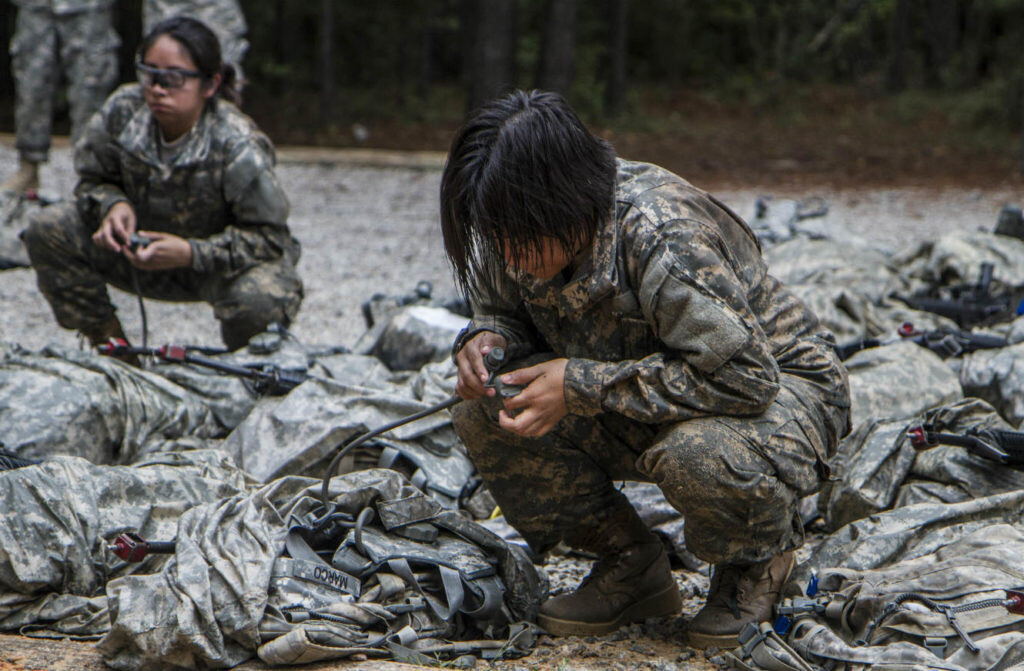
"There are quite a few female soldiers, but the military system is male-dominated, so it would be good to look at it from a gender-equality perspective." "As the population is declining, it seems necessary for the Ministry of Gender Equality and Family to prepare in advance for the issue of women's conscription."
On the 25th, 97 individuals in their 20s and 30s gathered at Yonsei University's Paichai Hall to discuss how to address the life problems experienced by men through gender-equality policies.
According to an on-site survey conducted among participants, 83.1% answered "yes" to the question "Do men also struggle because of their gender?", while 84.4% agreed with the item "Do you think the scope of gender-equality policies should be expanded to include men?"
The public debate focused on male-dominated military culture and reverse discrimination caused by military service, difficulties for men in using parental leave and mental health services, and job restrictions and task allocation due to gender concentration.
One participant shared a personal story, saying, "I told my boyfriend to get psychological counseling, but he refused," while another confessed, "I lost some of my hearing while serving in the military."
In addition, experiences directly and indirectly faced were shared, such as the problems faced by the minority gender in occupations biased toward one gender—like male nurses or hairdressers—and the inability to take parental leave due to income issues.
However, opinions were divided on whether gender-equality policies should encompass these issues.
For instance, after a participant who recently served as a company commander in the military stated, "Even though about 20% were female soldiers, systems for women were not well-developed," another participant countered, "Military service should be approached from the perspective of the treatment of all soldiers, regardless of gender."
A session where participants directly created and proposed gender-equality policies followed.
They proposed concrete alternatives, such as improving awareness among middle managers to revitalize male parental leave, introducing a gender-equality point system that grants benefits upon completing education, and establishing a support center for father-led single-parent families.
As the areas most in need of gender-equality policies, participants selected "strengthening data collection to identify policy blind spots" (16.7%), "easing barriers to men's use of caregiving systems" (13.5%), "improving blind spots in support for victims of violence" (12.9%), and "education on relationships and roles to reduce gender stereotypes" (12.9%).
Minister of Gender Equality and Family Won Min-kyung emphasized, "Addressing men's experiences through policy and improving women's structural inequality do not need to be positioned on opposite sides. What is important is not dividing the problems of men and women, but how to resolve the constraints caused by gender."
[Copyright (c) Global Economic Times. All Rights Reserved.]