![[등록] 2026-09-01 15:48:31](/support/_updata/banner2/tl181982910_6749.png)


TOKYO — A researcher at a conservative Japanese private think tank suggested on October 8 that North Korea may be conducting operational training for a compact nuclear reactor intended for a nuclear submarine at its primary nuclear facility, the Yongbyon Nuclear Research Center.
According to Kyodo News, Yuki Kobayashi, a principal researcher specializing in nuclear issues at the Sasakawa Peace Foundation, raised the possibility based on observations that the light-water reactor (LWR) at the Yongbyon facility has frequently alternated between operation and shutdown.
Kobayashi noted that a view is emerging among nuclear experts in Japan that these repeated cycles of starting and stopping the Yongbyon reactor could be operational training simulating the deployment of a nuclear submarine.
North Korea announced its plan to construct the Yongbyon light-water reactor in 2009, with an estimated output of 100,000 kilowatts. In December 2023, the International Atomic Energy Agency (IAEA) stated that there were indications the reactor had reached "criticality," where nuclear fission is stably sustained.
According to IAEA analysis, operations at the Yongbyon reactor were temporarily suspended from September to October 2024, in April and from August to November 2025, and from March to April 2026. While these stoppages could be attributed to issues during trial runs, the high frequency has fueled speculation that North Korea is training to operate a nuclear submarine reactor.
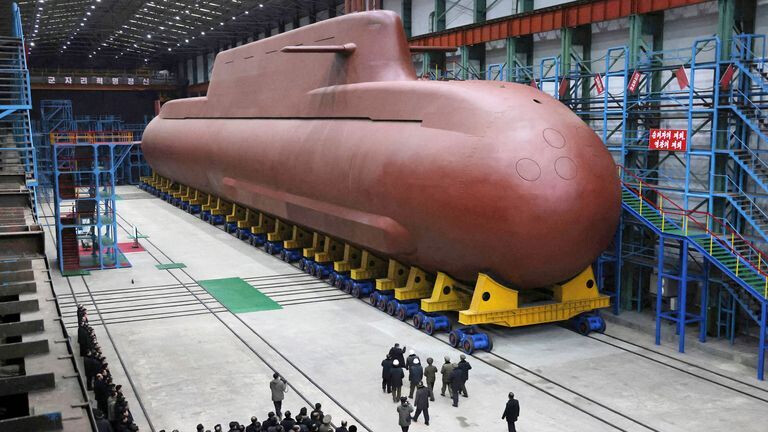
Regarding the nuclear-powered submarine that North Korea unveiled photos of while under construction last December, Kobayashi estimated that the reactor was likely not yet installed at that time.
During the 8th Workers' Party Congress in January 2021, North Korea outlined the acquisition of "nuclear-powered submarines and underwater-launched nuclear strategic weapons" as one of the five core defense development tasks. It subsequently released photos of an 8,700-ton class nuclear submarine under construction last December.
Kobayashi explained that operating a nuclear submarine reactor is technically demanding, as it requires frequent output adjustments depending on operational situations, unlike standard light-water reactor operations.
He further noted that Russia's cooperation is essential for North Korea to rapidly develop a nuclear submarine reactor and secure operational technology. Citing foreign media reports, he pointed to the possibility that a Russian cargo ship that sank off the coast of Spain in 2024 was en route to North Korea carrying parts for a nuclear submarine reactor. He noted that the output of the reactor model associated with those parts is 90,000 kilowatts, which is similar to the output of the Yongbyon light-water reactor.
[Copyright (c) Global Economic Times. All Rights Reserved.]