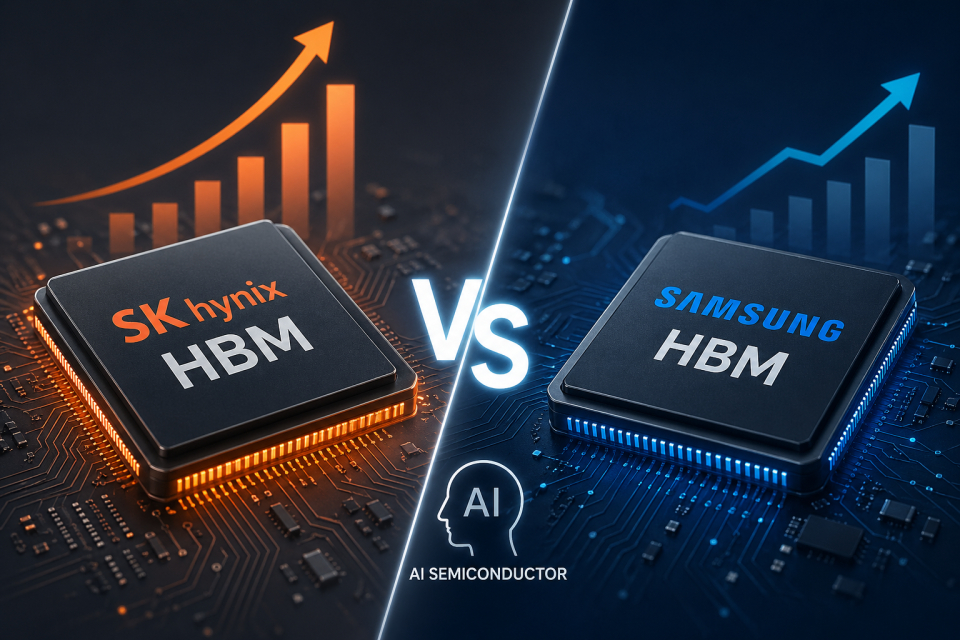
The competition surrounding memory semiconductors—the core infrastructure of the Artificial Intelligence (AI) era—is expanding beyond the performance enhancement of High Bandwidth Memory (HBM) into next-generation memory technologies.
This shift is driven by the rapid growth of AI models, the proliferation of inference and AI agent services, which have increased the demand not only for data processing speed, but also for power efficiency and data storage and management capabilities.
According to industry sources on the 24th, the two memory giants, Samsung Electronics and SK hynix, are strengthening their market strategies with technologies that elevate AI computing power by restructuring the combination of memory and processors, and improve data management efficiency through low-power memory modules.
Samsung Electronics is focusing on next-generation three-dimensional (3D) memory architectures designed to push past the performance and power efficiency limits by vertically stacking memory on top of AI processors. Representative examples are the next-generation technological concepts "zHBM" and "zNAND-O," which were recently unveiled at domestic and international semiconductor technology exhibitions.
"zHBM" is a structure that directly stacks HBM on top of AI accelerators to minimize the physical distance of data travel. According to Samsung, this structure resolves data bottlenecks and maximizes power efficiency, delivering up to 8x higher performance per Graphics Processing Unit (GPU) and up to 3x higher performance-per-watt compared to HBM5 (the 8th generation of HBM).
"zNAND-O" is a high-performance NAND flash solution optimized for on-device AI environments. By combining Through-Silicon Via (TSV) technology with existing V-NAND vertical stacking technology, it simultaneously resolves the capacity shortage of DRAM and the low bandwidth limitations of NAND, enabling the efficient processing of massive datasets.
Meanwhile, SK hynix has presented 3D stacked DRAM as a solution for next-generation memory. This approach involves stacking DRAM directly on top of computing semiconductors such as GPUs and Neural Processing Units (NPUs) to shorten the physical travel distance of data. By supplying data closer and faster to the computing unit during large-scale AI model inference, it enhances performance while reducing power consumption.
As a next-generation storage technology to address the surging demand for memory capacity, SK hynix is developing High Bandwidth NAND flash (HBF), which combines the fast data processing speed of HBM with the large storage capacity of NAND flash. SK hynix aims to secure an HBF bandwidth level that is about half of the same-generation HBM while expanding capacity by approximately 10 times, establishing a new memory tier between HBM and DRAM.
Low-power memory designed to boost energy efficiency is another key battleground for both companies. In the first half of this year, Samsung and SK hynix successively commenced mass production of SOCAMM2, server-oriented low-power memory modules based on LPDDR (Low Power DRAM). Furthermore, Samsung successfully verified the industry’s first 16GB LPDDR6—a next-generation mobile low-power DRAM—on Qualcomm’s "Snapdragon 8 Elite Extreme 6th Generation" platform last month.
Samsung and SK hynix are also competing in Compute Express Link (CXL)—a technology that swiftly connects AI accelerators with memory—and CMM-based technologies utilizing it. CXL is regarded as a crucial technology capable of resolving memory shortage issues by efficiently expanding AI server memory capacity.
"The core of AI memory competition is shifting from merely improving individual product performance to enhancing the overall architecture and operational efficiency of servers and systems," an industry insider noted. "The timing of commercialization and the actual cost-reduction effects of these next-generation memory technologies will be the decisive variables shaping the competitiveness of Samsung and SK hynix in future markets."
[Copyright (c) Global Economic Times. All Rights Reserved.]