![[등록] 2026-09-01 15:48:31](/support/_updata/banner2/tl181982910_6749.png)


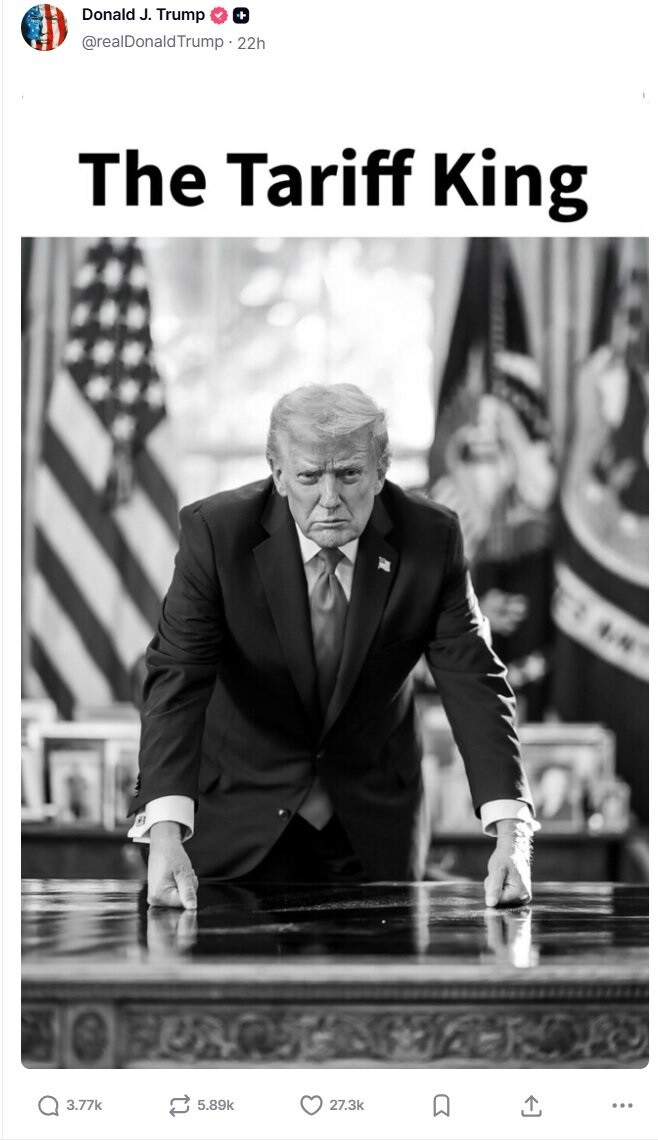
WASHINGTON D.C. – President Donald Trump has stirred public attention by posting images of himself labeled as “The Tariff King” and “Mister Tariff” on social media, just as the U.S. Supreme Court prepares to issue a landmark ruling on the legality of his reciprocal tariff policies.
On January 16 (local time), President Trump shared a series of black-and-white photos via Truth Social. The images depict the President sitting in what appears to be the Oval Office, staring sternly at the camera with his fists clenched on the desk. The bold captions “Mister Tariff” and “The Tariff King” were emblazoned across the top of the photographs. The White House’s official X (formerly Twitter) account also echoed this message by reposting the “Tariff King” image.
This provocative social media campaign comes at a critical legal juncture. Since taking office in January of last year, the Trump administration has aggressively implemented broad tariff measures, including the universal reciprocal tariffs announced last April. The administration cited the International Emergency Economic Powers Act (IEEPA) as the legal basis for these actions.
However, the policy has faced fierce legal challenges from importers who argue the move is an overreach of executive power. Both the first and second-instance courts have ruled against the administration, stating that the IEEPA does not grant the President the authority to impose such tariffs.
The case is now before the U.S. Supreme Court for a final decision. Despite a 6-3 conservative majority, the justices appeared skeptical of the government's arguments during oral arguments held last November.
Legal observers expected a ruling on January 14, but the Court has yet to deliver its final opinion. In response to the judicial pressure, President Trump has intensified his rhetoric, warning that a reversal of his tariff policies would spell "disaster" for the American economy, effectively launching a public relations offensive to influence the narrative surrounding the high-stakes case.
[Copyright (c) Global Economic Times. All Rights Reserved.]