As artificial intelligence rapidly reshapes the boundaries of daily existence, leading academic institutions are shifting their focus from pure technological advancement to the fundamental question of what it means to be human.
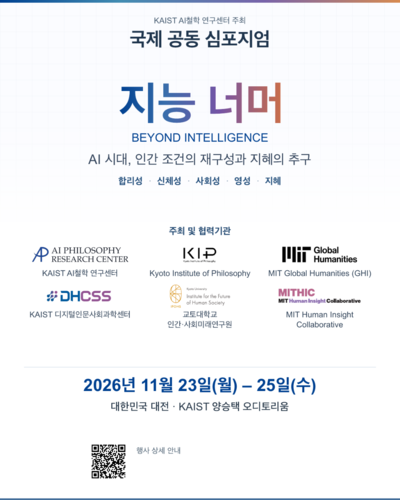
The Korea Advanced Institute of Science and Technology (KAIST) announced on November 13 that its AI Philosophy Research Center will co-host a major international symposium alongside scholars from the Massachusetts Institute of Technology (MIT) and Kyoto University. Entitled "Beyond Intelligence: Reconstructing the Human Condition and Pursuing Wisdom in the Age of AI," the three-day academic gathering will open on November 23 at the Yang Seung-taek Auditorium on KAIST's main campus in Daejeon.
Rather than concentrating strictly on algorithms and problem-solving metrics, the conference aims to establish a multidisciplinary dialogue spanning philosophy, science, and industry. Organizers hope to chart a course where technological progress remains firmly tethered to human ethics, core values, and the collective welfare of society.
"Technology must always serve humanity, not the other way around," said KAIST President Bae Choong-sik. He emphasized that the symposium will act as a vital melting pot where humanities and hard sciences unite to safeguard human dignity in an automated future.
The core agenda is structured around three foundational pillars of human existence: corporeality (embodiment), sociality, and spirituality.
Corporeality looks at physical existence and sensory experience as AI and robotics increasingly operate in the physical world.
Sociality tackles the changing dynamics of authority, collaboration, and ethical accountability between people and machines.
Spirituality dives into existential inquiries regarding life's purpose and how individuals can preserve a meaningful, autonomous existence as machine capabilities scale upward.
A prestigious lineup of global thinkers will take part in the event. International contributors include prominent researchers from MIT’s Global Humanities initiative, Tsinghua University, Hong Kong Baptist University, and Kyoto’s specialized philosophy institutes. They will be joined by top South Korean scholars representing diverse fields such as cultural anthropology, psychology, complex systems science, and philosophy.
"We have reached a point where daily decisions, interpersonal ties, and personal autonomy are directly influenced by algorithms," remarked Prof. Kim Dong-woo, head of the KAIST research center. "This symposium is designed to give us the cross-cultural insights necessary to ensure people stay in the driver's seat of their own lives."
[Copyright (c) Global Economic Times. All Rights Reserved.]