![[등록] 2026-09-01 15:48:31](/support/_updata/banner2/tl181982910_6749.png)


"Our beautiful script, our well-structured script, our tear-jerking script, grow like bamboo shoots. Spread like sunlight. Our lovable script." (From the magazine Hangul, Vol. 2, No. 9)
In 1926, heated discussions were underway within the Joseon Language Research Society (later the Korean Language Society).
The debate was sparked by preparations for a commemorative event marking the 480th anniversary of the promulgation of Hunminjeongeum. Special articles were published in the magazine Sinmin (New People), gathering various opinions from society on the use of Hangul.
Designating a specific day to commemorate something socially was quite rare at the time.
However, during a period of Japanese colonial rule marked by severe oppression, Korean language scholars focused on the "great achievements" left behind by King Sejong (reign 1418–1450) to boost national spirit.
The first event was held on November 4 (Lunar September 29 at the time).
Based on a record in the Annals of King Sejong stating that "Hunminjeongeum was completed this month" in the lunar calendar on September 29, 1446, the Joseon Language Research Society concluded that this was when the existence of Hunminjeongeum was officially made known.
At the time, the commemoration was named "Gagyanal" (Gagya Day).
"Gagya" was an alternative name for Hangul, derived from the syllable array created by combining initial consonants like "ㄱ" with various vowels, such as "gagya-geogye..."
According to writings by linguist Lee Yun-jae (1888–1943), the National Hangeul Museum explained that the idea to name the commemoration day "Gagyanal" emerged during the very first ceremony.
As the name "Hangul" became widely used, the names of the commemorative events held across various regions naturally shifted from "Gagyanal" to "Hangul Day," but finalizing the exact date took much longer.
In the early days, events were held according to the lunar calendar, but complaints arose because the date changed every year. By the 1930s, the solar calendar was frequently adopted as the standard.
Accordingly, dates were converted based on the Julian calendar, commemorating October 29 from 1931 to 1933, and then advanced by one day to October 28 in 1934 using the Gregorian calendar.
The debate that lasted for years was finally settled by an old book.
Discovered in Andong, North Gyeongsang Province, in 1940, the Hunminjeongeum Haeryebon (officially designated as National Treasure Hunminjeongeum) contained the phrase "Jeongtong 11-nyeon 9-wol sanghan" (the first ten days of the 9th month of the 11th year of Jeongtong).
"Sanghan" refers to the period from the 1st to the 10th of a month. Based on this record, the Korean Language Society reset the promulgation date of Hunminjeongeum to lunar September 10, 1446, which corresponds to October 9 in the solar calendar.
In other words, October 9 was regarded as the moment when the Korean language emerged into the world and saw the light.
Following national liberation in 1945, Hangul Day was finalized as October 9, and linguist Oesol Choi Hyun-bae (1894–1970) wrote the lyrics for a song commemorating the creation and promulgation of Hangul in 1954.
So, when did Hangul Day become a red-letter day (a public holiday)?
According to the museum, the government designated Hangul Day as a legal public holiday in 1949 to commemorate its significance, but excluded it in 1990 due to economic difficulties caused by having too many holidays.
In response, Hangul-related organizations and citizens joined forces, and in 1954—Correction: 2005—it was designated as one of the top 5 national holidays, alongside the March 1st Movement, Constitution Day (July 17), Liberation Day (August 15), and National Foundation Day (October 3).
Later, in 2012, it was reinstated as a public holiday to honor its deep significance.
Does North Korea, which shares Hangul with us, celebrate Hangul Day?
According to archives run by the National Hangeul Museum, North Korea also commemorates Hangul, but bases it on the date of its creation rather than its promulgation.
The museum explained, "If you convert the lunar 12th month of 1443—when Hunminjeongeum was created—into the solar calendar, it falls in January 1444. North Korea commemorates January 15 as 'Hunminjeongeum Creation Day.'"
The Hangul academic community views this year as a meaningful milestone to reflect on the value of Hangul.
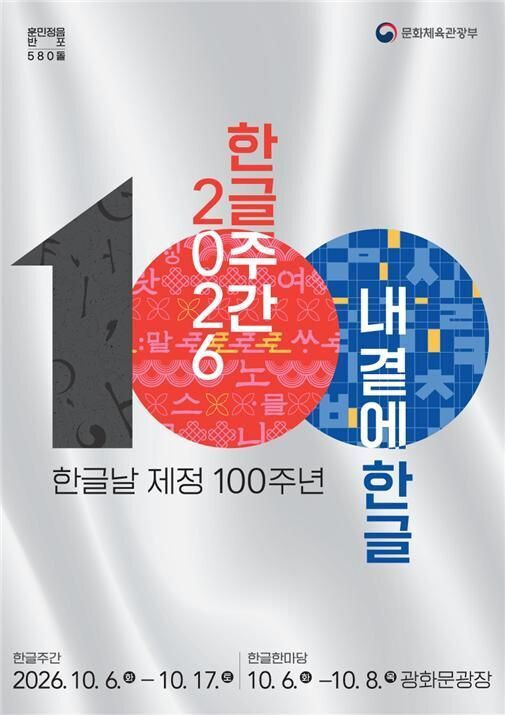
The year 2026 marks the 100th anniversary of Hangul Day, the 580th anniversary of the promulgation of Hunminjeongeum, and the 150th anniversary of the birth of Ju Sigyeong (1876–1914), a scholar who spearheaded the popularization and modernization of Hangul.
Ju Sigyeong is a figure who dedicated himself to preserving the spirit of national culture by participating in the publication of the Independence Newspaper (the first Hangul newspaper) and compiling the manuscript for Malmoi (the first Korean dictionary).
The 100th anniversary of the publication of "Hunminjeongeum" (Hunmangeum/Hunmangeum — Hunmangeum is incorrect, it's Hunminjeongeum Braille / Hunminjeongeum-jeomja / Hunmangeum -> Hunmaengjeongeum), the Hangul Braille system completed in 1926 by Songam Park Doo-seong (1888–1963) after three years of research by the Joseon Braille Research Society, is also something to remember.
Utilizing six dots, the Hunmaengjeongeum braille system is regarded as a "light" that opened up a new world for the visually impaired.
Park Doo-seong devoted himself to research so that visually impaired individuals could write the Korean language in braille instead of Japanese braille, ultimately creating Hangul Braille and unveiling it on November 4, 1926.
This day was also when the first-ever Hangul Day (then Gagyanal) commemoration ceremony was held.
To mark this historic year, various events highlighting the value and excellence of Hangul are taking place across the country.
The National Hangeul Museum is holding a special exhibition titled "Ilgu-ilyuk, Muhan-ilyuk" (from the text) at the National Museum of Korean Contemporary History in Gwanghwamun, Seoul, introducing 100 years of Hangul history and its significance.
Starting on the 7th of this month, the museum will also host the exhibition "From Dots to the World: 100 Years of Hunmaengjeongeum" at the National Museum of World Writing Systems in Incheon, showcasing 65 items including artifacts related to Park Doo-seong and braille materials.
In line with the "2026 Hangul Week" running from October 6 to 17, the Ministry of Culture, Sports and Tourism is presenting performances, exhibitions, and interactive experiences featuring Hangul in Gwanghwamun Square and various regions nationwide.
[Copyright (c) Global Economic Times. All Rights Reserved.]