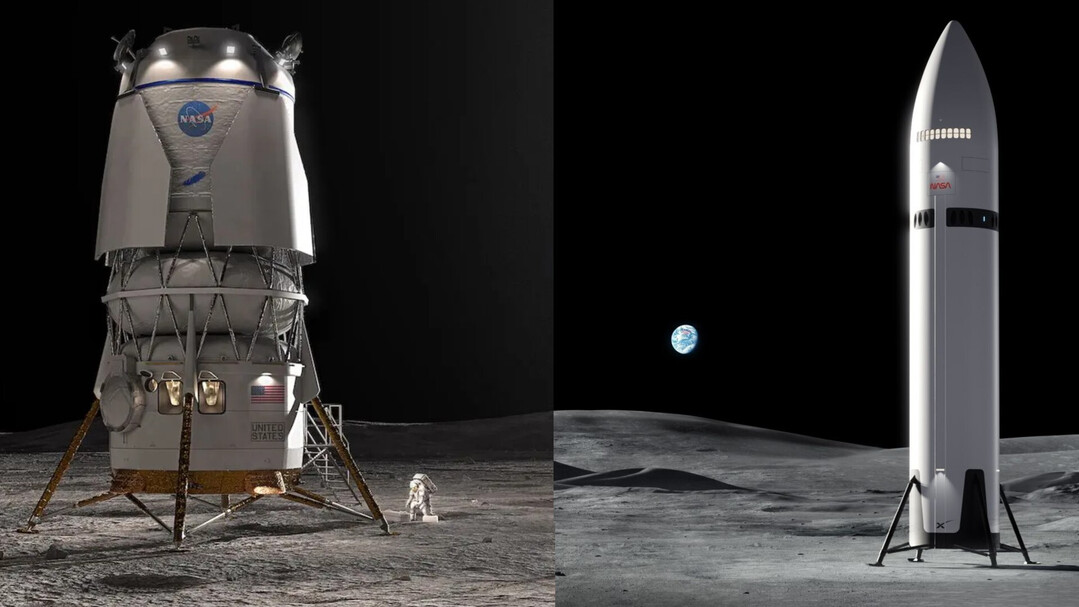
NASA announced on the 23rd (local time) that it will conduct an Artemis 3 test flight in 2027, launching three spacecraft for the first time in history to sequentially dock in low Earth orbit. This serves as a rehearsal for the crewed lunar landing of Artemis 4, which is targeted for 2028.
Artemis 3 will carry three NASA astronauts and one European Space Agency (ESA) astronaut. During the 14-day test flight, the astronauts will practice procedures essential for Artemis 4's landing at the lunar South Pole.
Jeremy Parsons, the Artemis program manager, stated, "This mission, conducted in Earth orbit, focuses on minimizing risks before sending astronauts back to the Moon."
The core of the Artemis 3 spaceflight is deploying three rockets and three spacecraft all at once—a method NASA has never attempted before. Both the rockets and spacecraft will be launched from Kennedy Space Center in Florida.
Blue Moon, Orion, and Starship Launched in Sequence
The first rocket to launch will be Blue Origin’s heavy-lift rocket, New Glenn. New Glenn will carry Blue Origin's lunar lander, Blue Moon, into space first. Next, NASA’s Space Launch System (SLS) rocket will lift the Orion spacecraft carrying the Artemis 3 crew into orbit. Finally, SpaceX’s next-generation mega-rocket, Starship, will be launched.
The success of this flight depends on precision docking and system verification in low Earth orbit. Because low Earth orbit presents more challenging thermal environment control than deep space, the Orion spacecraft will undergo thermal stability testing in low orbit after launch. Once this process is completed, on flight day 3, Orion and Blue Moon will attempt docking at an altitude of 440 km. Afterward, the astronauts will transfer to the Blue Moon lander to test life support systems and emergency response scenarios.
SpaceX’s Starship, launched on flight day 6, will attempt to dock with the Orion spacecraft at an altitude of 380 km on flight day 8. NASA stated, "The docking between Orion and Starship will be brief at two hours, and the astronauts will not board Starship." The docking with Starship focuses on acquiring core data and analysis materials necessary for future deep space exploration.
Even after undocking from Starship, the Artemis 3 astronauts will continue their mission in low Earth orbit for a few more days before returning to Earth. NASA noted that this process could extend the total mission duration to 17 days.
During the flight, the astronauts will also evaluate new spacesuits, undergo precision health checkups, and conduct scientific experiments to check all risk factors for the upcoming lunar South Pole landing.
Targeted for Next Summer, But May Be Delayed
NASA has not yet finalized whether to use the Blue Moon or Starship lander for Artemis 4. Initially, NASA contracted with SpaceX to use Starship as the Artemis 4 lander, but NASA holds the final choice.
During a press conference that day, NASA Administrator Jared Isaacman said, "Artemis 3 is intended to give both partner companies maximum preparation opportunities prior to the lunar landing."
Depending on which lander NASA selects, the flight method to the Moon will change. Blue Moon will dock with the Orion spacecraft in lunar orbit, while Starship will dock in Earth orbit.
The exact launch schedule for Artemis 3 remains uncertain. While NASA is targeting next summer, meeting that schedule may prove difficult. According to reports from the space media outlet Space.com, Administrator Isaacman revealed in an internal memo to employees last month that the Artemis 3 launch is delayed by approximately 90 days from the original schedule.
Parsons noted that one of the greatest challenges in human lunar landing missions is the supply of lunar landers. Starship recently conducted its first orbital flight, and New Glenn has not resumed launches following an explosion accident during a ground static fire test last May.
[Copyright (c) Global Economic Times. All Rights Reserved.]