

Internal friction within South Korea's ruling Democratic Party has flared into a full-scale factional dispute following a controversial statement by a senior party official regarding President Lee Jae-myung's past political positions.
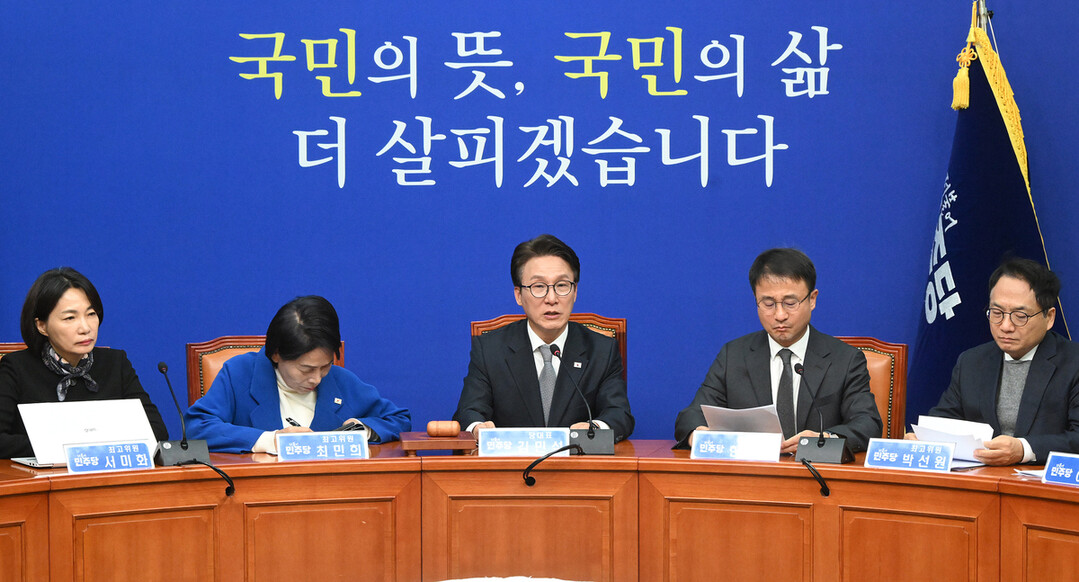
The controversy centers on comments made by Supreme Council Member Choi Min-hee during an October meeting, where she asserted that President Lee—then serving as the party leader—had opposed the impeachment of former President Yoon Suk-yeol. The remarks were reportedly used to challenge Lee’s current moderate political posture.
Party leader Kim Min-seok swiftly directed the party's ethics watchdog to investigate the remarks, viewing them as more than a simple oversight. However, the situation escalated when Choi, joined by fellow pro-Chung Chung-rae faction Supreme Council members Han Min-soo and Lee Sung-yoon, held a retaliatory press conference claiming that Party Leader Kim himself should be the subject of inspection. This fiery pushback threatens to shatter the fragile truce established during the August national convention, compounding recent pressures from ongoing controversies.
While some hardliners within the leadership have called for Choi's expulsion, political observers note that such extreme penalties require definitive proof of malice, which is difficult to establish through internal probes alone. Conversely, treating the incident merely as a lapse in memory risks undermining accountability, given the significant political influence wielded by a senior member of the party leadership. Analysts suggest a balanced disciplinary approach anchored by genuine self-reflection is necessary to contain the political fallout.
This internal power struggle comes at a vulnerable time for the ruling party, which has recently lagged behind the conservative opposition in automated response opinion polls. Senior party figures have issued urgent warnings against self-inflicted division, emphasizing that the party must redirect its focus toward stabilizing public livelihoods. These internal distractions arrive as external pressures mount, including global economic uncertainties and geopolitical shifts, leaving the public increasingly concerned over the ruling bloc's preoccupation with internal politics.
[Copyright (c) Global Economic Times. All Rights Reserved.]