

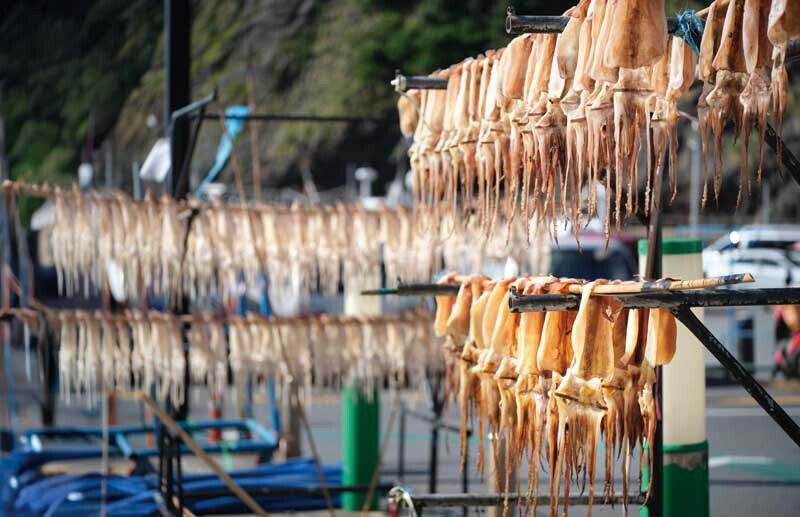
ULLEUNG — Once the bustling lifeblood of local fisheries, the squid harvest in South Korea’s Ulleung Island has experienced a staggering collapse. Official figures reveal that local catches dropped from 11,315 metric tons in 2000 to a mere 141 tons by 2025—a destructive 98.8% decrease over a quarter-century. With only 54 tons hauled in between January and September of this year, local authorities report that the downward spiral shows no signs of reversing.
Data released by the Ulleung County Office and the Ulleungdo-Dokdo Ocean Research Station illustrate a severe, long-term contraction. Annual yields steadily deteriorated from 1,852 tons in 2015 to 1,172 tons in 2020, before plummeting to the triple-digit lows seen recently.
Marine scientists point to rapid environmental shifts as the chief culprit, primarily ocean warming. Research by the National Institute of Fisheries Science indicates that water temperatures at a 50-meter depth in the southern East Sea climbed by 2 to 4 degrees Celsius in the 2010s compared to the 1990s, forcing cold-water-preferring squid away from traditional habitats.
Long-term forecasts suggest conditions will worsen. Meteorological projections anticipate that surface temperatures in the southern East Sea could rise by an additional 1.8 to 2.5 degrees Celsius by the end of the century.
Compounding the environmental stress, the warming waters have attracted natural predators like yellowtail into the region, intensifying the pressure on dwindling squid stocks. Meanwhile, heavy overfishing by foreign vessels, including unauthorized Chinese fishing fleets operating nearby, has further depleted the marine ecosystem.
The crisis has severely impacted local infrastructure, leaving only a handful of seafood processing firms operational on the island. Provincial lawmakers are urging immediate structural reforms. Regional leaders emphasize that Ulleung must pivot away from its historic reliance on squid by cultivating alternative commercial fish species and pioneering new, sustainable fisheries management frameworks to safeguard the island’s economic future.
[Copyright (c) Global Economic Times. All Rights Reserved.]