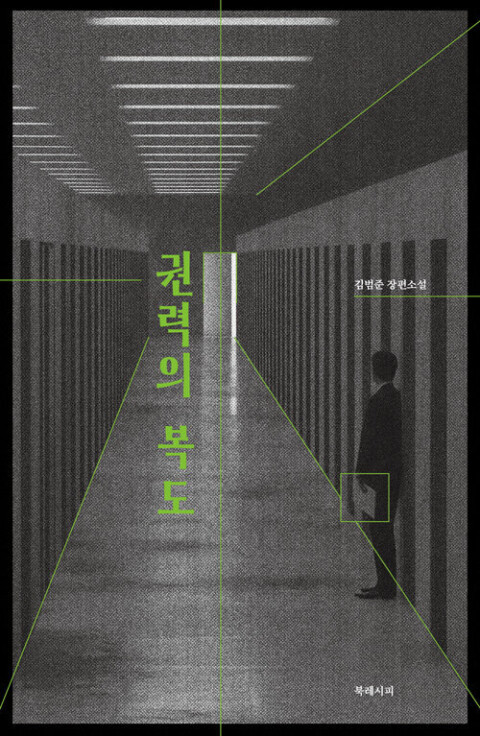
SEOUL — When discussions of politics fill the public square, attention usually gravitates toward the figures standing under the brightest lights: the presidents, party leaders, and lawmakers vying for supremacy. Yet, a compelling new novel shifts the lens entirely, offering a rare, insider’s perspective from the dimly lit hallways where decisions are actually executed.
In his debut novel, The Corridor of Power (published by Book Recipe), author Kim Beom-jun traces a 28-year journey through South Korea's modern political landscape. The narrative follows Kim In-baek, a fictional protagonist who enters the ruling party’s ranks through open recruitment in 1996. Over the next nearly three decades, his career weaves through the dizzying heights of factional power struggles, grueling election campaigns, intense nomination battles, presidential impeachments, and ultimately, the chilling reality of the December 3, 2024 martial law decree.
Beyond the Limelight: The Perspective of the Staffer
Unlike classic political dramas that focus on powerful whips or ambitious policymakers gunning for the top, The Corridor of Power examines the machinery of governance from the ground level. Protagonist Kim In-baek does not orchestrate history; rather, he prepares the paperwork, drafts the explanations, manages the fallout after a bruising election, and picks up the pieces the morning after.
Though featuring fictionalized characters whose backgrounds and traits closely mirror prominent figures in modern Korean political history—such as historical heavyweights reminiscent of Kim Dae-jung, Roh Moo-hyun, Lee Hoi-chang, and Lee Jun-seok—the book serves as a literary reflection rather than a factual exposé. As the publisher’s tagline succinctly puts it: "The characters are fiction, but the silence is fact."
A Rare Addition to the Inner-Circle Political Genre
Political insiders turning their firsthand experiences into fiction is a tradition with rich global precedents. C.P. Snow explored the Whitehall machinations of nuclear policy in Corridors of Power (1964), while Michael Dobbs drew on his days as a Conservative Party chief of staff in Thatcher-era Britain to write House of Cards (1989). Similarly, Joe Klein’s Primary Colors (1996) captured the raw, unvarnished reality of a U.S. presidential campaign through the eyes of a young staffer.
Yet, South Korean literature has rarely seen a sweeping political novel penned by an actual veteran of party headquarters and parliamentary offices. Kim Beom-jun brings profound authenticity to the page. Having spent nearly 30 years working within and around conservative political circles—serving as a party official, legislative aide, policy planner, and political researcher—he intimately understands the distinct atmosphere of a closed-door meeting, the private vernacular of politicians, and the delicate hierarchy of party loyalty.
Anatomy of Silence and Collective Responsibility
At its core, The Corridor of Power tackles a profound moral and organizational question: How do systemic pressures erode critical thinking?
The novel explores how dissent gradually vanishes within large political organizations. The author categorizes this institutional compliance into three distinct types of silence: "loyal silence," born out of personal allegiance; "habitual silence," where individuals gradually accept questionable directives to secure their place in the hierarchy; and "evasive silence," characterized by the deflection of responsibility under the excuse of "that's not my department."
Drawing on sociological concepts like Irving Janis’s "groupthink" and Albert Hirschman’s framework of exit, voice, and loyalty, the narrative illustrates how a career built on institutional loyalty can silently morph into complicity.
A Warning for Modern Democracy
Moving past the superficial gloss of election victories and policy triumphs, The Corridor of Power asks uncomfortable questions about accountability. It reminds readers that democracy is preserved not merely through formal constitutions and electoral rules, but through the courage of individuals within institutions to ask critical questions and bear personal responsibility for their choices.
As South Korea continues to reflect on the turbulent political milestones of its recent past, Kim’s novel offers a timely meditation on the unseen machinery of power—and the heavy price paid by those who choose to remain silent in the corridors where history is made.
Book Title: The Corridor of Power (Gwonryeok-ui Bokdo)
Author: Kim Beom-jun
Publisher: Book Recipe
Length: 328 pages
[Copyright (c) Global Economic Times. All Rights Reserved.]