![[등록] 2026-09-01 15:48:31](/support/_updata/banner2/tl181982910_6749.png)


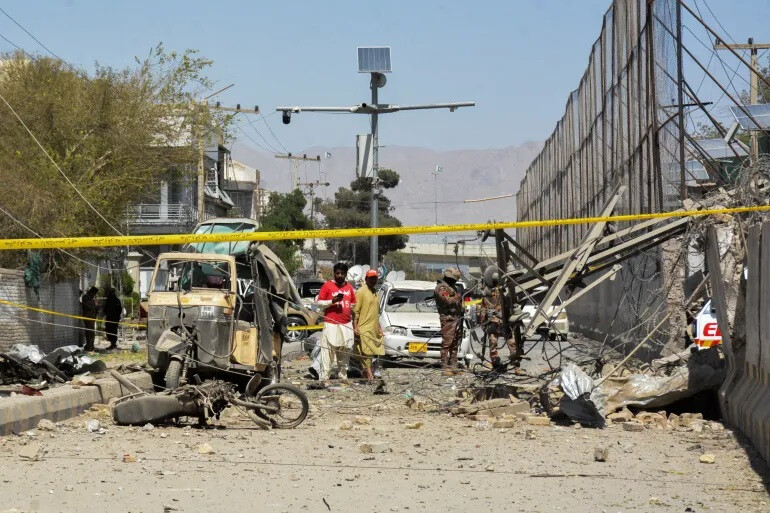
(C) Al Jazeera
Peshawar, Pakistan — A brazen suicide bombing and armed assault struck a paramilitary headquarters in Peshawar, the capital of Pakistan's northwestern Khyber Pakhtunkhwa province, on Sunday, resulting in the deaths of three security personnel and injuring 11 others. The attack, occurring in one of the city's busiest districts, has reignited serious concerns about the escalating cross-border militant threat and the fragile security dynamic between Pakistan and the Taliban-ruled Afghanistan.
Details of the Audacious Attack
The target of the attack was the heavily guarded headquarters of the Frontier Constabulary (FC), a key paramilitary force responsible for border security and maintaining law and order in the region bordering Afghanistan.
According to initial reports and high-ranking local officials, the coordinated assault began when one terrorist targeted the main gate of the FC headquarters. Subsequently, two other assailants managed to breach the compound. The attackers then opened fire before detonating explosive devices. FC personnel swiftly responded, engaging the militants, and ultimately managing to neutralize both assailants inside the complex.
Crucially, the attack occurred while approximately 150 Pakistani security personnel were conducting a parade drill in an outdoor courtyard within the base. Peshawar Police Chief Said Ahmad stated that the quick response by the forces prevented a far greater catastrophe, as the terrorists, who were on foot, were unable to reach the main parade ground.
The location of the attack, directly across from a major shopping mall in a highly commercial area of Peshawar, underscores the militants' intent to cause maximum casualties and generate significant public fear.
A Familiar Shadow: The Afghan Connection
While no group immediately claimed responsibility for the assault, state broadcaster PTV reported that the two terrorists killed were identified as Afghan nationals. This unconfirmed detail immediately focuses suspicion on the Tehrik-i-Taliban Pakistan (TTP), a prominent Sunni militant group often referred to as the Pakistani Taliban, and its relationship with the Afghan Taliban regime.
The TTP, which shares a similar ideology with the Afghan Taliban but operates as a separate entity, has long sought to overthrow the Pakistani government and establish an Islamic state based on their interpretation of Sharia law. They are known to maintain significant hideouts and operational bases in Afghanistan, using the porous border to launch attacks into Pakistan.
The Pakistani government has repeatedly accused the Afghan Taliban of tolerating and tacitly supporting TTP activities along the shared frontier, a charge the Afghan Taliban consistently denies.
Escalation in Cross-Border Violence
This latest incident is not an isolated event but part of a disturbing trend of escalating militant violence that has plagued Pakistan's northwest.
The attack comes just two weeks after a separate suicide bombing near a district court in the capital, Islamabad, on November 11, which left 12 people dead and 27 injured. Pakistani counter-terrorism police have since arrested seven individuals in connection with aiding that attack.
More critically, security tensions between Pakistan and Afghanistan reached a dangerous peak last month. On October 9, the Pakistani military launched an airstrike targeting TTP leadership inside Afghanistan's capital, Kabul. The Afghan Taliban responded with retaliatory fire, leading to armed clashes along the border that resulted in the deaths of over 70 people, including soldiers and civilians on both sides.
The TTP's resurgence in strength and capability since the Afghan Taliban took control of Kabul in August 2021 has become Pakistan's most significant internal security challenge. According to security analysts, the TTP now operates with greater impunity, leveraging sophisticated weapons and improved safe havens across the border.
Political Condemnation and Call for Justice
Pakistani leaders were quick to condemn the attack. President Asif Ali Zardari issued a strong statement denouncing the incident as a "despicable act by terrorists supported by foreign elements," implicitly pointing the finger at forces operating outside Pakistan's control.
Prime Minister Shehbaz Sharif vowed to foil the "evil designs of the terrorists attacking the unity of Pakistan." He emphasized the urgent need to identify the perpetrators and swiftly bring them to justice, underscoring the government's commitment to maintaining the nation's integrity.
The Geopolitical Quagmire
The persistent violence near the Durand Line—the 2,670-kilometer border between Afghanistan and Pakistan—exposes a deep-seated geopolitical challenge. Pakistan seeks to secure its border and eliminate the TTP threat, viewing the group's presence in Afghanistan as an existential risk. In contrast, the Afghan Taliban views border security through a domestic lens and has largely resisted taking decisive action against the TTP, a group it views as an ideological ally.
The pattern of attacks suggests a strategic effort by the militants to test the resolve of the Pakistani state and undermine public confidence in security forces. For Pakistan, the next steps will involve intensifying internal counter-terrorism operations while simultaneously applying diplomatic and security pressure on the Afghan regime to honor its commitment to prevent its soil from being used for cross-border attacks. The tragic events in Peshawar serve as a grim reminder that stability in one South Asian nation remains intrinsically linked to the complex, volatile politics of its neighbor.
[Copyright (c) Global Economic Times. All Rights Reserved.]