![[등록] 2026-09-01 15:48:31](/support/_updata/banner2/tl181982910_6749.png)



(C) Global Pricing Innovations
SEOUL, South Korea — South Korea has entered the global race for advanced medical artificial intelligence (AI) with the unveiling of a homegrown large language model (LLM) designed to assist clinical practitioners. On November 28, Naver, South Korea's leading internet technology firm, and Seoul National University Hospital (SNUH), the country's preeminent medical institution, jointly launched 'K-Med', positioning it as a direct challenger to models developed by giants like Google and Microsoft.
K-Med was developed using an extensive dataset of over 38 million records from SNUH, including outpatient, surgical, and prescription data. This massive, domestically sourced data pool provides K-Med with an unparalleled understanding of South Korean medical practices, terminologies, and regulatory frameworks—a critical advantage over foreign-developed models.
Outperforming Global Benchmarks
The performance of K-Med has already impressed experts. In a benchmark test based on the Korean Medical Licensing Examination (KMLE), K-Med achieved a score of 96.4 points. This score surpassed several leading global AI models:
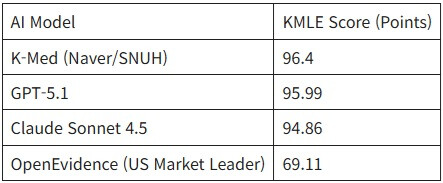
The significant underperformance of OpenEvidence, the current market leader in U.S. medical AI, underscores K-Med's strength: its deep integration of local clinical guidelines, domestic medical terminology, and Korean healthcare laws.
Easing '3-Minute Appointments' and Administrative Overload
A key expectation is that K-Med will help alleviate the notorious problem of 'three-minute appointments' (3분 진료), a persistent issue in high-volume university hospitals where administrative burdens severely limit the time physicians can spend with patients.
SNUH, for example, generates over 3.21 million clinical documents annually, utilizing more than 3,000 different medical record forms. K-Med is designed to act as a diagnostic assistant, streamlining the process of clinical documentation, prescription guidance, and administrative tasks—effectively taking on the role of a highly efficient resident or intern.
When a physician queries the model—for instance, "How should I treat a patient who forgot to administer their Wegovy dose?"—K-Med provides evidence-based responses, citing relevant clinical documents and guidelines. By automating this vast administrative workload, the AI is expected to free up medical professionals to focus more time and attention on direct patient care, significantly improving service quality.
Market Potential and Future Plans
The global medical AI market is experiencing explosive growth, making K-Med a cornerstone of Naver's new growth strategy. According to Precedence Research, the global medical AI market is projected to skyrocket from $38 billion last year to a staggering $891 billion within the next decade. Furthermore, a McKinsey Global Institute report estimates that the introduction of generative AI could generate up to $120 billion (approximately 160 trillion Korean won) in economic value annually within the healthcare sector.
The K-Med project is the culmination of a collaborative effort launched in February 2024, following Naver's commitment to invest 30 billion Korean won over three years to support digital bio research at SNUH.
Looking ahead, Naver and SNUH plan to leverage K-Med to release specialized AI agents for different clinical departments in the first half of next year. These agents will be continually updated to reflect the latest information on pharmaceuticals, domestic medical laws, new clinical guidelines, and frequently changing national health insurance (Yoyanggeupyeo) standards, ensuring that the tool remains a dynamic and indispensable resource in the evolving clinical setting. K-Med not only signifies a technological breakthrough but also marks South Korea's strong ambition to secure a leading position in the rapidly expanding global healthcare AI landscape.
[Copyright (c) Global Economic Times. All Rights Reserved.]