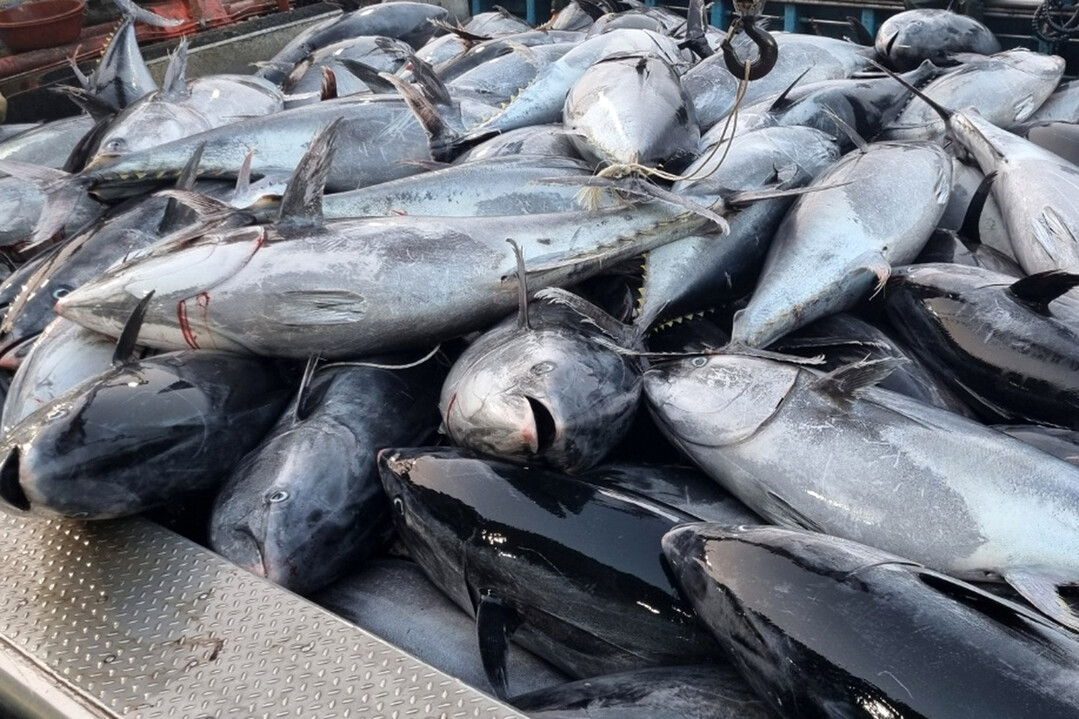
South Korea and Japan have clashed head-on in an international meeting regarding Pacific bluefin tuna, considered a top-tier tuna. As the population of bluefin tuna—once driven to the brink of extinction by overfishing—has recovered, a decision was made to increase catch limits starting next year. However, the two countries are locked in a fierce dispute over how the increased catch should be distributed. Japan insists on a flat 25% increase based on existing catch quotas, while South Korea demands the correction of a historically unbalanced allocation structure.
According to the Asahi Shimbun and other sources on the 11th, South Korea, Japan, and Taiwan discussed quota allocation plans for Pacific bluefin tuna applicable from 2027 during an online meeting of the Northern Committee of the Western and Central Pacific Fisheries Commission (WCPFC). This followed an agreement in August to increase the overall catch quota for large Pacific bluefin tuna (30kg or heavier) across the Western and Central Pacific by 25%. However, negotiations broke down without an agreement due to differing stances between South Korea and Japan.
Japan argues that countries with historically high catch volumes should continue to receive larger shares, whereas South Korea asserts that the newly increased volume should be distributed fairly, separate from past catch records.
Currently, Japan's quota for large bluefin tuna stands at approximately 8,400 tons, and Taiwan's at 2,947 tons, while South Korea's is a mere 500 tons—making Japan's quota about 17 times larger than South Korea's. If quotas were increased by 25% across the board as Japan proposes, Japan would secure an additional 2,100 tons, whereas South Korea's share would increase by a mere 125 tons.
Consequently, South Korea proposed that half of the increase be distributed according to existing quota ratios, and the remaining half be divided equally among South Korea, Japan, and Taiwan. Under this formula, South Korea's quota would increase by 111% to 1,057 tons. Japan’s would grow by 18% to 10,526 tons, and Taiwan’s by 29% to 3,684 tons.
The roots of the conflict date back some 20 years. Pacific bluefin tuna populations plummeted from the 1960s onward due to overfishing. In response, the international community tightened fishing regulations starting in 2015, using past catch records as the basis for national quotas. In particular, average catch volumes between 2002 and 2004 served as a critical benchmark. Japan, which had been catching large quantities since that period, secured a large share, whereas South Korea, with relatively low historical catch records, was assigned a small quota.
The problem is that marine conditions have changed. Amid recent shifts in water temperatures and marine environments, the appearance and catch of bluefin tuna have also increased in South Korea's coastal waters. Spawning grounds for bluefin tuna have even been discovered in the East Sea. Nevertheless, due to internationally fixed quotas, local fishermen cannot catch tuna without restriction, even when they get caught in nets. The South Korean government has argued that allocation methods based on decades-old catch records fail to properly reflect the changed fishing ground environment.
Japan is the world's largest consumer market for bluefin tuna (known as hon-maguro in Japanese), with high demand in the premium sushi and sashimi sectors. Citing the recovery of bluefin tuna resources, Japan has spearheaded public opinion by continuously demanding quota expansions at international meetings. It maintains that it cannot compromise in order to secure as much of the increased quota as possible to protect the interests of its domestic fishermen.
This clash was foreseeable. At an international meeting held in Nagasaki, Japan last July, South Korea proposed that the increase in large bluefin tuna quotas be divided equally into thirds among South Korea, Japan, and Taiwan. At the time, the entire agreement collapsed due to overlapping complications regarding quota allocations between the Western and Central Pacific and the Eastern Pacific.
During the November meeting, South Korea stepped back slightly to offer a compromise in which only half of the increase is distributed equally, but Japan rejected it. The tug-of-war between the two countries over bluefin tuna catch quotas is expected to continue ahead of the WCPFC Annual Meeting scheduled to be held in Vanuatu from November 30 to December 5. An agreement must be reached by then for the increased catch quotas to apply for the 2007–2028 (Note: 2027–2028) period.
[Copyright (c) Global Economic Times. All Rights Reserved.]