• 2026.06.05 (Fri)
  • All articles
  • LOGIN
  • JOIN
Global Economic Times
fashionrunwayshow2026
  • Synthesis
  • World
  • Business
  • Industry
  • ICT
  • Distribution Economy
  • Well+Being
  • Travel
  • Eco-News
  • Education
  • Korean Wave News
  • Opinion
  • Arts&Culture
  • Sports
  • People & Life
    • International Student Report
    • With Ambassador
  • Column
    • Cho Kijo Column
    • Cherry Garden Story
    • Ko Yong-chul Column
    • Kim Seul-Ong Column
    • Lee Yeon-sil Column
  • Photo News
  • New Book Guide
MENU
 
Home > New Book Guide

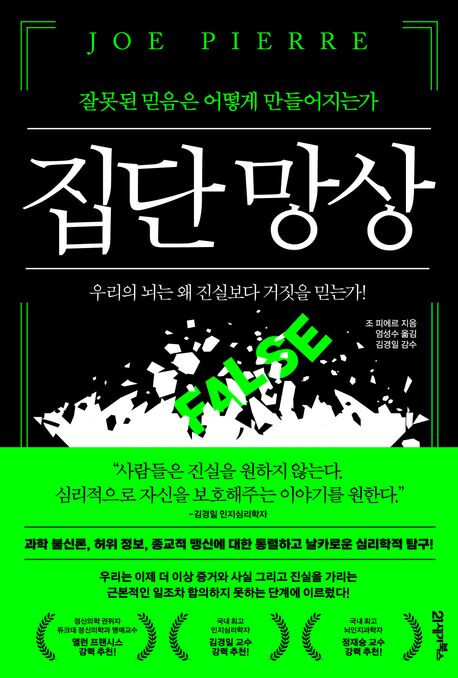
The Spreading Delusion: How to Break Free from Collective Misbelief

KO YONG-CHUL Reporter / Updated : 2025-11-24 10:29:19
  • -
  • +
  • Print


In an increasingly interconnected world, a phenomenon described as "collective delusion" or "delusional-like beliefs" is spreading throughout society. This trend sees growing numbers of individuals accepting misinformation and conspiracy theories as truth, a subject explored in depth by psychiatrist and University of California, San Francisco (UCSF) professor Dr. Joe Pierre in his book, Collective Delusion.

Pierre’s work highlights a critical distinction between clinical delusion—like that experienced by Frank Dunbar, who believes government satellites are intentionally aiming "energy beams" at him, causing physical pain—and these widespread misbeliefs. He introduces the category of "delusional-like beliefs" through cases such as Cecily Perkins, a small-town store manager who spends hours watching satellite conspiracy videos. While not personally experiencing the effects, Perkins is driven by anxiety and acts upon this information, petitioning officials to "stop infringing on civil liberties." Her belief is not rooted in subjective, internal experience (like Frank's pain) but in information consumed online.

The book argues that the propensity for such misbeliefs is not limited to fringe groups but is a fundamental human vulnerability. Cognitive bias, the ingrained "fast thinking" we rely on to make quick decisions, helps us navigate the world but can simultaneously lead to distorted conclusions and the adoption of false beliefs when sufficient information is not reviewed.

What has changed recently is the scaling of this cognitive vulnerability into a societal crisis, fueled by structural factors. Dr. Pierre points to the Internet as the biggest accelerant. In the past, individuals with unusual or non-mainstream beliefs would struggle to find like-minded peers locally and often faced ridicule. Today, the internet makes it effortless to find communities that share even the most marginal convictions, effectively normalizing them and rendering the term "fringe" meaningless.

The Prescription: Empathy Over Isolation 

If collective delusion is the illness, what is the treatment? Dr. Pierre, approaching the problem from a clinical perspective, offers behavioral solutions centered on real-world interaction and experience.

He cites the example of Ken Stern, a progressive former NPR CEO. Stern embarked on a cross-country journey, attending evangelical churches, hunting wild hogs in Texas, and participating in conservative Tea Party meetings. The experience led him to conclude, in his book My Father's Tribe, that Americans are not as ideologically divided as they seem. He discovered "far more common ground and consensus" than expected, eventually retracting his Democratic support and declaring himself an independent.

Another compelling case is that of author John Howard Griffin, who, in 1959, medically darkened his skin to travel through the segregated American South as a Black man. His book, Black Like Me, recorded the direct experience of racial discrimination, bringing him as close as possible to the reality faced by Black Americans.

Dr. Pierre's core prescription is that genuine understanding requires one to "walk a long distance in another person's shoes." In an era dominated by online social interaction, direct, physical encounters and shared experiences are essential to understanding those on the opposite ideological spectrum. This practice serves as a critical antidote, mitigating emotional polarization and pulling society back from the brink of extreme conflict fueled by misinformation. The book powerfully asserts that in-person experience is the necessary countermeasure to the digital isolation that breeds collective misbelief.

[Copyright (c) Global Economic Times. All Rights Reserved.]

  • #globaleconomictimes
  • #micorea
  • #mykorea
  • #Lifeplaza
  • #nammidonganews
  • #singaporenewsk
  • #Samsung
  • #Daewoo
  • #Hyosung
  • #A
KO YONG-CHUL Reporter
Reporter Page

Popular articles

  • BMW Korea Ignites May with Exclusive 9-Model Online Limited Edition Lineup

  • U.S. Intelligence: Iran’s Nuclear Capabilities Remain Intact Despite Two Months of Strikes

  • Kakao Hits Record Q1 Performance: Operating Profit Surges 66% as Focus Shifts to "Agentic AI"

I like it
Share
  • Facebook
  • X
  • Kakaotalk
  • LINE
  • BAND
  • NAVER
  • https://globaleconomictimes.kr/article/1065576526045090 Copy URL copied.
Comments >

Comments 0

Weekly Hot Issue

  • South Korea Emerges as Global AI Powerhouse, Ranking 3rd in Clarivate’s Inaugural 'AI50' Report
  • Star Historian Choi Tae-sung and 2NE1’s Sandara Park Appointed as Honorary Ambassadors for the Overseas Koreans Agency (OKA)
  • SKT Partners with NVIDIA to Bring Digital Twin Technology to SK Hynix Semiconductor Fabs 
  • South Korea’s Top Five Automakers Suffer Broad May Sales Decline Amid Weakening Domestic Demand and Global Headwinds
  • Chinese Humanoid Robotics Pioneer Unitree Clears Shanghai IPO Hurdle to Raise $580 Million
  • Hyundai Motor Bets on ‘The New Grandeur’ to Jumpstart Sluggish Domestic Sales

Most Viewed

1
From a moment of collective sacrifice to a moment of collective democracy: The Timing of the Election in Ethiopia and Korea
2
U.S. Holds Off on Immediate Comprehensive Semiconductor Tariffs, but Pressure Mounts for Samsung and SK Hynix to Accelerate Domestic Investments
3
[Interview] "Halal is Not a Religious Regulation, but a 'Trust Infrastructure'… Creating a Premium 'K-Halal' Centered on Data and Platforms"
4
‘600 Million Won Bonus’ at Samsung Electronics Triggers Deep Sense of Relative Deprivation Among Korean Workers
5
Musk’s SpaceX Secures Space Hegemony with Flawless Starship V3 Recovery Ahead of Historic IPO
광고문의
임시1
임시3
임시2

Hot Issue

South Korea Emerges as Global AI Powerhouse, Ranking 3rd in Clarivate’s Inaugural 'AI50' Report

Overcoming the Fragility of Robot Firms is Prerequisite to the Flourishing of Physical AI

South Korea’s Top Five Automakers Suffer Broad May Sales Decline Amid Weakening Domestic Demand and Global Headwinds

SKT Partners with NVIDIA to Bring Digital Twin Technology to SK Hynix Semiconductor Fabs 

Fashion Runway Show 2026

Global Economic Times
korocamia@naver.com
CEO : LEE YEON-SIL
Publisher : KO YONG-CHUL
Registration number : Seoul, A55681
Registration Date : 2024-10-24
Youth Protection Manager: KO YONG-CHUL
Singapore Headquarters
5A Woodlands Road #11-34 The Tennery. S'677728
Korean Branch
Phone : +82(0)10 4724 5264
#304, 6 Nonhyeon-ro 111-gil, Gangnam-gu, Seoul
Copyright © Global Economic Times All Rights Reserved
  • 에이펙2025
  • APEC2025가이드북TV
  • 반달곰 프로젝트
Search
Category
  • All articles
  • Synthesis
  • World
  • Business
  • Industry
  • ICT
  • Distribution Economy
  • Well+Being
  • Travel
  • Eco-News
  • Education
  • Korean Wave News
  • Opinion
  • Arts&Culture
  • Sports
  • People & Life 
    • 전체
    • International Student Report
    • With Ambassador
  • Column 
    • 전체
    • Cho Kijo Column
    • Cherry Garden Story
    • Ko Yong-chul Column
    • Kim Seul-Ong Column
    • Lee Yeon-sil Column
  • Photo News
  • New Book Guide
  • Multicultural News
  • Jobs & Workers