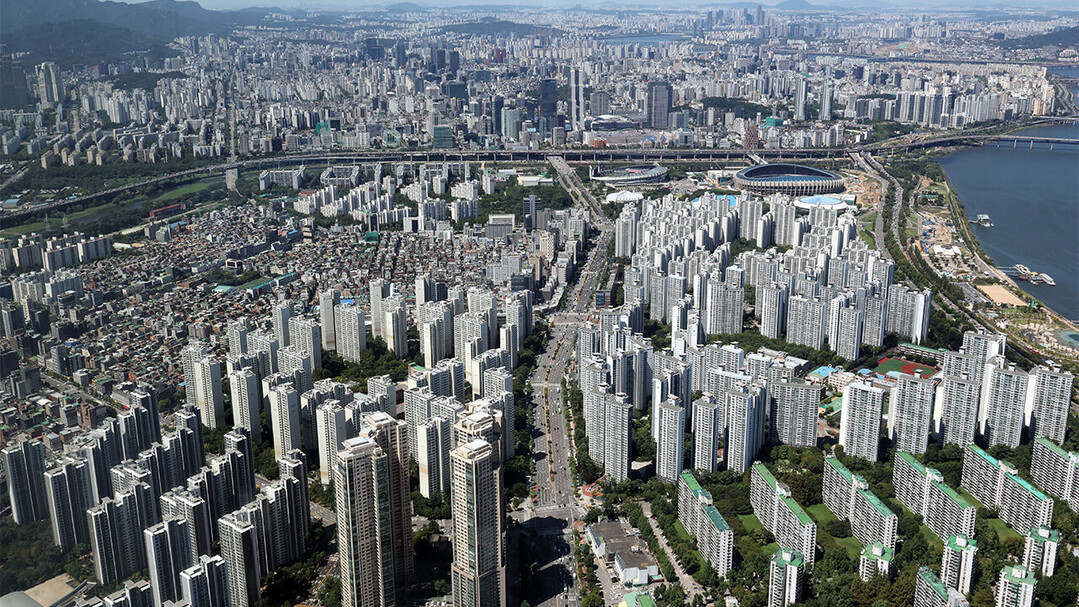
The long-awaited imposition of the Reconstruction Excess Profit Restitution (REPR) charge is poised to kick off within the year, sending massive shockwaves through the real estate market.
This comes as Seocho-gu announced plans to levy the charge on "Banpo Hyundai"—the very first complex subject to the REPR in the Gangnam district—before the end of the year. While reconstruction cooperatives are threatening legal action in response, the market is facing severe turmoil, including the emergence of "dual pricing" in newly settled complexes.
"Dual Pricing" and Soaring Uncertainty
In Banpo Raemian Trinione in Seocho-gu, which began welcoming residents last August, price gaps for the exact same housing type have widened to over 1.8 billion won.
Beyond standard differences in floor height, view, or urgent sales listings, prices have diverged heavily based on who will bear the burden of the REPR charge. For instance, in the 84㎡ exclusive area, a 35th-floor unit is listed at 5.7 billion won, while a 32th-floor unit is listed at 5.15 billion won. The crucial difference lies in the REPR responsibility: the 5.7 billion won unit includes the charge to be paid by the seller, whereas the 5.15 billion won unit lists the REPR charge separately, to be borne by the buyer.
Initially, Seocho-gu notified the complex in 2020 at the management disposal stage that the estimated REPR charge would average 402 million won per household. However, due to subsequent hikes in general sales prices and soaring nearby property values, current projections suggest the actual charge could skyrocket to around 700 million won per household.
While market prices for the 84㎡ units range from 4.5 billion won up to a staggering 6.3 billion won depending on urgent sales and REPR conditions, local real estate agents note that transactions remain frozen due to uncertainty over when and how heavily the charges will strike.
"Although the REPR law remained on the books, enforcement has been suspended or deferred for years, leaving very few union members believing they would actually have to pay," a local realtor in Banpo-dong explained. "If the charges are actually levied, market chaos will be immense."
Nationwide Crackdown and Legal Friction
Across the nation, over 60 complexes are estimated to be subject to REPR charges, with Seoul alone accounting for 46 complexes and 18,000 households.
Although a March 2024 amendment pushed the calculation benchmark back to the cooperative establishment approval stage and mandated local government heads to calculate and notify unions within five months of completion, no complex has actually paid the charge yet.
While former legislative moves by the ruling party and the previous administration's push to abolish the tax caused discussions to stall, the current administration has seen those abolition talks fade, paving the way for full-scale enforcement. Seocho-gu’s push to target Banpo Hyundai (now Banpo Centrevill Asterium) within the year is expected to trigger similar enforcement across other local governments.
Having moved in on July 30, 2021, Banpo Hyundai has surpassed five years since its completion. Seocho-gu justifies its year-end rush by citing provisions in Article 18 of the REPR Act, which follows the "Restitution of Development Gains Act." The latter sets a five-year statute of limitations from the exercisable date for collecting development charges and refunding overpayments. Consequently, calculating the completion date and the five-month assessment window, the district aims to levy the charge before the year is out.
However, the Ministry of Land, Infrastructure and Transport interprets the law differently, arguing that because the law was amended in March 2024, authorities have a five-year grace period until 2029 to levy the charge.
Unresolved Inequities and Threat of Lawsuits
Reconstruction complexes nationwide are fiercely pushing back against the assessment mechanism, warning of immediate provisional injunctions and administrative lawsuits the moment charges are formally issued.
Cooperatives point out several fundamental flaws in the REPR law:
Punitive Unrealized Gains: It acts as a punitive tax on unrealized gains, functioning as a "luck of the draw" penalty dependent on market values at the time of entry.
Flawed Baseline Calculations: Complexes like Banpo Hyundai argue that applying the Korea Real Estate Board's housing price index—which has faced statistical manipulation controversies—results in an inflated calculation of excess profits.
Equity and Developer Disparities: While massive development projects like Seongsu, Hannam, and Noryangjin face no such redevelopment charges, reconstruction projects—which already shoulder heavy public contributions like land donations—are hit unfairly. Furthermore, structural issues persist regarding fairness between original cooperative members (who enter at different times) and general buyers.
In Daejeon, for instance, the Dunsan The Shop Eliff complex (Yongmun District 1, 2, and 3), which completed moving in last February via a single-home reconstruction model rather than redevelopment, anticipates REPR charges ranging from 100 million to 200 million won per household.
[Copyright (c) Global Economic Times. All Rights Reserved.]