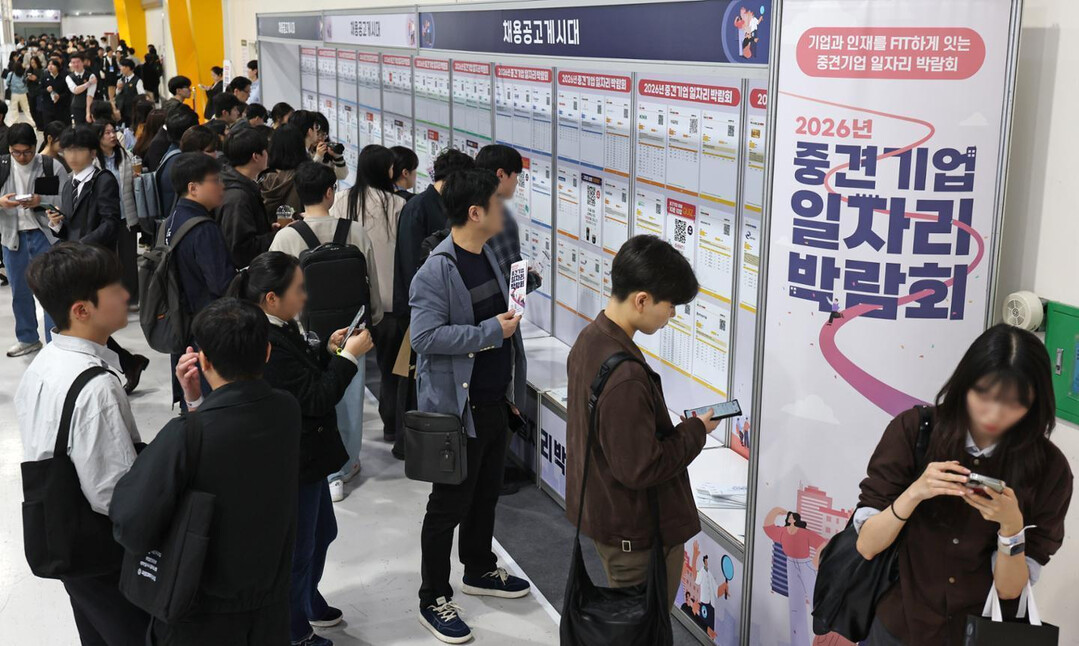
Nearly half of all young wage earners in South Korea are now employed as non-regular workers, marking the highest proportion since data collection began.
According to the Supplementary Results of the Economically Active Population Survey released by the National Data Agency on the 15th, non-regular workers accounted for 46.0% (1.48 million) of the 3.22 million youth wage earners (aged 15–29) as of last August. This is the highest level recorded since 2003.
The proportion of young non-regular workers has jumped by 14.2 percentage points (p) over the past 23 years, rising from 31.8% in August 2003. Over the same period, the non-regular worker ratio for all age groups increased by 5.9 percentage points from 32.6% to 38.5%, meaning the growth rate for young adults is more than double the national average.
Sharp Decline in Full-Time Youth Jobs
The soaring rate of non-regular employment is largely driven by a sharp contraction in stable, full-time positions for young people. Full-time jobs for youth plummeted 38.1% from 2.81 million in August 2003 to 1.74 million this August—a loss of over 1.07 million positions.
Total youth wage earners fell by 901,000 (21.8%) from 4.12 million to 3.22 million over the same period, indicating that full-time positions disappeared at a much faster rate than overall employment. In contrast, the number of non-regular youth workers increased by 172,000, rising from 1.31 million to 1.48 million.
The downward trend persists in the short term. Over the past year alone, youth wage earners decreased by 166,000, driven by a drop of 103,000 in full-time positions (from 1.84 million to 1.74 million). Meanwhile, non-regular jobs declined by a smaller margin of 63,000 (from 1.55 million to 1.48 million), pushing the non-regular ratio up from 45.6% to 46.0%.
By age bracket, 43.8% of wage earners in their 20s were non-regular workers, a 14.2 percentage-point increase from August 2003 (29.6%). Consequently, the proportion of full-time workers in their 20s fell from 70.4% two decades ago to 56.2%. Among teenagers aged 15–19, roughly 9 out of 10 wage earners were non-regular workers.
In contrast, other age groups saw declines in their non-regular ratios over the same period: down from 26.3% to 24.1% for those in their 30s, 31.2% to 24.2% for those in their 40s, and 40.0% to 32.9% for those in their 50s. While workers aged 60 and older saw an increase from 65.8% to 70.3%, the magnitude of their rise was about one-third of that seen among youth.
Over a Quarter of Young Workers Stuck in Part-Time "Alba" Jobs
As full-time positions vanished, part-time jobs moved in to fill the gap. The number of youth part-time workers nearly tripled, jumping from 302,000 in August 2003 to 884,000 this August.
The share of part-time work among young wage earners surged from 7.3% to 27.4%, meaning more than one in four young employees works in short-hour, part-time roles (commonly known as alba). This concentration is significantly higher than the overall economy-wide part-time ratio, which rose from 6.5% to 19.5% over the same period.
The barrier to entry for career starters reflects a similar reality. According to a May youth survey, 25.8% of young graduates reported that their very first job was part-time, up 1.5 percentage points from the previous year. Furthermore, 32.0% started their careers in jobs with contracts lasting one year or less, marking a 1.1 percentage-point increase.
Longer Job Preparation and Shifting Corporate Hiring Trends
The shrinking availability of quality full-time jobs is extending the time youth spend preparing for employment. Among college graduates with a history of taking a semester off, 30.5% cited "job hunting and certification exam preparation" as their reason (multiple responses allowed)—a 2.9 percentage-point increase from a year earlier and the highest figure since related tracking began in 2007 (14.7%).
Regarding their first jobs after graduation, the hospitality and food services sector accounted for the largest share at 15.9%, followed by wholesale and retail (12.4%), and health and social welfare services (12.1%). Meanwhile, manufacturing dropped to 12.0%, down 1.1 percentage points from the previous year. In May 2013, manufacturing had commanded the largest share at 16.9%.
Corporate hiring trends have also placed a heavy burden on job seekers. A 2026 survey of 500 companies with 100 or more employees, conducted by the Korea Enterprises Federation, revealed that 67.6% of respondent firms consider "job-related work experience" the most important factor in new recruitment. Experts note that companies' growing preference for experienced hires and rolling recruitment models continue to weigh heavily on youth employment numbers.
[Copyright (c) Global Economic Times. All Rights Reserved.]