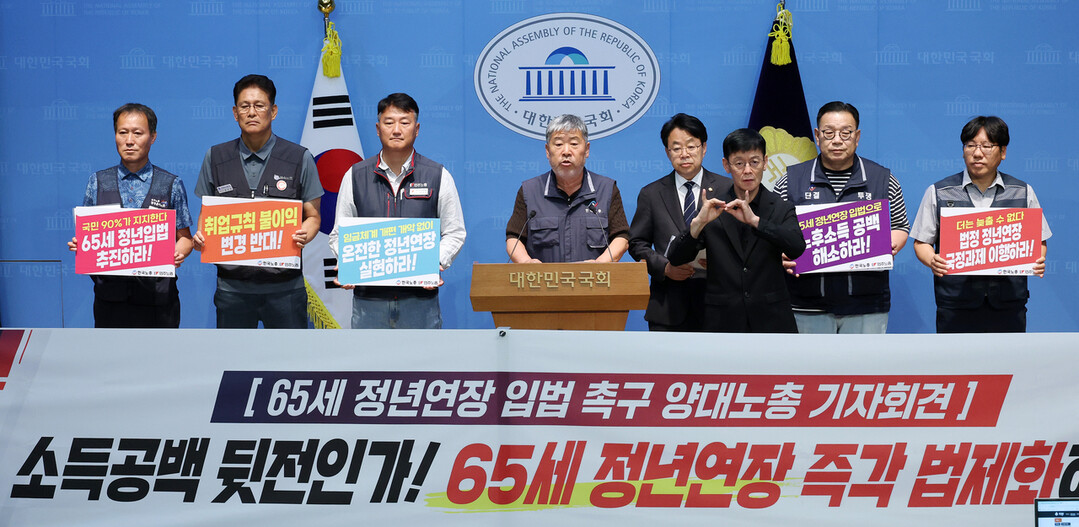
SEOUL — South Korea’s ruling Democratic Party is accelerating legislative efforts to gradually raise the statutory retirement age from 60 to 65 by 2037, moving forward without a consensus between labor unions and business groups.
Following months of stalled negotiations, the party’s special committee on retirement age extension plans to conclude its sessions early next month and introduce a compromise bill before the end of the year. The Ministry of Employment and Labor will participate in upcoming parliamentary reviews to fine-tune the legislation rather than submitting a separate government proposal.
A Dual-Track Roadmap to 2037
The proposed legislation blends a phased extension of the legal retirement age with a mandatory post-retirement re-employment system:
Statutory Retirement Age: Set to increase from 60 to 61 in 2029, rising by one year every two years to reach 65 in 2037.
Mandatory Re-employment: Designed to protect workers retiring during the transition, this mandate will begin at age 61 in 2028 and gradually expand to age 65 by 2035.
To cushion the financial impact on employers, lawmakers are also considering a temporary legal exemption. Under this clause, companies would be permitted to revise employment rules—including wage structures—specifically for the extended employment period without obtaining the majority consent of labor unions or workers, which is strictly required under current labor laws.
Bridging the Pension Gap vs. Economic Strain
The primary driver behind the reform is a looming demographic and financial mismatch. While the mandatory retirement age remains 60, the eligibility age for South Korea’s National Pension is scheduled to rise to 64 in 2028 and 65 in 2033. Without policy intervention, citizens born in or after 1969 face up to five years without steady income before receiving pension benefits, heightening the risk of elderly poverty.
Despite agreeing on the necessity of keeping older workers in the workforce, labor and management remain sharply divided on execution:
Business Concerns: Employers warn that extending retirement under South Korea’s traditional seniority-based pay system will trigger unsustainable payroll spikes. The Korea Enterprises Federation estimates that a blanket extension to age 65 would cost businesses an additional 30.2 trillion won ($22 billion) annually, potentially forcing companies to scale back entry-level hiring for younger generations.
Labor Pushback: Unions oppose a re-employment-heavy model, arguing it would downgrade senior employees to precarious, one-year contracts with steep pay cuts, undermining the goal of securing retirement income.
Navigating Labor Market Polarization
Economists also warn that the policy could deepen South Korea’s dual labor market. Because job security up to the statutory retirement age is largely confined to regular employees at major conglomerates and public institutions, workers at smaller firms or in non-regular positions may see little benefit.
"Unlike Japan, where wage gaps between regular and non-regular workers are narrower and over 70 percent of firms smoothly utilize re-employment, South Korea has severe disparities depending on company size and unionization," noted Jung Heung-jun, a professor of business administration at Seoul National University of Science and Technology. While calling the gradual extension unavoidable, Jung urged the government to provide clear guidelines on wage restructuring and job reassignment to prevent generational job competition.
Park Ji-soon, a professor at Korea University Law School, echoed the need for structural flexibility. "Extending retirement under a 'same position, same pay' framework will entrench high cost structures and severely obstruct youth employment," Park said. "While job stability should be guaranteed until pension eligibility without relying on one-year contracts, companies must be granted broad flexibility to redesign roles and wage systems based on a reasonable minimum pay floor."
[Copyright (c) Global Economic Times. All Rights Reserved.]