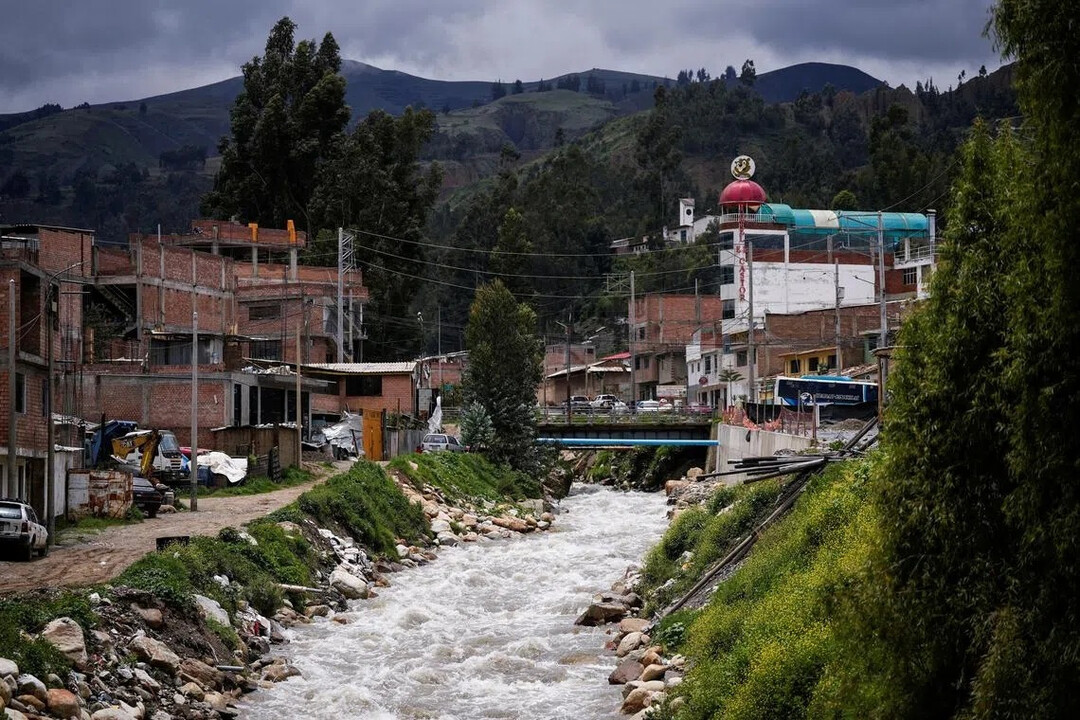
For Saul Luciano Lliuya, the terrifying reality of climate change hit home in the pre-dawn hours of April 28 of last year.
At around 3:30 a.m., an avalanche of weakened bedrock collapsed from Mount Valunaraju (5,686 meters) in Peru’s Andean mountain range. Massive boulders crashed into a glacial lake, triggering a violent overflow that sent a torrent of mud and rocks tearing down the Cascara River valley. The resulting debris flow slammed into the city of Huaraz, destroying dozens of homes and tragically killing a 10-month-old infant and their 24-year-old mother while they slept.
For Lliuya, a 45-year-old farmer and mountain guide born and raised in Huaraz, the disaster was a living nightmare. Visiting Seoul ahead of the 31st UN Climate Change Conference (COP31) in Antalya, Turkey, Lliuya shared his anxieties with reporters.
"Ever since the disaster last year, residents have lived with the constant fear that it could happen again," Lliuya said. "And seeing the catastrophic floods in Nepal this past August only amplified that terror." The late-August disaster near the Nepal-China border, which claimed thousands of lives, bore an eerie resemblance to the tragedy at Mount Valunaraju.
A 'Ticking Time Bomb' in the Andes
Known as the "Heart of the Andes," Huaraz is celebrated for its breathtaking snow-capped peaks and glacial lakes. However, rising global temperatures are melting these glaciers, drastically elevating the risk of catastrophic dam bursts.
High above the city at 4,562 meters lies Lake Palcacocha, an emerald glacial body frequently dubbed a "ticking time bomb." In 1941, a massive outburst flood from the lake submerged one-third of Huaraz. Today, the lake holds over 17 million cubic meters of water—enough to fill Seoul’s Yeouido district to a depth of six meters.
This looming threat drove Lliuya to embark on a grueling, decade-long legal battle in German courts. In 2015, he sued German energy giant RWE, arguing that the corporation should bear a fraction of the flood-mitigation costs proportional to its historical greenhouse gas emissions.
Although the Hamm Higher Regional Court dismissed his appeal in May of last year—ruling that the probability of Lliuya’s home facing flood damage over the next 30 years was only about 1%—the case still marked a groundbreaking legal milestone by establishing that major emitters can indeed be held legally accountable for climate-related civil damages.
Farmers United Across Continents
Despite the court's low-risk assessment, Lliuya’s fears remain entirely valid. Surrounding the Huascarán National Park near Huaraz are over 500 glacial lakes. While early warning systems were installed following his lawsuit, reports suggest proper maintenance is lacking.
Climate change is also altering the daily rhythm of Lliuya's life. Pests have infested traditional storage spaces beneath his roof called qolqa. "Thirty years ago, potatoes could be kept for a year and corn for three years," he noted. "Now, they get infested with bugs in just two or three months." Pastures are shrinking, and securing drinking and agricultural water has become increasingly difficult.
During his visit to Seoul, arranged by the climate solutions group Solutions for Our Climate, Lliuya met with South Korean farmers facing their own climate hardships, including apple farmer Ma Yong-woon and rice farmer Hwang Sung-yeol. Last August, South Korean farmers filed a lawsuit against state utility Korea Electric Power Corporation (KEPCO) and five of its generation subsidiaries, demanding compensation for severe crop damage fueled by climate disruptions.
Though oceans apart and growing entirely different crops, the farmers found immediate common ground.
"When your livelihood is threatened through no fault of your own, you begin to question your own abilities and how you're going to survive," Lliuya said. Sending a message of solidarity to South Korean farmers, he emphasized, "The food farmers grow sustains the people. I hope those responsible realize the profound damage they are leaving behind for the rest of us."
[Copyright (c) Global Economic Times. All Rights Reserved.]