SEOUL — The missile rivalry on the Korean Peninsula is entering a new phase as both South and North Korea push the range of their frontline tactical ballistic missiles to the 300-kilometer mark, each tailoring its warhead technology to exploit the other’s tactical vulnerabilities.
While Seoul is doubling down on deep-penetration capabilities to neutralize hardened underground artillery sites, Pyongyang is focusing on wide-area denial weapons, including cluster munitions and scatterable landmines, designed to stall allied troop movements.
South Korea’s Push for Mobile, Deep-Strike Precision
South Korea’s Defense Acquisition Program Administration (DAPA) and the Agency for Defense Development (ADD) are accelerating upgrades to the Korea Tactical Surface-to-Surface Missile (KTSSM) family. Originally fielded as a 160-kilometer fixed-launch system dubbed "Ure" (Thunder) to destroy North Korean long-range artillery hidden in mountain tunnels, the KTSSM is undergoing a major transformation in both range and mobility.
Under a 319.6 billion KRW ($230 million) program running through 2028, Seoul is developing the mobile KTSSM-II series alongside the upgraded KTSSM-I Block II. The upcoming Block II variants will stretch the missile's operational reach to roughly 300 kilometers—a distance sufficient to strike key military installations across most of North Korea, reaching as far as the Yalu River estuary from the western front.
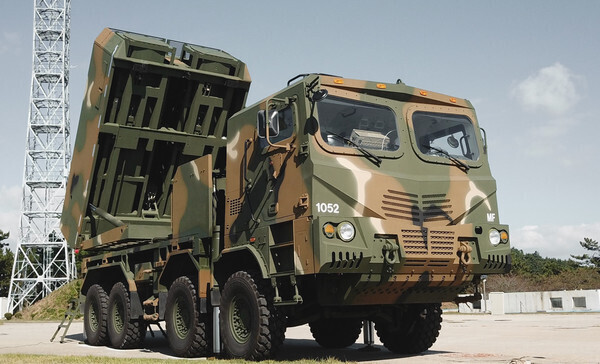
To survive counter-battery fire and improve rapid deployment, the KTSSM-II shifts from static ground launchers to wheeled transporter erector launchers (TELs). While the Block I variant adapts the Chunmoo multiple rocket launcher chassis to carry two missiles, the heavier Block II will utilize a modified five-axle Hyunmoo-2 ballistic missile chassis equipped with dual launch tubes. Engineers are also lightening the warhead to extend its range while simultaneously boosting its armor-penetrating power and electronic warfare resistance. Full-scale mass production for the Block II is slated to run until 2033, alongside a separate initiative to develop a domestic replacement for aging U.S.-made ATACMS missiles.
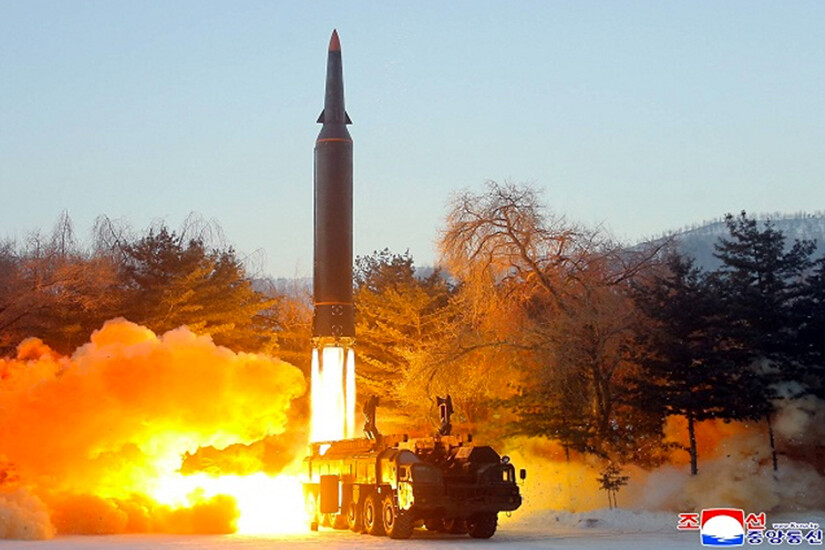
North Korea Counters with Area-Denial Payloads North Korea is mirroring the 300-kilometer range expansion through the rapid evolution of its Hwasong-11D tactical ballistic missile. First revealed in 2022 as a compact, solid-fuel replacement for its aging KN-02 missiles, the Hwasong-11D has reportedly seen its range nearly triple from an initial 110 kilometers to 300 kilometers.
Rather than focusing on bunker-busting capabilities, Pyongyang has demonstrated a shift toward area-denial tactics. Recent launches overseen by North Korea's Missile Administration tested the Hwasong-11D with cluster warheads and air-dispersed landmines.
Military analysts warn that deploying scatterable mines via ballistic missiles poses a severe logistical threat. In the event of a conflict, North Korea could target major highways, railways, and airfields in central South Korea, effectively paralyzing the maneuverability of South Korean and U.S. forces until extensive mine-clearing operations are completed.
As field commanders on both sides gain direct access to fast, cost-effective, 300-kilometer-class precision strike assets, the tactical buffer zone along the Demilitarized Zone is shrinking rapidly.
[Copyright (c) Global Economic Times. All Rights Reserved.]