![[등록] 2026-09-01 15:48:31](/support/_updata/banner2/tl181982910_6749.png)


Korean Restaurants Refusing 'Solo Diners' Sparks Controversy Over Regression; The Shadow of the 'Single Economy' Attracts International Attention
Outdated business practices in some restaurants, such as requiring orders for two servings or prohibiting YouTube viewing, are clashing with the growing trend of single-person households, igniting a fierce domestic and international debate. This report provides an in-depth analysis of the deep-seated prejudice against 'single customers' in South Korea, often hidden behind exclusive slogans like 'We don't sell loneliness,' and explores social solutions to cope with the changing times.
"Please Don't Come Alone"... Overt Refusal of Solo Diners
Recently, instances of some Korean restaurants refusing or discriminating against 'solo diners (Honbap-jok)' have been continuously reported, causing widespread public outrage. Major foreign media outlets, including the South China Morning Post (SCMP) in Hong Kong, have highlighted this issue, focusing on the conflict between South Korea's changing demographics and its outdated social customs. This is interpreted as a clear example of how poorly Korean society is accommodating the rapidly advancing 'era of single-person households,' extending beyond a simple service industry debate.
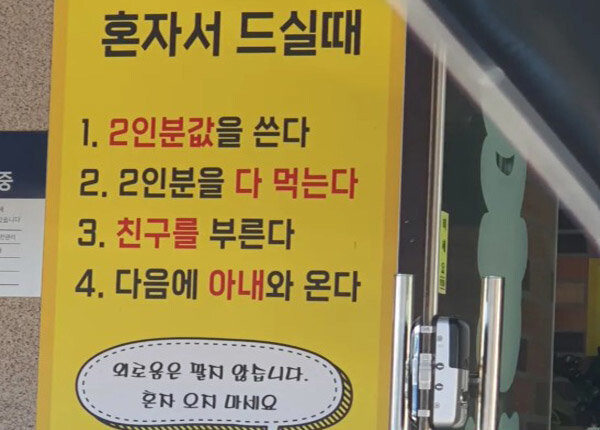
At the center of the controversy is a notice posted at a noodle house in Yeosu, Jeollanam-do. The restaurant sparked a furor by posting a sign that read, 'We don't sell loneliness. Please don't come alone,' along with four purported options for solo diners: "1. Pay the price for two servings 2. Eat all two servings 3. Call a friend 4. Come back later with your wife." This notice quickly spread across online communities and social media, drawing sharp criticism from many netizens, who called it an "anachronistic idea that equates eating alone with loneliness" and "a disrespectful attitude that fails to honor the customer."
Another incident in Yeosu occurred in July when a YouTuber, who visited a restaurant alone and ordered two servings, was rudely told, "We're not just here to watch a girl. Hurry up and eat. We have a reservation coming," forcing her to leave the premises after only 20 minutes. This incident became a national controversy. The YouTuber claimed she had obtained permission to film before the meal, but the restaurant cited her slow eating speed and the camera filming as the problem. The controversy escalated to the point where the local government, the city of Yeosu, intervened directly, providing courtesy training to the restaurant and conducting special sanitary inspections.
'No YouTube Viewing While Eating'... A Strict Standard Only for 'Honbap'
The exclusive attitude toward solo dining is not solely limited to the issue of 'table turnover rate.' Earlier this year, a controversy arose over a sign posted at another restaurant that read 'No YouTube viewing when eating alone.' An employee even pointed out the sign and warned a solo diner who was watching YouTube with earphones.
In response, many people criticized, "Why is it allowed to spend time talking with a friend but forbidden to quietly watch a video alone?" and "They are trying to impose excessive control only on solo diners." The restaurant owner cited the problem of table occupation due to delayed dining, but the prevailing criticism was that "prohibiting even short video clips or listening to music is an excessive control over customers."
These series of incidents demonstrate that the prejudices deeply rooted in Korean society regarding 'communal dining culture' and 'individual consumption patterns' are clashing with the flow of the 21st-century 'Single Economy.'
The Tide of the Times: Single-Person Households Become the Social Norm
Behind these controversies lies the rapid demographic shift in Korean society. According to the SCMP report, the number of single-person households in South Korea has been continuously increasing in recent years. In particular, the proportion of one-person housing in the capital, Seoul, is projected to increase from 29.5% in 2015 to 39.3% in 2023. Data from Statistics Korea clearly shows this trend, with survey results indicating that more than 42% of Koreans eat alone at least one meal a day.
Despite the fact that single-person households and solo dining culture are no longer exceptional but have become the mainstream lifestyle of society, the core problem is that some restaurants are still clinging to outdated business practices like 'minimum order of two servings required,' rejecting the current trend. This is a direct collision between the restaurant's profit logic (maximizing revenue per four-person table) and the rights of single consumers and social change.
Solutions in Advanced 'Single Economy' Nations and South Korea's Challenge
Professor Shin Gi-wook of the Sociology Department at Stanford University in the United States suggested that "South Korea needs to resolve the prejudice against 'single customers' in a systematic way." Indeed, many countries, including China, already recognize the growth of single-person households as a new economic driver and are rapidly embracing the 'single economy.' Many restaurants in China welcome individual customers by offering single-person set menus, and products and services targeting single customers are rapidly growing in almost all sectors, including cooking, real estate, social activities, education, and home appliances.
However, a strong remnant of collectivist culture remains in South Korea, leading to a perspective that equates the state of being 'alone' with 'loneliness' or being 'non-mainstream.' The 'refusal of solo dining' by some restaurant owners is the manifestation of this social prejudice combined with the logic of economic profit.
Of course, some opinions defend the owner's choice, citing the 'freedom of business operation,' but the majority of experts criticize that "exercising the freedom of business operation in a way that excludes the socially vulnerable or non-mainstream in a public space like a restaurant undermines social inclusivity." Especially given the reality that single-person households constitute a majority in our society, the rude and discriminatory attitude toward them should not be overlooked, as it can negatively affect South Korea's overall image and tourism industry.
Now, a paradigm shift is urgently needed in Korean society to recognize single-person households not as 'non-mainstream' or 'lonely customers,' but as proud consumer subjects. Restaurant owners must embrace the new consumer base through service innovation that meets the demands of the times, such as developing single-person menus and setting up individual seating. Furthermore, local governments should also make practical efforts to resolve social prejudices, for example, by actively discovering and supporting solo-dining-friendly restaurants. South Korea's contemplation on how to move toward a society where the dignity of 'being alone' is respected as much as the value of 'being together' is currently ongoing.
[Copyright (c) Global Economic Times. All Rights Reserved.]