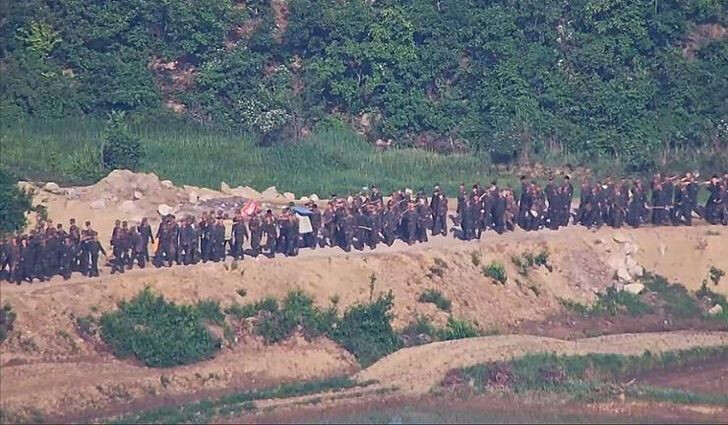
Pythagorean estimates indicate that North Korea has newly planted approximately 960,000 landmines in and around the Demilitarized Zone (DMZ) since 2024. Following North Korean leader Kim Jong Un's declaration of "hostile two states," Pyongyang has embarked on what it calls "border fortification" since 2024, newly laying more landmines in just over two years than the total estimated number installed by North Korea in the DMZ for 70 years since the Korean War.
According to the National Assembly's Intelligence and Defense Committees on the 23rd, the Joint Chiefs of Staff (JCS) reported to the National Assembly, "It is estimated that North Korea has newly laid about 960,000 landmines in the DMZ area from 2024 to the present." In connection with this, the JCS explained that North Korea has buried a significant number of landmines north of the Military Demarcation Line (MDL).
Before 2024, the number of landmines buried by both South and North Korea in the DMZ area was estimated to be around 2 million. Unification Minister Chung Dong-young also mentioned during a parliamentary audit on the 7th that there are "more than 2 million" landmines inside the DMZ. Among them, the number of landmines buried in the North Korean side of the DMZ was estimated at about 800,000. Adding the recent North Korean installations, the total number of landmines in the DMZ and surrounding areas reaches approximately 3 million.
While the military believes that most of the landmines planted by North Korean troops since 2024 are located north of the MDL, it also suspects that some minefields have been laid south of the MDL. On the 21st of last month, in the Western Front DMZ, a North Korean landmine buried south of the MDL exploded, injuring three South Korean soldiers.
Meanwhile, the Ministry of National Defense made a fresh proposal on the 23rd for military talks to discuss verifying the MDL, restoring military communication lines, and preventing accidental clashes. This marks the second proposal following the initial one in November of last year. However, analysts point out that the possibility of North Korea accepting this dialogue offer is low, given that Kim Yo-jong, department deputy director of the Workers' Party of Korea, stated on the 2nd of this month, "Under no circumstances will we ever face them."
The estimation by our military that North Korean leader Kim Jong Un's declaration of "hostile two states" has been followed by the new planting of approximately 960,000 landmines in and around the Demilitarized Zone (DMZ) over the past two years or so shows that Pyongyang is staking its all on solidifying the severing of inter-Korean relations. While the government pursued the restoration of the September 19 Military Agreement under the banner of easing military tensions within the DMZ, North Korea was reportedly pulling out all stops for "border fortification" by installing a "triple barrier" along with a staggering scale of landmines exceeding the total number laid over the 70 years since the Korean War. On the 23rd, the military again proposed inter-Korean military talks, but observations suggest that North Korea, which has continued its unreasonable and defiant threats while rejecting dialogue, is unlikely to respond.
● South Korea Proposes Restoring Sept. 19 Military Agreement While North Korea Plants 960,000 Landmines
North Korea has pushed forward with "border fortification"—including landmine laying and the installation of barriers and fences—starting in April 2024, after Kim Jong Un defined inter-Korean relations as "hostile two states" at the end of 2023. The Joint Chiefs of Staff reported to the National Assembly that North Korea is estimated to have newly buried about 960,000 landmines in the DMZ area since 2024.
Landmines in the DMZ area were laid on a large scale during the Korean War and the post-war confrontation. Previously, the total was estimated at around 2 million, consisting of about 1.2 million on the South Korean side (DMZ and Civilian Control Zone) and about 800,000 on the North Korean side (DMZ). Adding the roughly 960,000 landmines estimated to have been recently planted by North Korea brings the total to approximately 3 million.
The military believes that most of the landmines recently laid by North Korea are located north of the Military Demarcation Line (MDL). However, Minister of National Defense Kang Shin-chul stated during a parliamentary audit on the 7th that there are "several locations" suspected of having landmines buried south of the MDL. On the 21st of last month, a North Korean landmine exploded about 10 meters south of the MDL in the Western Front DMZ, injuring three soldiers. The military is investigating other suspected areas in conjunction with the United Nations Command (UNC).
The government has pursued easing tensions in the DMZ and restoring inter-Korean dialogue by proposing the restoration of the September 19 Military Agreement. In 2018, under the Moon Jae-in administration, the two Koreas undertook landmine clearance operations in the Joint Security Area (JSA) in Panmunjom and Arrowhead Hill in Cheorwon, respectively, as the first implementation measures of the September 19 agreement. In its August policy report this year, the Ministry of Unification also stated that it would pursue preemptive tension reduction through the restoration of the agreement and the peaceful use of the DMZ.
However, the military believes that North Korea has actively laid landmines to fortify its border following the "hostile two states" declaration. Kim Yo-jong, the younger sister of Chairman Kim and department deputy director of the Workers' Party of Korea, stated on the 21st, "The head of state [Chairman Kim] commanded that there must not be an inch of concession in exercising territorial sovereignty, and that the border line with the hostile state must be made into the most permanent line."
● North Korea Declares "No Facing Them," Yet Military Talks Proposed Again
Kim Hong-chul, director-general for defense policy at the Ministry of National Defense, proposed military talks on the 23rd aimed at mutually verifying the locations of the MDL, restoring military communication lines, and preventing accidental clashes. Citing differences in inter-Korean perceptions of the MDL, he stated, "North Korea's recent activities along the Military Demarcation Line and the increase in our side's warning broadcasts and warning shots are not unrelated to this situation."
The possibility of a tripartite meeting involving the United Nations Command has also been left open. The UNC stated on the day, "We are striving to comply with the Armistice Agreement and reduce the risks of miscalculation and unintended escalation of tension along the MDL."
The military authorities considered proposing inter-Korean military talks as one of the follow-up measures to align the differing MDL baseline standards between the two Koreas following the landmine explosion. Attendees at the National Security Council (NSC) Standing Committee meeting on the 22nd were also known to have shared a consensus on the necessity of making the proposal. Initially, the government even considered a ministerial-level proposal, but it was reportedly made in the name of the Director of Defense Policy. Analysts suggest this leaves room to elevate the level of the proposing authority should North Korea reject it.
North Korea failed to respond to the first proposal for military talks in November of last year. Kim Yo-jong asserted on the 2nd of this month, "Under no circumstances will we ever face them," arguing that the border would be drawn through the "use of force."
Meanwhile, the Ministry of Foreign Affairs announced on the 23rd that it sent a letter containing the position that the DMZ landmine explosion incident violated the Armistice Agreement to the United Nations Security Council on the 22nd (local time) under the name of Cha Ji-hoon, South Korea's deputy permanent representative to the UN. The government reportedly demanded an apology and responsible measures from North Korea while urging dialogue to prevent escalating tensions and restore trust.
[Copyright (c) Global Economic Times. All Rights Reserved.]