![[등록] 2026-09-01 15:48:31](/support/_updata/banner2/tl181982910_6749.png)


(C) Hanwha
SEOUL – South Korea’s defense industry is preparing for another historic milestone. Following a year of unprecedented global expansion, the nation’s top four defense contractors are projected to achieve combined annual sales of 50 trillion won (approximately $38 billion) in 2026, marking a "quantum leap" that solidifies South Korea’s position as a premier global arms supplier.
According to data from financial information provider FnGuide on December 31, the collective revenue for the "Big Four"—Hanwha Aerospace, Hyundai Rotem, Korea Aerospace Industries (KAI), and LIG Nex1—is estimated to reach 50.58 trillion won in the coming year. This represents a staggering increase of over 10 trillion won in just 12 months, compared to the 40 trillion won recorded in 2025.
Exponential Growth Across the Board
The individual performance of these companies paints a picture of a flourishing industry. Hanwha Aerospace is expected to lead the charge, with sales projected to surge from 26.9 trillion won to 31.78 trillion won. Hyundai Rotem is also on a high-growth trajectory, with revenues climbing from 5.9 trillion won to 7.75 trillion won. KAI is set for a near-doubling of its revenue, jumping from 3.76 trillion won to 6.01 trillion won, while LIG Nex1 is forecasted to exceed the 5 trillion won mark.
Profitability is following a similar upward curve. The combined operating profit for these four giants is expected to reach 7.5 trillion won in 2026, up from 5.2 trillion won in 2025. Experts attribute this boost to the massive order backlogs—now totaling nearly 100 trillion won—being recognized as actual revenue, alongside improved cost efficiency.
Global Footprint Expands: From Europe to Latin America
The surge is driven by a series of high-profile international contracts. Hanwha Aerospace recently secured a 5.6 trillion won deal to supply Chunmoo multiple rocket launchers to Poland. Meanwhile, Hyundai Rotem successfully broke into the Latin American market, signing a contract with Peru for 54 K2 Black Panther tanks and 141 K808 wheeled armored vehicles.
KAI is also strengthening its ties in Southeast Asia. After signing a deal for 12 FA-50 light combat aircraft with the Philippines in mid-2025, the company recently secured an additional contract for performance upgrades on previously delivered jets.
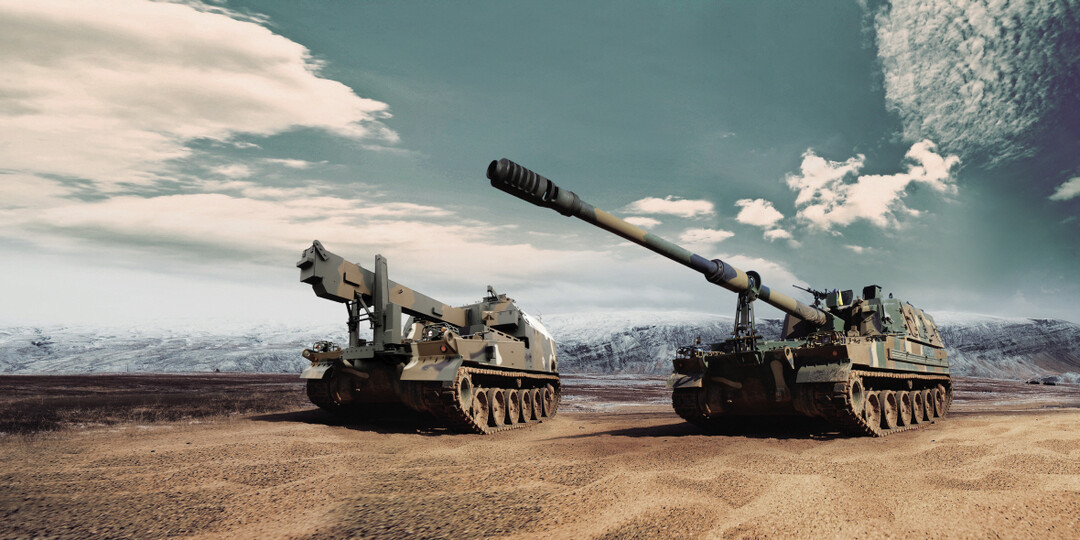
Looking ahead, the pipeline remains robust. Hanwha is targeting markets in Saudi Arabia, Iraq, and the U.S. for its flagship K9 self-propelled howitzers. KAI is in advanced talks with Egypt and Malaysia for FA-50 exports, with contracts expected as early as the first half of 2026. Hyundai Rotem is eyeing Romania and Iraq for further K2 tank exports while negotiating a third major contract with Poland. LIG Nex1 is focusing its efforts on the Middle East, promoting the L-SAM (Long-range Surface-to-Air Missile) system as a cornerstone of regional air defense.
A Strong Domestic Foundation
While exports are the primary engine of growth, the domestic market remains a vital pillar. The South Korean Ministry of National Defense has identified several core projects for the next five years, including the integration of air-to-air weaponry for the KF-21 fighter jet and the establishment of advanced air defense systems. LIG Nex1 is notably leading a 1.9 trillion won electronic warfare project aimed at neutralizing enemy communication networks.
"The massive export deals signed since 2022 are now translating into significant financial gains," said an industry official. "As nations look to modernize their militaries and replace aging equipment amid persistent geopolitical risks, the demand for South Korean defense solutions—known for their price competitiveness and reliability—continues to grow."
The market’s confidence in this sector is reflected in its valuation. The total market capitalization of these four companies nearly tripled over the past year, rising from 30.5 trillion won to approximately 89.4 trillion won, signaling that investors see the "K-Defense" boom as a long-term trend rather than a temporary spike.
[Copyright (c) Global Economic Times. All Rights Reserved.]