![[등록] 2026-09-01 15:48:31](/support/_updata/banner2/tl181982910_6749.png)


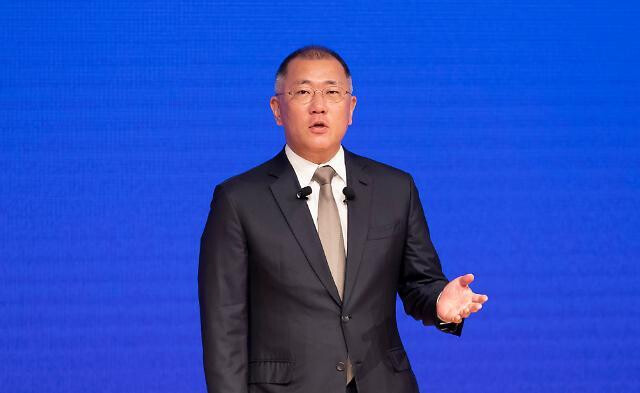
As Chung Eui-sun, Chairman of Hyundai Motor Group, marks his 6th anniversary in office on the 14th, the robotics business—championed as a core future growth engine—has entered a testing phase toward commercialization. Hyundai Motor Group plans to deploy the humanoid robot "Atlas" to its U.S. automotive plant by 2028 and secure a production capacity of 30,000 units per year. The strategy is to expand its business scope beyond traditional automobile manufacturing into a physical AI enterprise combining robotics and artificial intelligence (AI).
The critical variable is profitability. Boston Dynamics has accumulated a loss of approximately 1.7 trillion won from its acquisition by Hyundai Motor Group in 2021 through last year. Although expectations for robot commercialization have driven up enterprise value, it has yet to be verified whether this translates into actual capital recovery and improved automotive productivity. In particular, because Boston Dynamics' shares are divided among Chairman Chung personally and multiple entities such as Hyundai Motor and Kia, critics point out that the growth of the robotics business and the economic benefits gained by Hyundai Motor’s shareholders must be evaluated separately.
◆ Group Robotics Value Differs from Hyundai Motor Shareholders’ Share
According to the automotive industry on the 12th, Hyundai Motor Group’s robotics strategy is taking concrete shape centered around Boston Dynamics. Following the decision to acquire the company in December 2020—shortly after Chairman Chung took office—the acquisition of an 80% controlling stake was finalized in June 2021. At that time, Chairman Chung also invested personal funds to secure a 20% stake.
The equity structure has shifted through subsequent capital injections and other measures. When the push to acquire the remaining stake was pursued last July, Boston Dynamics’ equity breakdown was reported as 56.4% held by HMG Global, 22.6% by Chairman Chung, 11.25% by Hyundai Glovis, and 9.65% by SoftBank. HMG Global is an investment corporation formed with participation from Hyundai Motor, Kia, and Hyundai Mobis.
HMG Global’s equity is structured as 49.5% for Hyundai Motor, 30.5% for Kia, and 20% for Hyundai Mobis. Applying this, Hyundai Motor’s indirect stake in Boston Dynamics via HMG Global at the time was approximately 27.9%—calculated by multiplying HMG Global’s 56.4% stake by Hyundai Motor’s 49.5% investment ratio.
If SoftBank’s remaining stake is distributed according to prior holding proportions, the structure adjusts to 62.5% for HMG Global, 25% for Chairman Chung, and 12.5% for Hyundai Glovis. In this scenario, Hyundai Motor’s indirect stake channeled through HMG Global rises to about 30.9%.
Even if the group secures 100% of Boston Dynamics' shares, the performance of the robotics business will not be monopolized by Hyundai Motor. Because Chairman Chung, Kia, Hyundai Mobis, and Hyundai Glovis have also invested, the outcomes will be distributed among multiple stakeholders. What matters most to Hyundai Motor shareholders is not the label of being a "group robotics company," but rather the return on investment Hyundai Motor generates relative to the capital it has deployed.
◆ Money Earned from Selling Robots vs. Money Saved in Factories
The effects Hyundai Motor expects from its robotics business largely fall into two categories: boosting investment value through increased external sales by Boston Dynamics, and lowering production costs by deploying robots into automotive plants.
For affiliates such as Hyundai Motor, Kia, and Hyundai Mobis, translating robotic technology into actual operational profitability on the manufacturing floor is a core challenge. From a shareholder perspective, how quickly investment costs can be recovered and production costs reduced is just as crucial as the performance of the robots themselves.
The first aspect is the growth of the robotics business. Expanding external sales and growing the maintenance and service sectors can increase profitability, thereby raising the value of the investment stake. However, an increase in enterprise value does not necessarily mean an influx of cash or an expansion of dividend resources for Hyundai Motor. Actual profit attribution and cash recovery depend heavily on the ownership structure, dividend policies, and potential stake sales.
Currently, a wide gap remains between growth expectations and financial performance. Citing a Hyundai Glovis public disclosure, Reuters reported in September that Boston Dynamics posted a loss of 528.4 billion won last year, with cumulative losses from 2021 to 2025 reaching approximately 1.7 trillion won. Massive losses persist alongside high expectations for the robotics business.
Boston Dynamics recently recruited Rohit Prasad, former head of AI at Amazon, as its chief executive officer (CEO). Attention is focused on whether this leadership change will move the company beyond technology development toward commercialization and the establishment of a viable profit model.
The second aspect is efficiency improvements in automobile manufacturing. To this end, Boston Dynamics opened and began operating the "Robotics Metaplant Application Center (RMAC)" at Hyundai Motor Group Metaplant America (HMGMA) in Georgia on the 21st of last month (local time). Hyundai Motor Group plans to deploy Atlas to HMGMA by 2028, initially assigning it sequencing tasks—sorting and arranging parts in order of production sequence. By 2030, the scope of application will expand to component assembly.
The benefit Hyundai Motor gains here is not robot sales profit, but rather operational gains during vehicle manufacturing. Performing repetitive tasks reliably and reducing the physical burden of moving heavy parts can enhance both productivity and workplace safety.
However, deploying robots cannot simply be equated with immediate cost reduction. The time savings and quality improvements must outweigh the combined considerations of acquisition prices, maintenance costs, and production line reconfiguration expenses. From the viewpoint of Hyundai Motor shareholders, how much production costs per vehicle and facility utilization rates improve matter far more than how many robots have been installed.
◆ "Capital Recovery" Matters More Than 30,000-Unit Production Capacity
Hyundai Motor Group plans to secure an annual production capacity of 30,000 robots by 2028. Production capacity differs from actual output or sales volume. To secure cost competitiveness through economies of scale, internal group demand must be backed by purchases from external customers.
Chairman Chung’s robotics strategy is significant in that it expands manufacturing capabilities into a new business domain. Hyundai Motor Group is combining its production facilities, manufacturing data, Hyundai Mobis’s component technology, and Hyundai Glovis’s logistics capabilities to foster the robotics business. Automotive plants serve as a testing ground for actual robot working capabilities and can act as an initial source of demand.
Nevertheless, group-level business expansion and Hyundai Motor’s shareholder value must be evaluated separately. Combining Chairman Chung’s personal investment performance, business opportunities for other affiliates in components and logistics, and Hyundai Motor’s productivity gains risks obscuring the exact share due to Hyundai Motor shareholders.
Marking his 6th year in office, Chairman Chung’s strategic gamble has moved past the stage of acquiring robot companies and demonstrating technology into the phase of field verification and mass production preparation. Moving forward, the indicators measuring the shareholder value of this robotics strategy will not just be robot performance, but the scale of additional investment, the reduction in production cost per vehicle, and the capital recovery period.
[Copyright (c) Global Economic Times. All Rights Reserved.]