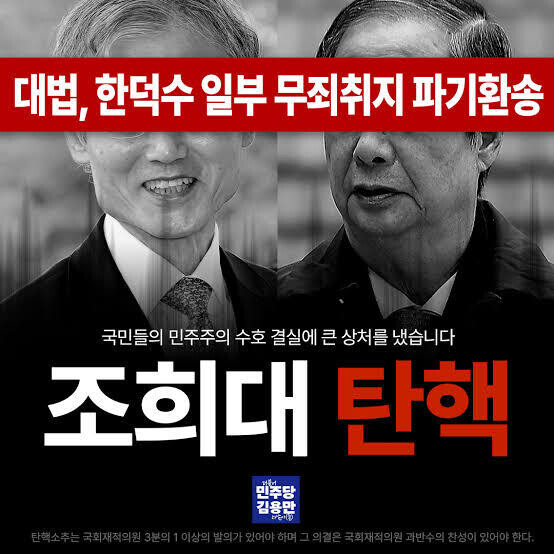
SEOUL, South Korea — Political tensions in South Korea have escalated sharply as the ruling Democratic Party (DP) moved to impeach Supreme Court Chief Justice Cho Hee-dae. The decision follows the top court's Thursday ruling to overturn and remand a lower court's 15-year prison sentence against former Prime Minister Han Duck-soo, clearing him of certain insurrection-related charges.
According to party officials, the DP convened a closed-door general meeting of lawmakers immediately after the ruling and reached a consensus to pursue Chief Justice Cho's impeachment. Speaking at a press briefing, DP Leader Kim Min-seok strongly criticized the court's decision, characterizing it as a "historical betrayal" that seeks to justify insurrection and those who abetted it. Kim stated that the party felt a historical duty to hold the judiciary accountable by impeaching its top representative, adding that the DP plans to officially adopt the impeachment motion as its party platform on Friday.
The ruling party's shift toward impeachment comes amid heightened sensitivity ahead of the second anniversary of the December 3 martial law declaration. Following an earlier first-instance acquittal of Daegu Mayor Choo Kyung-ho—who served as the People Power Party’s floor leader during the martial law crisis—on similar charges, some DP members expressed concern that recent judicial rulings could alter the historical and legal assessment of the event. Hardline figures within the party, including former leader Jung Chung-rae and Legislation and Judiciary Committee Chair Seo Young-kyo, echoed the leadership's stance, accusing the Supreme Court of granting impunity for insurrection.
However, internal dissent surfaced during the DP's deliberations, particularly among lawmakers with legal backgrounds. Representative Kim Nam-hee, a former lawyer, and Representative Kim Ki-pyo, a former prosecutor, reportedly argued that grounds for impeachment were insufficient. They noted that the Supreme Court still recognized the unconstitutionality of the martial law declaration, upheld Han's detention, and found him guilty of post-declaration actions—such as urging cabinet members to sign documents—while only acquitting him regarding the formal convening of the cabinet prior to the declaration. Despite warnings from some members about potential backlash from moderate voters, the party leadership pressed ahead with the impeachment plan.
Conversely, the main opposition People Power Party (PPP) welcomed the Supreme Court's decision as proof that "judicial justice remains alive" and a vindication of its claim that the ruling bloc has been orchestrating a political witch hunt. PPP Leader Jang Dong-hyeok described the ruling as a blow to the Lee Jae-myung administration and condemned the DP's impeachment push as an "act of parliamentary rebellion" and "political suicide." PPP Floor Leader Jung Jeom-sik also criticized the move as a retaliatory "parliamentary coup," arguing that the DP is neglecting year-end budget negotiations and public livelihood bills.
The judicial clash has also spurred signs of unity across the broader conservative spectrum. Independent lawmaker Han Dong-hoon criticized the impeachment effort on social media as a threat to the separation of powers, daring the ruling party to impeach the entire Supreme Court bench rather than singling out the Chief Justice. Reform Party former leader Lee Jun-seok similarly condemned the DP's move, suggesting on Facebook that the High Court should respond by resuming the remanded trial proceedings concerning President Lee Jae-myung to uphold constitutional checks and balances.
With the PPP intensifying its street protests—including a planned march in western Seoul—and ongoing filibuster standoffs in the National Assembly, legislative gridlock is expected to deepen through the end of the year.
[Copyright (c) Global Economic Times. All Rights Reserved.]