![[등록] 2026-09-01 15:48:31](/support/_updata/banner2/tl181982910_6749.png)


(C) Headlight.news
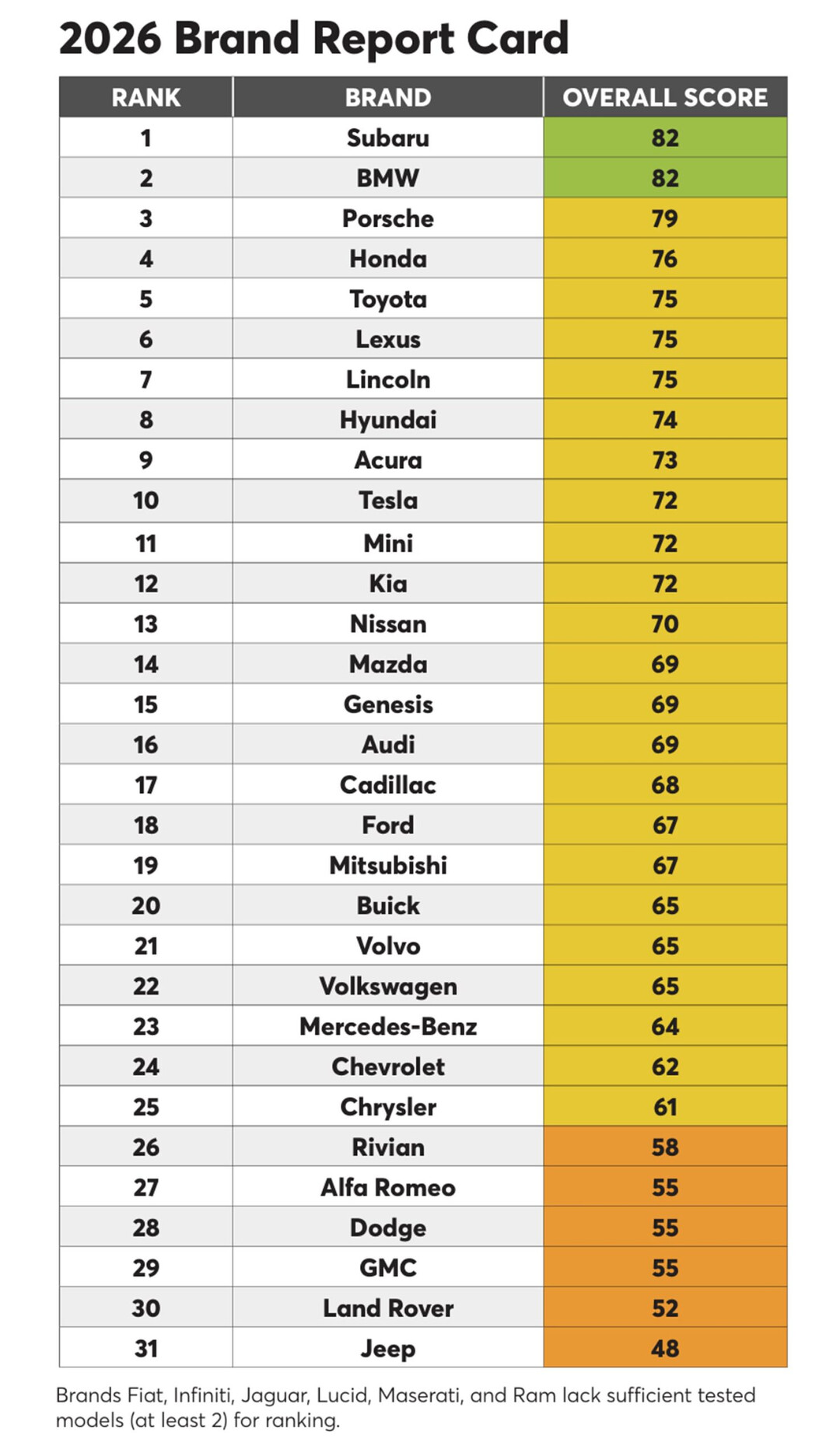
LOS ANGELES — In the annual car brand ratings released by the influential U.S. consumer publication, Consumer Reports (CR), Japanese manufacturers, particularly Subaru, have significantly bolstered their standing, while Korean brands experienced a dip in overall performance.
Subaru clinched the coveted No. 1 position among 31 brands, achieving an overall score of 82 points and displacing last year's leader, BMW, which settled for second place. The podium was rounded out by Porsche with 79 points.
Japanese brands exhibited robust dominance in the top ranks. Following the top three, Honda (76 points), Toyota (75 points), and Lexus (75 points) secured spots up to sixth place. Both Honda and Toyota showed improvement, ascending one and four places, respectively, compared to the previous assessment, though Lexus slipped by three spots.
Hyundai's Steady Position, Kia and Genesis Drop
The results were mixed for the Korean automakers. Hyundai Motor maintained its eighth-place ranking with 74 points, holding steady from the last report. However, its siblings saw a decline: Kia dropped five positions to 12th place (72 points), and the luxury arm, Genesis, fell two places to 15th (69 points).
A notable advancement was made by Tesla, the electric vehicle pioneer led by Elon Musk, which leaped eight places to secure the 10th position with 72 points, demonstrating a conspicuous gain in the rankings.
CR Methodology and Expert Insights
Consumer Reports determines its annual brand evaluation by aggregating comprehensive scores derived from its own road tests, safety assessments, brand reliability predictions, and owner satisfaction survey results.
Jake Fisher, CR’s senior director of auto testing, praised Subaru for its top-ranking performance, noting that the brand "not only delivers excellent performance and comfort but excels in areas that may not be immediately apparent during a test drive. By sharing proven components, it consistently ensures outstanding reliability."
Fisher attributed Tesla's climb in the standings to an overall increase in reliability over time. He suggested this improvement is partly due to the company not frequently making significant design changes across multiple models—a common practice among traditional automakers.
Beyond individual brand performance, the report also highlighted a broader trend in vehicle types: Hybrid vehicles continue to outperform both electric vehicles (EVs) and traditional internal combustion engine (ICE) cars.
[Copyright (c) Global Economic Times. All Rights Reserved.]