![[등록] 2026-09-01 15:48:31](/support/_updata/banner2/tl181982910_6749.png)


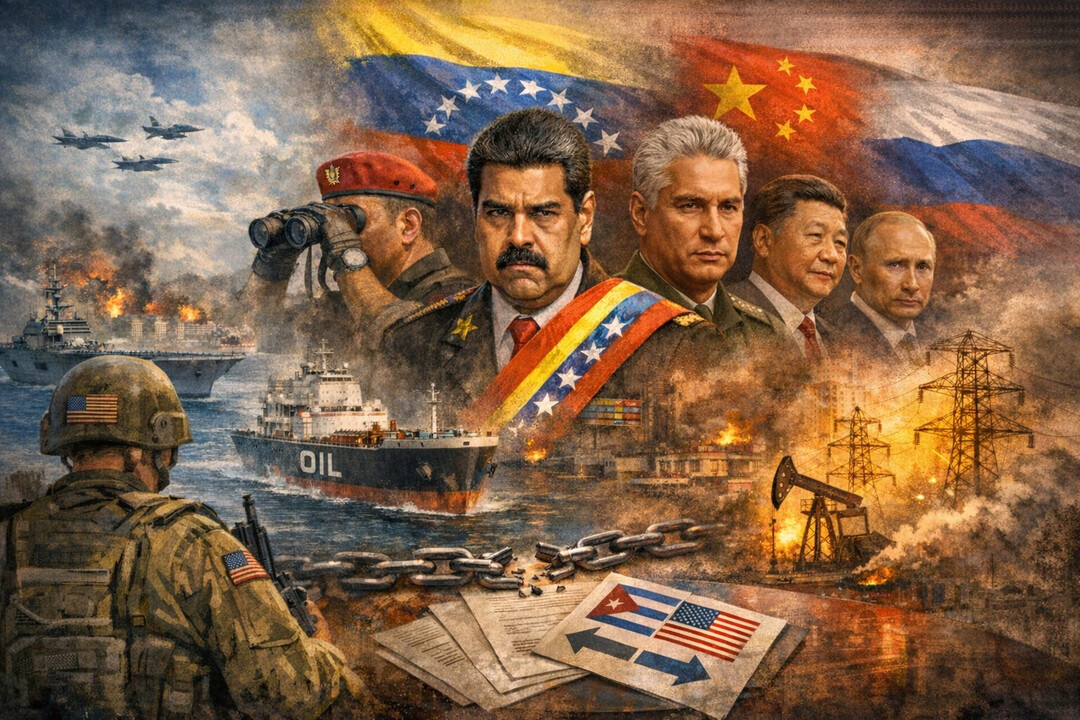
(C) China-Russia Report
SEOUL – The shocking capture of Venezuelan President Nicolás Maduro by U.S. forces on January 3, under the banner of "Operation Absolute Resolve," has sent ripples through the international community. While the world enters the second quarter of the 21st century, this event serves as a stark reminder that the global order remains firmly dictated by the "might of great powers."
A New ‘Don-roe’ Doctrine
The Trump administration’s operation involved over 150 bombers and reconnaissance aircraft, targeting infrastructure across northern Venezuela to facilitate a "snatch-and-grab" mission by Delta Force and the 160th Special Operations Aviation Regiment. President Trump has framed this as a revival—and expansion—of the Monroe Doctrine, asserting U.S. dominance over the Western Hemisphere until a "proper transition" occurs.
However, legal experts argue the raid violates Article 2 of the UN Charter, which prohibits the use of force against the sovereignty of another state. Critics point out that while Maduro was indicted on narco-terrorism charges in 2020, using full-scale military force for law enforcement sets a dangerous precedent for "regime change by power."
The Domino Effect: From Caracas to Taipei
The implications extend far beyond Latin America. At the American Economic Association (ASSA) annual meeting in Philadelphia, Harvard Professor Kenneth Rogoff warned that the crises in Ukraine and Venezuela might embolden China to pursue a similar path regarding Taiwan. This suggests a potential "regional division" where the U.S., Russia, and China each assert unchecked control over their respective spheres of influence—the Western Hemisphere, Eurasia, and Asia.
The North Korean Reaction and Seoul’s Dilemma
Closer to home, the fallout is already visible. On January 4, North Korea conducted a hypersonic missile test, its first provocation of 2026. Kim Jong Un explicitly linked the drill to the "recent geopolitical crisis," denouncing the U.S. operation as a "nightmare scenario" of sovereignty encroachment. This suggests Pyongyang will further double down on its nuclear and missile capabilities, viewing them as the only viable deterrent against a similar fate.
For South Korea, the situation is increasingly precarious. Within the Lee Jae-myung administration, a perceived shift where "autonomy-first" factions (Jaju-pa) outweigh "alliance-first" factions (Dongmaeng-pa) is raising concerns. With China and Russia increasingly shielding North Korea from UN sanctions, the effectiveness of international organizations has been neutralized.
Conclusion: A Call for Strategic Realism
As the "New Monroe Doctrine" reshapes global alliances, South Korea must prioritize self-reliance and the strengthening of the ROK-U.S. alliance and ROK-Japan security cooperation. In an era where international law is secondary to military force, enhancing indigenous nuclear potential and maintaining a "constant state of readiness" is no longer a choice, but a necessity for national survival.
[Copyright (c) Global Economic Times. All Rights Reserved.]